My Son Borrowed $4,500 for a “Car Repair”—Then I Saw His Wife’s Christmas Gift
Chapter 1 – THE CARD IN MY POCKET
My daughter-in-law gave her mother a $4,500 Gucci bag at Christmas dinner.
She gave me a two-dollar card in the house I still owned.
For a few seconds, nobody seemed to understand why I had stopped smiling.
The roast I had cooked was steaming in the center of the dining table.
Rosemary and garlic hung warmly in the air, mixing with the faint pine smell from the Christmas tree.
Snow pressed against the windows in soft white streaks, and beyond the glass, the Hendersons’ inflatable snowman leaned sideways into the wind.
It did that every Christmas.
Daniel used to joke that the poor thing looked drunk by dessert.
The memory came so suddenly that I almost turned toward the empty chair beside me to tell him.
Instead, I tightened my fingers around the card in my cardigan pocket.
Across the room, Margaret stood in front of the window admiring herself with the cream-colored Gucci bag hanging from her shoulder.
“Oh, Brooke,” she said again. “This is too much.”
Her voice said the opposite.
Brooke smiled.
“Only the best for the best mom in the world.”
My son, Julian, lifted his wineglass and took a long drink.
He did not look at me.
That was when the humiliation changed into something else.
Until that moment, I had been trying to tell myself that it was merely an unfortunate contrast.
Brooke was allowed to spend whatever she wanted on her mother.
Margaret was allowed to enjoy an expensive present. I had never believed that affection could be measured by receipts.
Daniel and I had spent too many Christmases counting grocery money for me to believe that.
One year, when Julian was seven, Daniel made me a jewelry box from leftover oak because we could not afford gifts for each other.
I still had it.
Another year, Julian gave me a pinecone painted gold.
I still had that too.
The price was not the wound.
The $4,500 was.
Because one month earlier, Julian had stood in my kitchen looking embarrassed and asked me for exactly that amount.
“Unexpected car repairs,” he had said.
He had rubbed the back of his neck the way he had since childhood whenever he was nervous.
“Mom, I hate to ask.”
I had barely let him finish.
“What happened?”
“Transmission. A few other things. It’s complicated.”
“Four thousand five hundred?”
He had nodded.
“I’ll pay you back in January. I promise.”
I transferred it before dinner.
No paperwork.
No questions.
He was my son.
Now I watched Margaret stroke the leather of a handbag Brooke had spent weeks discussing.
The same handbag.
The same price.
And Julian could not meet my eyes.
Brooke crossed the room toward me.
She still looked pleased with herself, her dark green dress catching the light from the chandelier.
“And this is for you, Clara. Thanks for hosting tonight.”
She handed me a small blue envelope between two fingers.
I opened it.
Snowy mountains.
Season’s Greetings.
Nothing handwritten.
No message from Brooke.
No signature from Julian.
The bookstore I visited every Saturday was three streets away. Julian knew that.
Daniel had taken me there almost every weekend during the last years of our marriage, usually complaining that I could turn a ten-minute visit into an hour.
A note saying, Mom, I’ll go with you next Saturday, would have been enough.
A photograph would have been enough.
A bookmark.
A handwritten memory.
Anything that suggested I had occupied somebody’s thoughts for more than thirty seconds.
Instead, I received the kind of card you grabbed from a grocery-store display while waiting for the cashier to scan milk.
I folded it and put it into my pocket.
Then I stood.
My old armchair shifted against the rug.
Julian looked up immediately.
“Mom?”
Brooke turned.
“Everything okay, Clara?”
I looked around my own living room.
Daniel’s photographs used to cover the mantel.
Now there were candles.
Cream candles in glass holders Brooke had bought because, according to her, the mantel had looked “visually crowded.”
Daniel’s reading lamp had been moved to the garage.
My blue rug had disappeared.
The pillows I had sewn myself were gone.
My dining table had been moved closer to the wall because Brooke said the room flowed better that way.
And my armchair—the faded brown one Daniel had bought me thirty years earlier after a winter storm knocked out our electricity—had nearly been banished to the basement.
I had refused that one.
It was the only time I had refused.
Suddenly, I understood why.
If I had let that chair disappear too, there might have been nothing left in the room that belonged to my life before Brooke decided what my home should look like.
Julian put down his glass.
He knew.
I could see it in the way his shoulders tightened.
I looked directly at him.
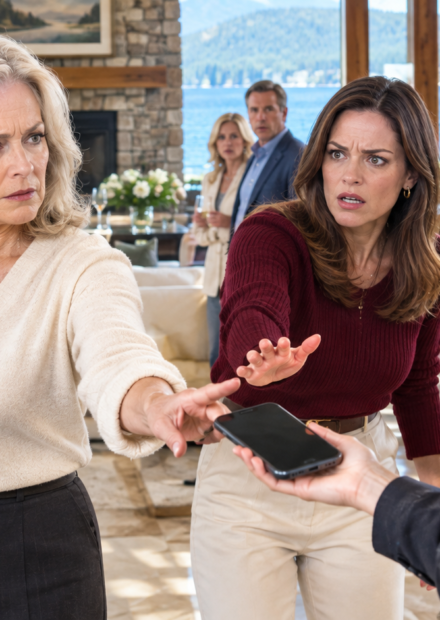
“Julian,” I said, keeping my hand around the card in my pocket, “I need to ask you about the $4,500.”
Silence dropped over the room.
Margaret stopped touching her handbag.
Brooke’s smile vanished.
Julian swallowed.
“Mom.”
It was only one word, but I heard the warning inside it.
Not here.
Not tonight.
Don’t embarrass us.
I had heard variations of that message for years.
Don’t make Brooke uncomfortable.
Don’t make things awkward.
Don’t turn something small into something big.
I looked at my son.
“What happened to your car?”
Brooke stared at him.
Then at me.
“What car?”
There it was.
Small.
Almost nothing.
But enough.
I felt something inside me settle.
Julian pushed back his chair.
“Mom, can we talk about this privately?”
“No.”
His face reddened.
“Please.”
“You asked me privately.”
Margaret carefully lowered herself onto the sofa.
The Gucci bag remained on her shoulder.
I continued.
“You came into my kitchen last month and told me you needed $4,500 for unexpected car repairs.”
Brooke’s expression changed.
Not guilt.
Confusion.
She turned toward Julian.
“You told her that?”
He stared at the table.
“Julian?”
“It wasn’t exactly—”
I interrupted him.
“Did my money buy that handbag?”
Margaret’s hand fell from the strap.
Brooke’s face went pale.
Then hard.
“What are you implying?”
“I’m asking my son a question.”
“You’re making it sound like I stole from you.”
“I didn’t say that.”
“You didn’t have to.”
“Then let Julian answer.”
His eyes finally met mine.
For one desperate second, I saw the little boy he had been.
The child who had once come home crying because he had broken a neighbor’s window with a baseball.
He had confessed before anyone asked.
“I did it, Mom,” he had sobbed. “I’m sorry.”
I had hugged him before I disciplined him because Daniel and I wanted him to understand that telling the truth mattered.
That boy was gone.
The man sitting at my table looked away.
“It wasn’t supposed to happen like this.”
My stomach tightened.
“What wasn’t?”
“The car thing was temporary.”
“There was no car repair, was there?”
He did not answer.
He did not need to.
Brooke stood straighter.
“Julian, what did you do?”
He rubbed both hands over his face.
“I borrowed money.”
“From your mother?”
“Yes.”
“For my Christmas shopping?”
He hesitated.
That hesitation told me more than the answer.
Brooke stepped back.
“Oh my God.”
Margaret immediately lifted the handbag from her shoulder.
“Brooke, I don’t want this if—”
“Mom, stop.”
“No, I mean it.”
“Please.”
Margaret placed the Gucci bag carefully on the sofa beside her, as if it had suddenly become dangerous.
Julian looked at me.
“I was going to pay you back.”
“That isn’t what I asked.”
“I know.”
“You told me your car needed repairs.”
“Yes.”
“Was that true?”
“No.”
The word was quiet.
It still hit me harder than shouting would have.
I nodded once.
“Thank you.”
He blinked.
“For what?”
“For finally answering.”
Brooke crossed her arms.
“This is unbelievable.”
I looked at her.
“I agree.”
Her eyes flashed.
“I didn’t know he borrowed money from you.”
“I believe you.”
That seemed to surprise everyone, including Julian.
But I did believe her.
Brooke had many faults.
She was controlling. She was dismissive. She had treated my home like a decorating project and me like a temporary inconvenience inside it.
But her confusion when I mentioned the car had been real.
Julian had lied to both of us.
That mattered.
It did not erase everything else.
But it mattered.
Julian stepped toward me.
“Mom, I can explain.”
“You can explain after dinner.”
Brooke laughed once, sharply.
“After dinner?”
“Yes.”
“You expect us to sit down and eat now?”
I looked at the roast.
I had started cooking at eight that morning.
I had peeled twelve potatoes.
I had made Daniel’s gravy recipe.
I had ironed the tablecloth.
I had polished the wineglasses.
I had done all of it because Brooke had said Christmas at my house would be “easier.”
And somehow I had ended up feeling like the least welcome person there.
“No,” I said.
Brooke frowned.
“No?”
“I don’t expect you to eat.”
I walked to the dining table.
Then I picked up my plate.
I served myself one slice of roast, potatoes and green beans.
Nobody moved.
I carried my plate to the little table beside my armchair.
Then I sat down.
The chair creaked beneath me.
I picked up my fork.
Julian stared at me.
“Mom, what are you doing?”
“Having Christmas dinner.”
He looked around helplessly.
“Can we please just talk?”
“We will.”
“When?”
“After I eat.”
Brooke whispered something under her breath.
I looked at her.
“What was that?”
“Nothing.”
“No. I think tonight is a good night to stop saying nothing.”
Her jaw tightened.
Margaret stood.
“I think I should go.”
Brooke turned quickly.
“Mom—”
“No.”
Margaret looked at me.
For the first time that evening, embarrassment replaced delight in her expression.
“Clara, I’m sorry.”
“You don’t owe me an apology.”
She glanced at the handbag.
“I didn’t know.”
“I know.”
“I can return it.”
“That is between you and your daughter.”
Julian winced.
Brooke did too.
Good.
Not because I enjoyed hurting them.
I didn’t.
But because truth had finally entered the room, and truth sometimes had sharp edges.
Margaret retrieved her coat.
Brooke followed her to the front door.
As they passed the mantel, Margaret paused.
She looked at the candles.
Then at the hallway.
Her gaze landed on one of Daniel’s photographs Brooke had moved there months ago.
It was our twenty-fifth anniversary picture.
Daniel had his arm around me.
We were both laughing.
Margaret looked from the photograph to me.
Something shifted in her expression.
She seemed to understand more than I had said.
“Good night, Clara.”
“Good night, Margaret.”
The door closed.
Snow blew briefly into the entryway.
Then it was only the three of us.
Brooke returned to the dining room.
Julian remained standing.
I cut another piece of roast.
Nobody spoke until I had swallowed.
Then Brooke said, “So what happens now?”
I put down my fork.
That was the question.
And, for once, I knew the answer.
“Now,” I said, “we discuss my house.”
Julian’s face changed.
Brooke went completely still.
And for the first time that evening, the Gucci bag was no longer the most expensive thing in the room.