My Son Borrowed $4,500 for a “Car Repair”—Then I Saw His Wife’s Christmas Gift
Chapter 4 – THE THING HE THOUGHT HE OWNED
For a moment, I thought I had misunderstood him.
“What did you say?”
Julian closed his eyes.
“I told Brooke that eventually the house would be mine.”
The kitchen seemed to tilt.
I withdrew my hand.
“You mean after I die.”
He flinched.
“I didn’t say it like that.”
“How did you say it?”
“That it was probably coming to me eventually.”
“Probably?”
“You don’t have other children.”
I stared at him.
He immediately realized how ugly the words sounded.
“Mom, I’m not waiting for you to die.”
“I should hope not.”
“I swear.”
“Then explain why my house was part of your financial planning.”
“It wasn’t exactly.”
“Julian.”
He rubbed his forehead.
“When we talked about buying, Brooke wanted us to save for something bigger. I told her not to worry so much because someday—years from now—the house would probably be mine.”
“And she believed that?”
“Yes.”
“Did you?”
He hesitated.
That hurt more than if he had simply said yes.
I stood.
He rose too.
“Mom.”
“Don’t.”
“I never meant—”
“I know what you meant.”
I walked into the living room.
The Christmas tree was still standing.
Daniel’s photograph was on the mantel again.
I stared at his face.
We had bought the house when Julian was four.
Daniel worked overtime for nearly six years to pay down the mortgage.
I taught piano lessons in the evenings.
We replaced the roof ourselves with help from Daniel’s brother.
We painted every room.
We planted the maple tree in the backyard.
We paid off the mortgage eleven months before Daniel died.
He had opened a bottle of cheap champagne and carried me around the kitchen.
“No bank owns our bedroom anymore,” he had shouted.
I had laughed until I cried.
Now my son had incorporated that house into a future balance sheet.
Not maliciously.
Perhaps that made it worse.
He had simply assumed.
“Did Brooke know I still own it completely?”
“Yes.”
“Did she know there is no mortgage?”
“Yes.”
“And you two talked about what you might do with it someday?”
He did not answer.
I turned.
“What did you plan?”
“Nothing.”
“Julian.”
“We talked.”
“About?”
“Renovations.”
I almost laughed.
Of course.
The rug.
The pillows.
The mantel.
The lamp.
The dining table.
Suddenly every small change felt different.
Not sinister.
I did not believe Brooke had moved into my home with a secret plan to steal it.
But somewhere along the way, she had begun imagining a future in which it belonged to them.
That future had made my presence temporary.
Even if nobody had said so.
“What renovations?”
“Opening the kitchen.”
I stared at him.
“Removing the wall?”
“Maybe.”
“The wall your father built.”
“He didn’t build the wall.”
“He rebuilt it.”
Julian looked miserable.
“I know.”
“No, you keep saying that.”
My voice rose.
“You keep saying you know, and then I discover another thing you never bothered to understand.”
“Mom—”
“This house is not an investment waiting for you.”
“I understand.”
“It is where I live.”
“I know.”
“It is mine.”
“Yes.”
“And I am alive.”
He went pale.
“I know that.”
“Do you?”
The words hung between us.
I immediately regretted their cruelty.
But not their truth.
Julian sank onto the sofa.
“I messed everything up.”
I sat in my armchair.
Neither of us spoke for a long time.
Eventually, he said, “What are you going to do?”
“With the house?”
He nodded.
“I don’t know.”
That was true.
Before Christmas, I had assumed Julian would inherit it.
Daniel and I had written our wills years earlier.
After Daniel died, I had updated mine.
Julian was the primary beneficiary.
There was nothing unusual about that.
He was my only child.
But something had changed.
Not because I wanted revenge.
Because I suddenly understood the danger of letting other people consider my life settled before I had finished living it.
“I may sell it someday.”
Julian looked surprised.
“You love this house.”
“I do.”
“Then why would you sell?”
“Because loving something doesn’t mean I have to die inside it.”
He stared at me.
I had surprised myself too.
For years, I had imagined my future as a gradual narrowing.
Daniel died.
Julian married.
I stopped traveling as much.
I stayed home more.
I preserved rooms.
I maintained traditions.
I had behaved as if the interesting part of my life had already happened.
Maybe Brooke was not the only person treating me like a temporary resident.
Maybe I had been doing it too.
The next morning, I called my attorney.
Not to punish Julian.
Not to cut him out.
To understand.
I reviewed my will.
My accounts.
The house.
My retirement.
For the first time since Daniel died, I looked at my finances not as something to preserve for Julian, but as resources meant to support the rest of my own life.
The realization was liberating.
And uncomfortable.
I had enough.
Not endless money.
But enough.
Enough to travel.
Enough to replace the old furnace without worrying.
Enough to take classes.
Enough to help Julian when there was a genuine emergency.
Enough to say no when there wasn’t.
On January fifteenth, Julian placed a cashier’s check on the kitchen table.
$3,000.
Combined with the $1,500 Brooke had already given me, it repaid the loan.
I looked at him.
“Where did this come from?”
“We sold some things.”
“What things?”
“My golf clubs.”
I frowned.
“You love those.”
“I haven’t played in a year.”
“What else?”
“Some electronics. Brooke returned clothes. I sold my watch.”
“The one your father gave you?”
His expression changed.
“No.”
I exhaled.
“Good.”
“I wouldn’t.”
“Good.”
He sat down.
“I wanted to repay you exactly when I said I would.”
I picked up the check.
“Thank you.”
“I’m sorry.”
“I know.”
He looked around the kitchen.
“Brooke and I are going to counseling.”
“Financial?”
“And marriage.”
I nodded.
“Good.”
“She almost left.”
I looked at him.
“Because of the debt?”
“Because of the lying.”
There was a difference.
He understood it now.
“She said she could handle being broke better than being fooled.”
“She is right.”
He smiled sadly.
“I told her that.”
“And how did that go?”
“Terribly.”
I laughed.
He did too.
Then he became serious.
“Mom, I need to ask something.”
“No loans.”
He laughed again.
“Not money.”
“What?”
“Did you change your will?”
I studied him.
He reddened immediately.
“Forget I asked.”
“No.”
“Mom—”
“You want the truth?”
“Yes.”
“I am reviewing it.”
He nodded.
“Okay.”
“Does that scare you?”
“A little.”
“Why?”
“Because I don’t want you to think I only care about what I get.”
“I don’t think that.”
He looked relieved.
“But I do think you started treating something as yours before it was.”
His relief disappeared.
“That’s fair.”
“And I think you need to build a life that doesn’t depend on anything I leave behind.”
“I do.”
“Good.”
He looked at Daniel’s old clock on the wall.
“I wish Dad were here.”
“So do I.”
“He’d know what to say.”
I smiled.
“No, he wouldn’t.”
Julian looked surprised.
“Your father once spent three days avoiding me because he accidentally used our mortgage money to repair his boat.”
Julian stared.
“Dad did that?”
“Yes.”
“You never told me.”
“Because by the time you were old enough to understand it, we had survived it.”
“What did you do?”
“I made him sell the boat.”
Julian laughed so loudly Brooke came into the kitchen.
“What?”
He pointed at me.
“Dad almost lost the mortgage payment because of his boat.”
Brooke looked at me.
“Seriously?”
“Your father-in-law was a good man,” I said. “He was not a saint.”
Something softened among the three of us.
Not forgiveness exactly.
Something more useful.
Reality.
People could fail without becoming monsters.
People could hurt one another without becoming enemies.
But only if they stopped pretending nothing had happened.
Brooke sat down.
“We signed the apartment lease.”
“When do you move?”
“January twenty-eighth.”
“That soon?”
She smiled slightly.
“You sound disappointed.”
“I can be ready for you to leave and still miss you.”
Her smile became real.
“Fair.”
She looked toward the living room.
“I have something for you.”
My stomach tightened.
“If it is another card—”
She laughed.
“No.”
She went upstairs.
When she returned, she carried a rectangular package wrapped in plain brown paper.
She handed it to me.
“This isn’t an apology present.”
“That sounds exactly like what someone says before giving an apology present.”
“Open it.”
I tore the paper.
Inside was a wooden frame.
In it was a photograph I had forgotten existed.
Daniel and I were standing in front of the house on the day we bought it.
Julian was four years old, sitting on Daniel’s shoulders.
I had one hand over my mouth because I was laughing.
Daniel was pointing toward the front door.
On the bottom of the frame, in small letters, Brooke had written:
Your home. Your history. Your choice.
I looked at her.
She seemed nervous.
“Where did you find this?”
“In one of the boxes from the hallway.”
“You went through my photographs?”
“With Julian.”
I looked at him.
He nodded.
“We thought you should have it.”
My eyes filled.
Brooke shifted awkwardly.
“I was wrong about the house.”
I touched the frame.
“So was I.”
She frowned.
“I kept saying yes when I meant no.”
“That doesn’t make what I did okay.”
“No.”
I looked at her.
“But it means I have something to learn too.”
She nodded.
For once, neither of us tried to win.
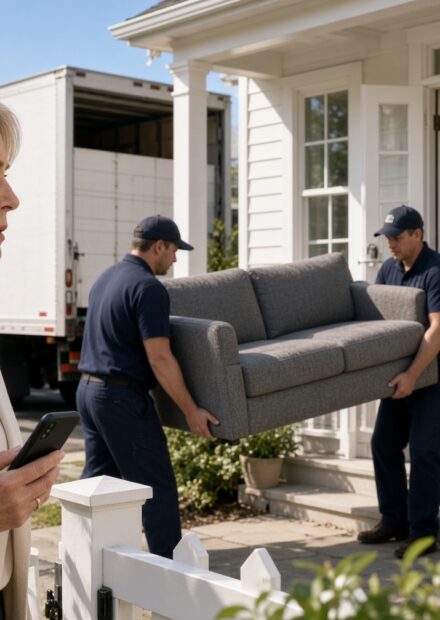
The moving truck came eleven days later.
And when the last box left my hallway, the house felt enormous.
Too enormous.
I stood alone in the living room.
Daniel’s chair was gone, of course.
He had been gone for years.
Julian’s footsteps no longer sounded upstairs.
Brooke’s perfume no longer drifted through the hallway.
There were no voices.
No slammed doors.
No laughter.
Just the ticking clock.
I sat in my faded armchair.
For a terrible moment, I wondered whether I had made a mistake.
Then I noticed something on the table beside me.
A bookstore bookmark.
And underneath it, an envelope.
This one had my name handwritten across the front.
I recognized Julian’s writing.
I opened it.
Inside was not a Christmas card.
It was a note.
Mom,
I know I can’t fix Christmas with a note. I know I can’t fix the last year by moving out.
But I finally understand something I should have understood before.
You were not lucky to have us living in your house.
We were lucky you opened it to us.
I forgot the difference.
I’m sorry.
Saturday. Ten a.m. Bookstore? My treat.
Love, Julian.
I read it twice.
Then a third time.
The two-dollar Christmas card was still in a kitchen drawer.
This piece of paper probably cost less.
But I pressed it against my chest and cried.