Chapter 2 – WHEN THIS PLACE BELONGS TO US
Trevor reached for the envelope.
Whitney grabbed it first.
“Why is my mail coming here?” she demanded.
It was an impressive attempt.
Turn fear into anger.
Turn the question around.
Make somebody else defend themselves.
I had watched her do it before.
“You used my address,” I said.
“I must have made a mistake.”
“For a mortgage company?”
Trevor looked at her.
“Mortgage?”
“It’s not what you think.”
He gave a humorless laugh.
“I haven’t told you what I think.”
Whitney held the envelope against her chest.
“It was preliminary.”
“What was?”
She glanced at me.
That glance told me something important.
Whatever she had done, she had expected to explain it to Trevor eventually.
She had never expected to explain it in front of me.
“Can we talk at home?”
Trevor shook his head.
“No.”
“Trevor.”
“Why did a mortgage company send something to my mother’s address?”
Whitney’s jaw tightened.
“I was looking at financing options.”
“For what?”
Silence.
I knew.
Not every detail.
But enough.
For months, Whitney had talked about renovating my house.
At first, I thought it was simply another one of her fantasies.
The kitchen was “dated.”
The upstairs bathrooms were “embarrassing.”
The dining room wall should come down.
The den needed French doors.
The back acreage could support another structure.
She even once mentioned converting the old barn into an event space.
I had laughed.
She had not.
One afternoon in October, I came into the kitchen and found her photographing the room.
“What are you doing?” I asked.
“Just getting ideas.”
“For my kitchen?”
“For someday.”
That word again.
Someday.
A polite word for after you’re dead.
I began noticing other things after that.
A measuring tape left on the kitchen counter.
A contractor’s business card beside the sink.
Whitney asking casually how many acres were attached to the property.
Whitney wanting to know whether the mortgage had been paid off.
Whitney asking Trevor whether there were “tax complications” when property passed from a parent to a child.
Each question, by itself, could be explained.
Together, they formed a sentence.
She was planning a life in my house.
A life that required me to no longer be living in it.
Trevor stared at his wife.
“Financing what?”
Whitney exhaled.
“The renovations.”
He went still.
“What renovations?”
“For here.”
He looked at me.
Then back at her.
“Here?”
“I told you I was getting estimates.”
“You said you were getting ideas.”
“That’s what estimates are.”
“No, Whitney.”
Her voice sharpened.
“Fine. I talked to a lender. That’s all.”
“Using Mom’s address?”
“Because this is the property.”
“This is Mom’s property.”
“I know that.”
“Do you?”
The question hung between them.
I watched my son’s face.
For years, I had wished he would defend me.
Now that he finally was, I found I didn’t enjoy it as much as I thought I would.
Because I could see what it cost him.
Marriage teaches people to build a shared version of reality.
Trevor’s was cracking in my hallway.
Whitney turned toward me.
“You’re making this sound sinister.”
“I haven’t said anything.”
“That’s worse.”
“Why?”
“Because you’re standing there judging me.”
I thought of Easter.
Thanksgiving.
The Fourth of July.
The Christmas lists.
The meals.
The bills.
The phrase *when this place belongs to us.*
“I’m listening,” I said.
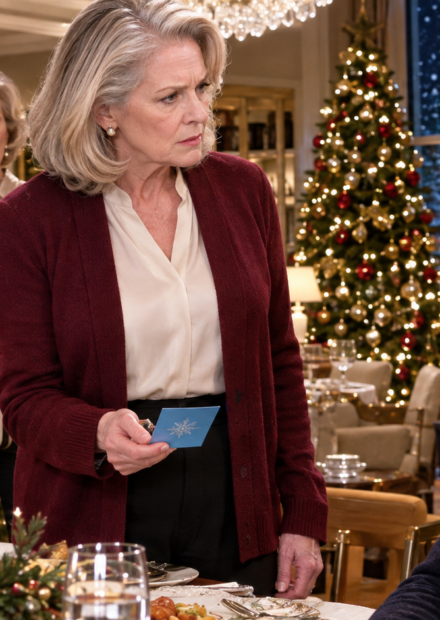
Trevor held out his hand.
“Open the letter.”
Whitney stared at him.
“Seriously?”
“Yes.”
“It’s addressed to me.”
“And it concerns my mother’s house.”
For a few seconds, nobody moved.
Then Whitney tore open the envelope.
She read.
Her eyes moved faster the farther down the page she got.
Trevor held out his hand again.
She gave it to him.
I watched his face while he read.
“What does it say?” I asked.
He looked up at Whitney.
“You applied for a home-equity loan.”
“Not exactly.”
“It says application.”
“It wasn’t finalized.”
“On Mom’s house?”
“No. Against the property once it transferred.”
My skin went cold.
There are sentences that reveal more than the speaker intends.
That was one of them.
Trevor lowered the page.
“Once it transferred?”
Whitney looked trapped now.
“Eventually.”
“Eventually when?”
She didn’t answer.
He asked again.
“When, Whitney?”
“When the house became yours.”
“My mother is standing right there.”
“I know she’s standing there!”
The words cracked through the hallway.
For once, Whitney’s mask slipped completely.
Her cheeks flushed.
Her eyes shone with anger.
Then she saw my face.
And she understood.
This wasn’t about Christmas anymore.
Maybe it never had been.
She softened her voice.
“Carolyn, nobody wants anything to happen to you.”
What a strange sentence to say when nobody had accused you of wanting anything to happen.
“I’m relieved,” I said.
She flinched.
Trevor dropped the letter onto the table.
“You planned a loan based on property I don’t own.”
“I was planning ahead.”
“With my inheritance.”
“That’s not fair.”
“Isn’t it?”
Whitney turned on me.
“You told him he would inherit this house.”
“I did.”
“So I wasn’t inventing anything.”
“No.”
Her expression changed.
She thought she had found solid ground.
“You see?”
“But I changed my mind.”
The room became silent.
Trevor stared at me.
Whitney stared harder.
“What does that mean?” Trevor asked.
I lifted the envelope from my attorney.
“It means this house is no longer part of an inheritance you can count on.”
Whitney’s lips parted.
Trevor looked hurt.
That was the first moment my resolve wavered.
He was still my son.
I remembered him at six years old, asleep on Frank’s chest.
At twelve, crying when his dog died.
At seventeen, trying to pretend he wasn’t nervous before his first date.
At twenty-nine, standing beside Whitney at their wedding, looking happier than I had ever seen him.
A mother can know her adult child has failed her and still remember every version of him that came before.
“Mom,” he said. “What did you do?”
“I protected my home.”
“From me?”
I shook my head.
“From entitlement.”
Whitney laughed once.
A small, bitter sound.
“There it is.”
“What?”
“You never liked me.”
“That isn’t true.”
“You’ve been waiting for an excuse.”
“Whitney—” Trevor began.
“No. She has. She’s always thought I was some gold digger.”
“I never used that word.”
“You didn’t have to.”
She pointed toward my attorney’s envelope.
“Look at what you’ve done.”
I felt something harden inside me.
“What I’ve done?”
“Yes.”
“You applied for financing against a future interest in property you do not own.”
“It was planning.”
“You invited twenty-five people to my house without asking.”
“It’s Christmas.”
“You told your mother you would remove my father’s trees after I was gone.”
Her face changed.
She hadn’t known I heard that.
Trevor turned.
“You said what?”
Whitney shook her head.
“That is completely out of context.”
“No,” I said. “It was actually remarkably clear.”
She looked at me with naked anger now.
“What do you want, Carolyn?”
The question surprised me.
Not because I didn’t know.
Because nobody had asked me that in years.
What did I want?
Not what Christmas needed.
Not what Trevor wanted.
Not what Whitney expected.
Me.
“I want,” I said slowly, “to stop being treated like the caretaker of everybody else’s future.”
Nobody answered.
I opened the attorney’s envelope.
“The house has been transferred into a trust.”
Whitney’s eyes narrowed.
“What kind of trust?”
“One you don’t control.”
“Who does?”
“I do while I’m alive.”
“And after?”
I looked directly at Trevor.
“The house will not pass outright to you.”
He swallowed.
I continued.
“You are still a beneficiary of part of my estate.”
His expression shifted.
Whitney’s did too.
“But not the house,” I said.
“Then who gets it?” Whitney asked.
“That depends.”
“On what?”
“On what happens to it.”
I had spent weeks discussing that question with Elaine.
I didn’t want to punish Trevor.
I wanted to protect the thing my parents had built and Frank and I had spent decades maintaining.
So the trust contained instructions.
After my death, Trevor would receive a defined portion of my financial assets.
The land behind the creek would remain protected.
And the house itself would not become anyone’s personal windfall.
Trevor could occupy it under specific conditions if he chose, but he could not borrow against it, sell it for a quick profit, or transfer control to someone else.
If he declined those conditions, the trust would sell the property and distribute the proceeds among the beneficiaries I had named, including charitable gifts important to Frank and me.
Whitney could not build her plans on it.
That was the point.
Trevor rubbed a hand across his mouth.
“You did all this without telling me.”
“Yes.”
“Why?”
“Because if I had told you first, would you have asked what I wanted?”
He looked away.
That was answer enough.
Whitney stepped toward me.
“You can change it back.”
I almost admired the certainty.
“I could.”
“Good.”
“I won’t.”
Her eyes flashed.
“Carolyn, think about what you’re doing.”
“I have.”
“To your son.”
That landed exactly where she intended.
But I was ready for it.
“I am leaving my son an inheritance. I am simply no longer leaving him my obedience.”
Trevor whispered, “Mom.”
“I love you. But love and ownership are not the same thing.”
Whitney folded the mortgage letter.
Very carefully.
“You’re going to regret this.”
Trevor looked at her sharply.
“What is that supposed to mean?”
She grabbed her coat.
“It means she’s blowing up this family over a Christmas dinner.”
“No,” I said.
Whitney stopped at the door.
“I’m refusing to cook a Christmas dinner. If that blows up the family, then perhaps dinner was holding up more than it should have.”
She left.
The door slammed.
Trevor remained.
For a while, neither of us spoke.
Finally he looked toward my suitcase.
“Are you really leaving?”
“Yes.”
“Where are you going?”
I told him.
A small inn in Asheville.
Frank and I had once planned to spend Christmas there.
We never did.
There was always family.
Always a meal.
Always another reason to wait until next year.
Trevor nodded.
Then he asked the question that told me he still didn’t understand.
“So what are we supposed to do about Christmas?”
I looked at my son.
And for the first time in his forty-one years, I let the problem remain his.
“I suppose,” I said, “you’ll have to figure it out.”