Chapter 1 – THE CHRISTMAS SHE THOUGHT SHE OWNED
The moment my daughter-in-law announced she had invited twenty-five people to my house for Christmas without asking me, she smiled as if the house already belonged to her.
“My whole family will be there,” Whitney said brightly. “It’s only twenty-five people.”
Only.
I stood on the other side of my kitchen island with both hands wrapped around a mug of coffee that had already gone cold.
Outside, the December sky over Kentucky had turned the color of dirty wool. It wasn’t even four o’clock, but darkness had begun settling over the fields behind my house. Bare branches scratched at the windows whenever the wind came down from the creek.
Inside, Whitney looked like she had dressed for a Christmas catalog.
Red dress.
Black heels.
Diamond earrings.
Expensive perfume.
Not one grocery bag in sight.
She was studying my kitchen while she spoke—not looking at me, exactly, but at my counters, my double oven, the breakfast nook, the doorway into the dining room.
Like a woman inspecting a venue she had already booked.
“I figured we could put the children in the den,” she continued. “The adults can use the dining room and kitchen. We’ll need your folding tables from the basement.”
“We?”
She either didn’t hear the word or chose not to.
“And my mother thinks the tree would look better by the front windows this year. That way people can take pictures when they come in.”
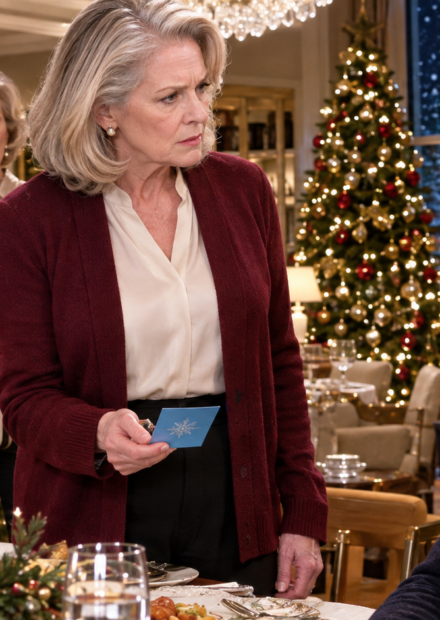
I looked toward my Christmas tree.
I had decorated it myself six days earlier.
Every ornament on it had a memory.
A wooden horse Trevor painted in second grade.
A glass angel my husband, Frank, bought me our first Christmas in the house.
A crooked little snowman Trevor made from cotton balls when he was seven.
My mother’s silver bell.
Apparently, those memories were now interfering with Whitney’s photographs.
She opened my refrigerator.
Actually opened it.
“What have you bought so far?”
That was when something inside me went completely still.
It wasn’t anger.
Anger would have been familiar.
I had been angry with Whitney before.
I had been angry when she volunteered me to host Easter brunch for eighteen people.
Angry when she invited her cousins to use my backyard for the Fourth of July and told me about it two days beforehand.
Angry when she announced at Thanksgiving that I was making two turkeys because her brother “didn’t really like ham.”
I had swallowed every bit of it.
This was different.
This was the moment when anger had finally burned itself clean.
“Nothing,” I said.
Whitney turned around.
“Nothing?”
“For Christmas.”
Her smile weakened.
“But Christmas is next week.”
“I’m aware.”
“Well, you usually start shopping by now.”
Usually.
That word had ruled my life for years.
Carolyn usually makes the turkey.
Carolyn usually has extra sheets.
Carolyn usually makes that pecan pie.
Carolyn usually doesn’t mind.
Carolyn usually pays.
Carolyn usually cleans up.
Carolyn usually smiles.
Women my age were raised to believe that love meant labor.
You remembered birthdays nobody else remembered.
You knew which child hated onions and which uncle couldn’t eat nuts.
You bought groceries.
You washed sheets.
You cleaned bathrooms before guests arrived and cleaned them again after guests left.
You carried folding chairs upstairs.
You put casseroles in the oven while everyone else opened wine.
You stood over a sink with swollen feet while laughter floated in from another room.
Then, at the end of the evening, somebody hugged you and said, “What a beautiful Christmas.”
Nobody asked who had made it beautiful.
For forty years, that person had been me.
Christmas happened in the same brick house outside Louisville.
Same scratched roasting pan.
Same porcelain dishes carried carefully down from the top cabinet.
Same sore knees at midnight.
When Frank was alive, he helped.
He carved the turkey, washed whatever I dirtied, and at eleven at night, when everyone had finally gone home, he would pour us each half a glass of wine.
“To another successful invasion,” he used to say.
I would laugh.
Then he died.
And somehow, after that, the invasion stopped being funny.
Whitney shut my refrigerator.
“Okay,” she said slowly. “Well, I can send you the menu.”
“No need.”
“Carolyn.”
“Whitney.”
Something in my voice finally made her look at me.
Really look.
I set my coffee on the counter.
“Wonderful,” I said. “Have all twenty-five people.”
Her smile returned.
“See? I knew—”
“But I won’t be here.”
Silence.
The refrigerator motor hummed behind her.
“What?”
“I’ll be away for Christmas.”
The smile disappeared completely.
“You’re joking.”
“No.”
“But we’re having Christmas here.”
“You’re having Christmas here.”
Her eyebrows drew together.
“I don’t understand.”
“You invited them. So you can buy the groceries, cook the food, set the tables, wash the sheets, clean the bathrooms, entertain the children, wash the dishes, take out the trash and put the house back together afterward.”
She stared at me as though I had begun speaking another language.
“Carolyn, I don’t cook for twenty-five people.”
“Neither did I the first time.”
“But you like doing this.”
There it was.
I almost laughed.
Instead, I asked, “Who told you that?”
“You always do it.”
“That wasn’t my question.”
Her face tightened.
For five years, Whitney had treated my house like a private country club with no membership fee and a built-in cook.
The strange part was that she could be delightful while doing it.
In public, Whitney was warmth and charm.
She kissed cheeks.
She remembered names.
She complimented dresses.
She posted photographs online with captions about gratitude and family.
People loved her.
And if you saw her only in those moments, you would have thought I was lucky to have her.
But without an audience, Whitney’s sweetness could disappear in a second.
The first time I noticed it was after an Easter dinner three years earlier.
Her relatives had left.
Trevor was outside loading their car.
I was scraping dried potatoes from a casserole dish when Whitney came into the kitchen.
I said, “Next year, I think somebody else should host.”
She didn’t even look up from her phone.
“But everyone likes it here.”
“It’s getting difficult for me.”
She sighed.
“Carolyn, you’re sixty-five, not ninety.”
Then Trevor walked back in.
Her face changed instantly.
She kissed my cheek.
“Thank you for everything. It was perfect.”
Trevor saw the kiss.
He didn’t hear what came before it.
That became the pattern.
And Trevor?
My only son had perfected the art of seeing just enough to feel guilty and not enough to act.
“Mom, you know how Whitney can be,” he would whisper.
Yes.
I knew exactly how Whitney could be.
What Trevor never understood was that eventually, “That’s just how she is” becomes another way of saying, “So you’ll have to be the one who keeps surrendering.”
The front door opened.
“Whit?”
Trevor’s voice carried down the hallway.
A moment later, he entered the kitchen wearing his navy office coat, his tie loosened at the collar.
He stopped when he saw our faces.
“What happened?”
Whitney folded her arms.
“Your mother says she’s leaving for Christmas.”
Trevor looked at me.
“Leaving?”
“I’m taking a trip.”
“When?”
“December twenty-third.”
“Where?”
“Does it matter?”
“Yes, Mom, actually, it does.”
“Why?”
“Because everyone already made plans.”
“I’m sure they did.”
His mouth tightened.
“It’s Christmas.”
“Yes.”
“It’s family tradition.”
That sentence hurt more than I expected.
Not because it was cruel.
Because Trevor believed it.
He believed tradition was something that simply existed.
Like weather.
Like gravity.
Not something his mother created through forty years of work.
I looked at him.
“Tell me something, Trevor. What part of the tradition belongs to you?”
He blinked.
“What?”
“The turkey?”
“Mom—”
“The shopping? Cleaning? Decorating? Guest rooms? Desserts? Dishes?”
“That’s not fair.”
“Which part?”
Whitney stepped between us.
“Nobody is forcing you to do anything.”
I looked at her.
“You invited twenty-five people to my home.”
“They’re family.”
“They’re your family.”
“They’re Trevor’s family too.”
“Then Trevor can cook.”
My son closed his eyes briefly.
“Can everybody calm down?”
That almost made me smile.
When a woman finally stops doing what everyone expects, somebody always asks her to calm down.
I crossed the kitchen into the hallway.
Beside the coat closet stood my suitcase.
I had brought it downstairs that morning.
Trevor saw it.
His expression changed.
“You’re serious.”
“Very.”
On the hallway table lay a cream-colored envelope.
I picked it up.
Whitney noticed the letterhead before Trevor did.
**Harrison, Pike & Weller — Attorneys at Law.**
Her face changed.
Not dramatically.
Whitney was too controlled for that.
But I saw her shoulders stiffen.
Three days earlier, I had sat in the office of Elaine Harrison, an estate attorney with silver hair and a habit of looking over her glasses when she asked important questions.
I had changed documents that had remained almost untouched for thirty years.
For three decades, I had intended to leave everything to Trevor.
My savings.
My investments.
My home.
And the land behind the creek that my parents had left to me.
Trevor knew that.
I had never hidden it.
But Trevor had treated it as something for the future.
Whitney had started treating it as something already purchased.
Twice, I had heard her say:
“When this place belongs to us…”
The first time, she was talking about remodeling the kitchen.
The second time, she was standing on my back patio with her mother.
“When this place belongs to us, I’m getting rid of those old trees. They block the view.”
Those trees had been planted by my father.
Something had shifted inside me that day.
Not enough to act.
Not yet.
But enough to begin paying attention.
Now Whitney stared at the envelope in my hand.
“Carolyn,” she said quietly. “What did you sign?”
I looked at her.
Then at my son.
I had set up a trust.
I had changed the beneficiaries.
And I had included one particular provision concerning the house that would make Whitney’s Christmas plans considerably more expensive than she understood.
I opened my mouth.
Then Trevor’s gaze moved past me.
Toward the mantel.
There was another cream-colored envelope sitting beside Frank’s old brass clock.
This one did not come from my attorney.
And it wasn’t addressed to Trevor.
Whitney’s name was written across the front.
I saw her notice it.
All the color drained from her face.
Trevor frowned.
“Whitney?”
She said nothing.
He walked toward the mantel.
She moved before he did.
“Don’t.”
One word.
Too sharp.
Too frightened.
Trevor stopped.
I looked from Whitney to the envelope.
That envelope had arrived by certified mail that morning.
I had signed for it because Whitney had used my address.
Again.
I had not opened it.
I didn’t need to.
The return address had already told me enough.
It came from the mortgage company handling the loan application Whitney had been talking about for weeks.
The loan she claimed would finance renovations on “their future property.”
My property.
Trevor looked at his wife.
“What is that?”
Whitney swallowed.
“Nothing.”
I had spent sixty-eight years learning that whenever someone looks terrified and calls something nothing, it is almost always the exact thing you should pay attention to.
I held out my hand.
“Maybe,” I said, “Christmas can wait five minutes.”
And for the first time that afternoon, Whitney stopped acting like she owned my house.
She started acting like she was afraid of losing something.