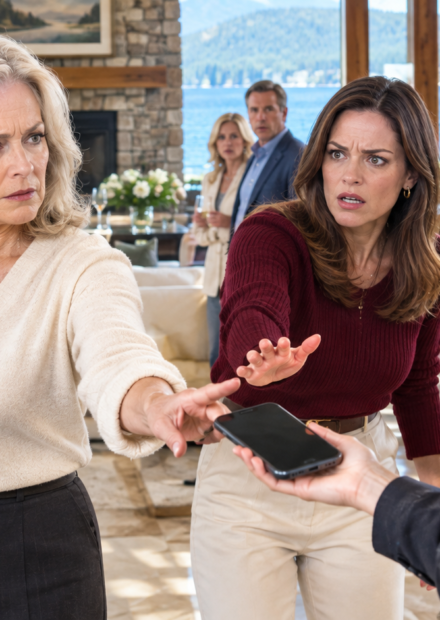
Chapter 3 – THE PRICE OF “TRADITION”
For the next three days, my phone behaved like a fire alarm.
Whitney called twice.
I didn’t answer.
Her mother called.
I didn’t answer that either.
Then came the messages.
*Whitney says there’s been a misunderstanding.*
*Everyone has already arranged travel.*
*The children are looking forward to it.*
*Couldn’t you just do Christmas this year and discuss everything afterward?*
That last one came from Whitney’s aunt.
I stared at it for a long time.
Do Christmas this year.
Meaning cook.
Clean.
Pay.
Smile.
Then afterward, once everyone had eaten my food and slept in my beds and left my house dirty, perhaps I would be permitted to discuss whether I had wanted any of it.
I put the phone facedown.
On Saturday morning, Trevor came over alone.
He knocked.
That mattered.
My son had a key.
He had always used it.
That morning, he knocked.
I opened the door.
“Coffee?” I asked.
“Please.”
We sat at the kitchen table.
For once, there was no Whitney between us.
No Christmas list.
No emergency.
Just a mother and her son.
He looked tired.
“We had a fight.”
“I’m sorry.”
“Are you?”
“Yes.”
He studied me.
“I thought you hated her.”
“I don’t.”
“Could’ve fooled me.”
“I hate some of the ways she treats me. That isn’t the same thing.”
He nodded slowly.
Then he said, “She says the loan application was just research.”
“Do you believe her?”
“I believe she didn’t think she was stealing anything.”
That was a careful answer.
“She thought the house would be mine eventually,” he continued. “And I think in her head, that made planning for it okay.”
“Does it make it okay in your head?”
He stared into his coffee.
“No.”
I let the silence sit.
Trevor had always been gentle.
As a boy, that gentleness made him kind.
As a man, it sometimes made him cowardly.
He hated conflict so much that he would allow the stronger person in a room to decide what everybody else had to tolerate.
I had blamed Whitney for taking advantage of that.
I was beginning to understand that I had done it too.
Every time Trevor said, “Mom, you know how she is,” and I said, “Fine,” I taught him that he did not have to choose.
I would absorb the cost.
That was my part in this.
Not the cause.
But the pattern.
“I should have said something earlier,” I told him.
He looked up.
“You did.”
“No. I complained. Then I kept doing everything.”
“That’s because you love us.”
“Yes.”
“And you like having everyone here.”
“I liked parts of it.”
That surprised him.
I smiled sadly.
“I loved seeing you. I loved the children running around. I loved using your grandmother’s dishes. I loved the moment after dinner when everybody was full and the house was noisy and, for ten minutes, I could look around and think, Frank would have loved this.”
My throat tightened.
“But loving the result didn’t mean I loved being taken for granted.”
Trevor’s eyes dropped.
“I did that.”
“Yes.”
“I’m sorry.”
Two words.
No excuses.
I had waited years to hear them.
They did not fix everything.
But they opened a door.
He leaned back.
“Whitney says you’re trying to control us with the inheritance.”
I almost smiled.
“If I wanted to control you with money, I would promise you more, not less.”
He considered that.
“What exactly does the trust say?”
So I explained it.
Not every legal phrase.
The meaning.
The house was protected.
The acreage could not simply be carved up according to somebody’s development fantasy.
Trevor would receive money, but not the blank check he and Whitney had assumed.
If he ever lived in the house after I was gone, there were restrictions.
No loans against it.
No immediate sale.
No transfer to a spouse.
No treating the property as a guaranteed source of capital.
He listened.
When I finished, he asked, “Was that clause because of Whitney?”
“Partly.”
He winced.
“The rest was because of me.”
“You?”
“I spent too much of my life believing the best thing I could leave you was everything I owned.”
“What changed?”
“I realized the best thing I could leave you might be the knowledge that you were never entitled to it.”
He looked at me for a long time.
“That sounds harsh.”
“It felt harsh to write.”
I reached across the table.
“I am not trying to leave you nothing, Trevor. I’m trying to stop my death from being part of somebody else’s financial plan.”
His face crumpled for half a second.
Then he looked away.
“I never thought of it like that.”
“I know.”
That was the tragedy of it.
He hadn’t.
Whitney had.
But he had allowed her to.
After he left, I began packing.
I packed sweaters.
Comfortable shoes.
A book I had been pretending I would read for six months.
Frank’s old scarf.
On December twenty-third, I loaded the suitcase into my car.
Before leaving, I walked through the house.
The tree lights glowed in the front room.
The refrigerator was almost empty.
The kitchen counters were clean.
No turkey thawing.
No pies cooling.
No grocery receipts tucked beneath the fruit bowl.
It felt wrong.
Then it felt wonderful.
I left a key for Trevor.
Not Whitney.
Trevor.
With it was a note.
**You may use the house for Christmas. Please leave it as you found it. Everything else is your responsibility. Love, Mom.**
I drove away at ten that morning.
The farther I got from Louisville, the easier I breathed.
I expected guilt to chase me.
It did.
At the first gas station.
At lunch.
When I saw a minivan full of children wearing Santa hats.
When a Christmas song Frank loved came on the radio.
But guilt is not always proof that you are doing something wrong.
Sometimes it is simply the pain of breaking an old habit.
By evening, I reached Asheville.
The inn had a stone fireplace, pine garlands and an enormous tree decorated with dried oranges and gold ribbon.
A young woman at the desk smiled.
“Christmas getaway?”
I looked at Frank’s scarf looped around my neck.
“Something like that.”
My room overlooked the mountains.
I ordered dinner.
For myself.
One plate.
One glass.
One fork.
When I finished, I put the plate outside the door.
Somebody else washed it.
I nearly cried.
Christmas Eve morning, Trevor called.
I answered.
“Everything okay?”
A pause.
“Define okay.”
I smiled.
“What happened?”
“Whitney’s mother is here.”
“Already?”
“She wanted to help.”
“That sounds promising.”
“She brought six centerpieces.”
“Less promising.”
“And Whitney ordered groceries.”
“Good.”
“For fifteen people.”
I laughed before I could stop myself.
“Twenty-five are coming.”
“I know.”
“Does she?”
“She does now.”
He sounded exhausted.
“Mom, how do you calculate how much food people need?”
The question was so sincere that I almost rescued him.
Almost.
“Experience.”
“Helpful.”
“You have the internet.”
“I know.”
“Then use it.”
He sighed.
“I deserved that.”
“Yes.”
At three, he called again.
“Where’s the roasting pan?”
“Lower cabinet beside the dishwasher.”
“It’s not there.”
“Then Whitney moved it.”
“She says she didn’t.”
I pictured the scratched old pan.
Then remembered.
“I put it in the basement after Thanksgiving. Bottom shelf near the freezer.”
“Got it.”
An hour later:
“How long does a twenty-pound turkey take?”
“Trevor.”
“Right. Internet.”
At six:
“Do you own a second gravy boat?”
“No.”
“Whitney says you do.”
“Whitney is welcome to search.”
By eight, I stopped answering.
I sat downstairs near the inn fireplace with a glass of wine.
An older couple played cards at a table near me.
Someone’s little girl slept curled in an armchair.
Snow began falling beyond the windows.
And for the first time in decades, Christmas Eve did not feel like an exam I was afraid to fail.
My phone buzzed.
A photograph from Trevor.
My kitchen.
Boxes everywhere.
A turkey sitting in the sink.
Whitney’s six centerpieces taking up half the dining room.
Three children already running through the background.
Underneath, he had written:
**I understand now.**
I looked at those words until they blurred.
Then another message arrived.
This one was from Whitney.
**We need to talk when you get back. There are things Trevor doesn’t understand.**
A minute later, another.
**You’ve put him in a terrible position.**
Then:
**This trust affects both of us. You had no right to make a decision this big without discussing it with your family.**
I read that sentence twice.
No right.
To decide what happened to my own property.
Without discussing it with people who had already decided what should happen to it.
I did not respond.
At nine-thirty, Trevor called again.
His voice was different.
Quiet.
“Mom?”
“What is it?”
“I found something.”
My stomach tightened.
“What?”
“A folder.”
“Where?”
“In the desk in the den.”
I knew the desk.
Frank’s desk.
Whitney had been using it that week to organize Christmas.
“What kind of folder?”
Trevor took a breath.
“Contractor estimates.”
I closed my eyes.
He continued.
“Kitchen. Bathrooms. Back patio. Barn conversion.”
I said nothing.
“And there’s a sketch.”
“For what?”
“The property.”
The fire popped in front of me.
“What kind of sketch?”
“Lot divisions.”
There it was.
Not a new betrayal.
Just the full shape of the old one.
The acreage.
My father’s trees.
The creek.
The land Whitney had asked about.
All those casual questions.
All those photographs.
All those plans for someday.
Trevor’s voice broke.
“She had all this planned, Mom.”
“I know.”
“No. I mean really planned.”
I could hear him turning pages.
“There are notes about what things could be worth.”
I stared into the fire.
“Trevor.”
“What?”
“Ask her.”
“Ask her what?”
“Ask her why she was planning to divide property she did not own.”
He went silent.
Then, from somewhere away from the phone, I heard Whitney’s voice.
“Who are you talking to?”
Trevor didn’t answer.
Her voice came closer.
“Trevor?”
Then the line went dead.
I sat with my phone in my hand.
Five minutes passed.
Ten.
Twenty.
At eleven-fifteen, a message arrived.
Not from Trevor.
From Whitney.
**You have no idea what you’ve done.**
I looked at it.
Then I turned my phone off.
Because for once, I did know.
I had stopped making it easy.
And apparently, easy had been the foundation of everything.