Chapter 4 – TWENTY-FIVE GUESTS AND NO SERVANT
Christmas morning, I woke at seven.
For forty years, waking at seven on Christmas morning would have meant I was already behind.
That year, I lay in bed.
I listened to the silence.
Then I laughed.
I took a long shower.
I put on a cream sweater.
I went downstairs and ate eggs somebody else cooked.
At ten, I called Trevor.
No answer.
At eleven-thirty, he called me.
“Merry Christmas, Mom.”
“Merry Christmas.”
Behind him, I heard chaos.
Children yelling.
A dog barking.
A woman asking where the ice was.
Something metallic crashed.
I covered my mouth.
“Don’t laugh,” he said.
“I’m not.”
“You are.”
“A little.”
“The turkey is still raw.”
“What time did you put it in?”
“Nine.”
“When are you eating?”
“One.”
“Trevor.”
“I know.”
Someone shouted his name.
He said, “Hang on.”
I heard muffled conversation.
Then Whitney’s voice.
“No, the rolls go in the other oven!”
Trevor came back.
“I have to go.”
“How many people came?”
“Twenty-seven.”
I laughed.
“Why twenty-seven?”
“Two cousins brought dates.”
“Of course they did.”
He hesitated.
“Mom?”
“Yes?”
“I’m sorry.”
“You already said that.”
“I’m saying it again.”
This time I heard something behind the words.
Understanding.
Not complete.
But growing.
“Go save your turkey,” I said.
“It may be beyond saving.”
“Then order pizza.”
He groaned.
I smiled after we hung up.
At two, Whitney called.
I let it ring.
At two-ten, she called again.
At two-thirty, Trevor sent me a picture.
Pizza boxes.
Eleven of them.
Across my dining table.
My mother’s porcelain dishes were nowhere in sight.
Under the photograph:
**New tradition.**
I laughed so hard a woman in the lobby looked at me.
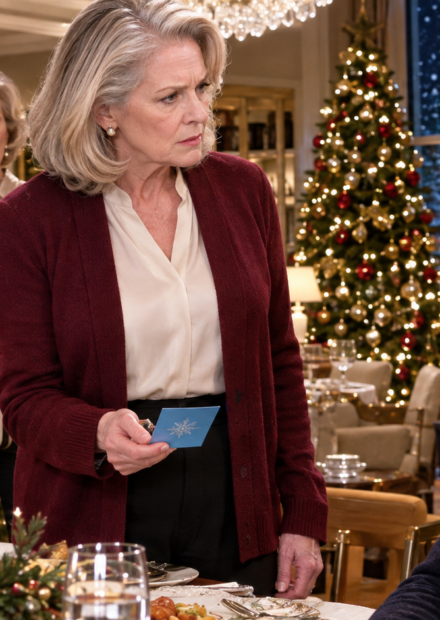
Christmas dinner at the inn was served at five.
I sat with six strangers at a long table.
A widower from Tennessee.
Two sisters from Ohio.
A retired teacher.
A couple celebrating their thirty-fifth anniversary.
Nobody expected me to serve them.
Nobody asked me where the gravy was.
Nobody told me the rolls were cold.
We talked.
We ate.
We laughed.
At dessert, the retired teacher asked why I was traveling alone.
“My family is having Christmas at my house.”
She blinked.
“Without you?”
“Yes.”
“That sounds complicated.”
“It was.”
“And now?”
I thought about it.
“Now it’s educational.”
She laughed.
I did too.
But back in my room that night, the laughter faded.
I looked at Frank’s scarf draped over the chair.
“I should’ve done this sooner,” I whispered.
And in the silence, I could almost hear him.
*You always did stay too long at the party, Care.*
I cried then.
Not because Christmas had been ruined.
Because it hadn’t.
That was the revelation.
Christmas survived without my turkey.
Without my dishes.
Without my labor.
The world did not collapse.
Twenty-seven people ate pizza and presumably lived.
Which meant all those years I had been told that everything depended on me were not quite true.
They had depended on me because I kept agreeing to be depended upon.
There is freedom in learning you are not indispensable.
Painful freedom.
But freedom.
I drove home on December twenty-seventh.
When I pulled into my driveway, I knew immediately something had changed.
Trevor’s car was there.
Whitney’s wasn’t.
Inside, the house was clean.
Not my version of clean.
But respectable.
Trash removed.
Floors vacuumed.
Counters wiped.
The tree still standing.
Trevor was in the kitchen.
He looked terrible.
“Coffee?” I asked.
He laughed weakly.
“You’re asking me?”
“My house.”
“Right.”
I made two cups.
We sat.
For a moment, neither of us mentioned Whitney.
Then I asked, “Where is she?”
“At her mother’s.”
I nodded.
“We had a fight Christmas Eve.”
“I assumed.”
“Then another Christmas night.”
He rubbed his face.
“I asked about the property plans.”
“And?”
“She said she was trying to build a future.”
“With land that wasn’t hers.”
“I said that.”
“What did she say?”
“That married people plan around future assets all the time.”
I didn’t answer.
“She said she thought I agreed.”
“Did you?”
Trevor’s eyes filled with shame.
“Not exactly.”
“What does that mean?”
“It means… when she talked about remodeling this place someday, I didn’t stop her.”
I waited.
“When she talked about the land, I didn’t stop her.”
I felt the old anger rising.
He continued before I could speak.
“I liked imagining it.”
That honesty stopped me.
He looked around the kitchen.
“I grew up here. Dad was here. You were here. I guess part of me liked thinking it would always be mine.”
“It can be part of your memories without being your possession.”
“I know that now.”
He swallowed.
“But I let her think more than that. I let myself think more than that.”
I sat back.
There it was.
The part I needed from him.
Not a villain.
Not a victim.
Responsibility.
“What happens now?” I asked.
“I don’t know.”
“With Whitney.”
“I don’t know.”
He looked toward the den.
“I love her.”
“I know.”
“She isn’t evil, Mom.”
“I never said she was.”
“She grew up differently. Her family talks about money constantly. Houses, investments, what things are worth. Her parents lost their house when she was a teenager. She says she promised herself she’d never be insecure like that again.”
For the first time, some of Whitney’s behavior made emotional sense.
It did not excuse it.
But motives and excuses are not the same thing.
Fear can explain greed.
It does not turn greed into permission.
“She wants security,” I said.
“Yes.”
“So do I.”
Trevor nodded.
“That’s what I told her.”
I looked at him.
He gave me a tired smile.
“You would’ve been proud.”
“I am.”
He looked down.
“She didn’t like hearing it.”
“I imagine not.”
Trevor reached into his coat pocket.
“There’s something else.”
He placed a folded paper on the table.
The mortgage-company letter.
“I called them.”
My eyes narrowed.
“You did?”
“Yes.”
“The application was never valid against your property. It couldn’t be. Whitney had no ownership interest.”
Relief moved through me, though I had expected as much.
“She hadn’t forged your signature or anything like that.”
I let out a breath.
That mattered.
I had been angry with Whitney.
I did not want to turn her into something worse than she was.
“So what did she do?”
“She made inquiries based on a possible future transfer. She submitted estimates and projections. They told her she’d need proof of ownership before anything could move forward.”
“Which she didn’t have.”
“Right.”
“And the letter?”
“A denial. Or more accurately, a refusal to proceed.”
I nodded.
So that was why Whitney had known exactly what the envelope was.
Embarrassment.
Exposure.
A plan collapsing.
Not a secret crime.
Just entitlement made visible on paper.
Trevor pushed the letter toward me.
“I wanted you to know.”
“Thank you.”
He stood.
At the doorway, he stopped.
“Mom?”
“Yes?”
“Don’t change the trust back because of me.”
I stared at him.
He continued.
“I was angry at first. But don’t.”
“Why?”
He looked around the house.
“Because I think you were right about something.”
“What?”
“I need to know that my life is mine to build.”
Then he left.
I sat alone in my kitchen.
And for the first time since signing those papers, I wondered whether the trust had protected more than my house.
Maybe it had protected my son from becoming a man who spent his life waiting for his mother to die.