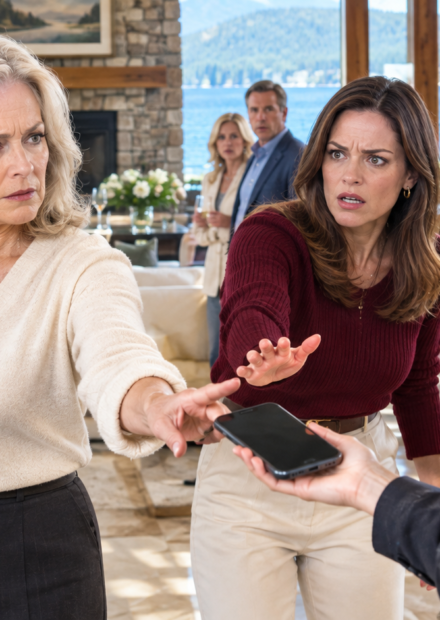
SHE HUMILIATED MY MOTHER AT OUR WEDDING. BY MORNING, I KNEW WHY SHE HAD REALLY WANTED TO MARRY ME.
Chapter 5 – WHAT SHE HAD REALLY WANTED
The email was only nine sentences long.
I read it three times.
Not because it was complicated.
Because it wasn’t.
That made it worse.
Stephanie had written:
Dad, stop pushing Charles about Willowbrook before the wedding. Every time you bring up development, he gets defensive. Once we’re married, I can approach it through Margaret’s future care and our estate planning. Charles will listen if he believes he’s protecting her. But if you keep treating him like a landowner you’re negotiating with, he’ll realize that’s what this is.
I stopped reading.
Daniel sat silently across from me.
Mom was beside me.
She had read it once.
That was enough for her.
I looked at the date.
Six months before our wedding.
Two months after I proposed.
“So she knew exactly what she was doing.”
Daniel chose his words carefully.
“She clearly understood that you resisted a direct property discussion and proposed approaching the issue differently after marriage.”
Mom touched my arm.
I stared at the paper.
All week, I had been searching for one piece of evidence that would let me believe Stephanie had merely been manipulated by her father.
The email didn’t prove she had never loved me.
Nothing could prove that.
Human feelings don’t leave clean paper trails.
But it proved something that mattered more.
She had planned to use my trust.
My concern for Mom.
Our marriage.
She had understood that I would say no if Richard treated me like a landowner.
So she intended to wait until she was my wife.
Then she would make the same proposal sound like family responsibility.
I finally understood what Emma had meant.
Why Stephanie needed the wedding to happen.
Marriage would not have magically transferred Willowbrook to her.
It would not have made Richard the owner.
It would have done something more useful to them.
It would have moved Stephanie inside the circle of trust.
After the wedding, documents from my wife would feel different from documents from a developer.
Questions about Mom’s future would sound like concern.
Estate planning would sound responsible.
Selling land would sound like protecting our family.
And every objection could be answered with the same words Stephanie had used for months.
You’re being emotional.
I looked at Mom.
“I’m sorry.”
“For what?”
“For bringing her into your life.”
Mom frowned.
“You didn’t make her do those things.”
“I should’ve seen it.”
“You saw it when it mattered.”
“At the altar.”
“Yes.”
“That’s pretty late.”
Mom smiled sadly.
“Still before ‘I do.’”
I laughed despite myself.
Then she squeezed my hand.
“Your father used to say a gate only has to close before the horse gets through.”
Daniel smiled.
“That sounds like him.”
Mom folded the email.
“I want this finished.”
Daniel nodded.
“What does finished mean to you?”
“No more paperwork brought to my house. No more discussions through Stephanie. No more assumptions that my farm is part of somebody else’s project.”
“And the offer?”
Mom thought about it.
Then she surprised me.
“I want to hear it properly.”
I turned toward her.
“You do?”
“Yes.”
“Mom, you don’t have to sell.”
“I know.”
“That number doesn’t matter.”
“Fourteen million dollars matters, Charlie.”
I opened my mouth.
She lifted one finger.
“But so does how a person asks.”
I waited.
“If Richard Whitmore wants to make a legitimate offer, he can make one through Daniel. We’ll understand every word. We’ll get our own valuation. We’ll learn exactly what the land is worth to him and exactly what happens if we say yes.”
She looked at me.
“And then I’ll decide.”
I smiled.
Dad would have been proud.
Not because she refused to sell.
Because she refused to be pushed.
That afternoon, Daniel responded to Whitmore Development.
The message was simple.
Any future discussion regarding Willowbrook would go through him.
No one was authorized to act for Mom.
No agreement existed.
No development consent had been given.
Any legitimate proposal could be submitted in writing.
For nearly a week, nothing happened.
Then Richard requested a meeting.
Mom insisted on attending.
So did I.
Daniel’s conference room had none of Richard’s marble or glass.
Just an old oak table, legal pads, water glasses, and sunlight through dusty blinds.
Richard arrived with two attorneys.
Stephanie was not with him.
He looked at Mom for the first time as though she were the person who actually mattered.
“Mrs. Hartwell.”
“Mr. Whitmore.”
“I regret the way events unfolded.”
Mom nodded.
“I imagine you do.”
One of his attorneys shifted in his chair.
Richard placed a folder on the table.
“We would like to begin again.”
Mom didn’t touch it.
“Then begin honestly.”
Richard looked at her.
She continued.
“My farm is not vacant land.”
“I understand.”
“It is not an obstacle.”
“I understand.”
“You do not get to discuss where I’ll live as part of your development plan.”
His jaw tightened.
“Agreed.”
“And nobody brings me documents and lies about what they are.”
Richard glanced toward Daniel.
“Agreed.”
Mom leaned back.
“Now you may make your offer.”
Watching her that day changed something in me.
For years, I had thought strength looked like endurance.
Mom taught me that sometimes strength was refusing to endure one more thing.
Richard presented his proposal.
Daniel asked questions.
Lots of them.
So did Mom.
The meeting lasted almost three hours.
She did not agree to sell.
She did not reject the possibility forever.
She simply refused to decide on Richard’s timetable.
That frustrated him more than anger would have.
When the meeting ended, he stood.
“So what happens now?”
Mom smiled.
“I go home.”
That was all.
No grand speech.
No threat.
No revenge.
She went home.
Richard left without Willowbrook.
In the weeks that followed, the project he had treated as inevitable became what it should have been from the beginning.
A proposal.
Nothing more.
Without Mom’s cooperation, parts of Richard’s preferred plan had to be reconsidered.
His company began evaluating alternatives.
Daniel made sure every communication was documented.
Mom hired an independent appraiser and land-use adviser.
She learned more about the value of Willowbrook in two months than I had learned in forty-four years.
And something unexpected happened.
She became excited.
Not about selling.
About choosing.
For decades, the farm had been something she fought to keep alive.
Now she began thinking about what she wanted the next twenty years of her life to look like.
She considered preserving most of the acreage.
She considered selling a small edge parcel someday.
She considered expanding the horse boarding operation.
She even joked about turning the old barn into an event space.
“The manure smell might hurt business,” I told her.
She threw a dish towel at me.
We laughed until both of us had tears in our eyes.
It was the first time Stephanie’s insult stopped hurting.
Emma and I stayed in contact.
Her relationship with Richard became strained after he discovered she had helped me.
I once apologized for putting her in the middle.
She shook her head.
“I put myself there.”
“Why?”
She thought about it.
“Because everybody in my family spent years pretending Dad’s way was the only way.”
Then she smiled faintly.
“Watching you walk out of that church made me realize somebody could just say no.”
I understood that better than she knew.
Stephanie contacted me several times.
At first, the messages were defensive.
Then angry.
Then apologetic.
Eventually, they became quieter.
One evening, almost three months after the wedding, she asked if I would meet her for coffee.
I nearly refused.
Then I decided there was one conversation I still needed.
We met at a small café halfway between town and Willowbrook.
Stephanie looked different.
Not physically.
She was still beautiful.
But there was no audience.
No Richard.
No Elaine.
No wedding planner.
No perfect room she needed to control.
Just her.
She sat across from me.
“I’m not here to ask you to take me back.”
“Okay.”
“I know you won’t.”
I said nothing.
She looked down at her coffee.
“I’ve been trying to understand why I did what I did.”
“Have you?”
“Yes.”
“And?”
She took a breath.
“I grew up believing my father was always the smartest person in every room.”
I waited.
“If he wanted something, there was always a reason. If someone disagreed, they were emotional or naïve or didn’t understand business.”
“That sounds familiar.”
“I became like him.”
There was no self-pity in her voice.
That mattered.
She continued.
“When he started talking about Willowbrook, I told myself he was right. I told myself you’d thank me eventually.”
“For deceiving me?”
“For making you see what the land was worth.”
“I knew it was worth something.”
“You didn’t act like it.”
That irritated me.
She saw it.
“I’m sorry.”
“Worth isn’t always a sale price, Stephanie.”
“I understand that now.”
“Do you?”
“I’m trying to.”
We sat quietly.
Then I asked the question that had haunted me since Emma opened that office door.
“Did you marry me for Willowbrook?”
Stephanie’s eyes filled.
“We never married.”
“You know what I mean.”
She nodded.
“No.”
I watched her.
“I did not start dating you for Willowbrook. I did not fall in love with you for Willowbrook.”
“But?”
“But once Dad showed me what the property could mean, I let it become part of how I imagined our future.”
“And you decided you could manipulate me into that future.”
“Yes.”
The honesty hurt.
But less than another lie would have.
“Why didn’t you tell me?”
“Because I knew you’d say no.”
There it was.
The simplest answer.
The only one that mattered.
I leaned back.
“That means you knew it was wrong.”
“Yes.”
She wiped her cheek.
“I think I kept telling myself that once we were married and you saw the money, you’d understand.”
“And Mom?”
Stephanie closed her eyes.
“I treated her terribly.”
“Before the wedding too.”
“I know.”
“You thought she was beneath you.”
She didn’t answer immediately.
Finally she whispered, “Yes.”
That was the hardest thing she said all afternoon.
And probably the most honest.
“I’m ashamed of that.”
I believed her.
But believing someone regrets hurting you is not the same as trusting them again.
Stephanie looked at me.
“Is there any version of this where you forgive me?”
“I already have.”
She blinked.
“What?”
“I don’t want to hate you.”
Hope appeared in her face.
I stopped it before it grew.
“But forgiveness isn’t the same as marriage.”
The hope disappeared.
I continued.
“I can forgive what happened and still know I should never put my life back in your hands.”
She cried quietly.
I didn’t enjoy it.
I didn’t feel victorious.
That surprised me.
For weeks, I had imagined truth arriving like revenge.
Instead, it arrived like clarity.
Clean.
Painful.
Final.
When we stood to leave, Stephanie said, “Your mother deserved better from me.”
“Yes.”
“So did you.”
“Yes.”
She nodded.
Then she walked away.
I never saw her socially again.
Six months after the wedding, Mom made her decision about Willowbrook.
She did not sell the farm to Whitmore Development.
Not because Dad’s letter ordered her not to.
Not because I begged her.
Not because fourteen million dollars suddenly became meaningless.
She refused because Richard’s preferred plan required more of Willowbrook than she was willing to give.
Later, through Daniel, she entertained a much smaller proposal involving acreage at the far edge of the property.
On her terms.
With independent advice.
With protections she understood.
And without anyone pretending it was for her own good.
The farmhouse stayed.
The barn stayed.
The western field stayed.
So did the hill where Dad’s ashes had been scattered.
One spring morning, I found Mom sitting on the porch drinking coffee.
She was wearing muddy boots.
Her hair was loose.
There was dirt on one cheek.
“You smell like manure,” I told her.
She stared at me.
I lasted about two seconds before laughing.
She threw a gardening glove at my head.
“Peasant,” I added.
She chased me halfway across the yard.
At sixty-nine.
I hadn’t seen her laugh that hard in years.
Later we sat on the porch steps.
The fields were green.
Horses moved slowly beyond the fence.
For the first time, I could look across Willowbrook without seeing Richard’s red development lines.
It was simply home again.
Mom nudged my shoulder.
“You ever going to get married?”
I groaned.
“Can I recover from the last wedding first?”
“It’s been six months.”
“My bride tried to turn our marriage into a land-development strategy.”
“She also insulted my dress.”
“That was clearly the greater crime.”
“Obviously.”
We laughed.
Then Mom became serious.
“Charlie.”
“Yeah?”
“Don’t let what Stephanie did make you suspicious of everyone.”
I looked across the field.
“I’m trying.”
“Good.”
She took another sip of coffee.
“Just be suspicious enough.”
That sounded like Dad too.
Sometimes I think about how close I came.
If Stephanie had smiled at Mom in that church, the wedding probably would have happened.
If she had endured one unwanted hug.
If she had kept her contempt hidden for another hour.
If Mom had signed those papers.
If I had continued ignoring Daniel’s envelope.
If Emma had stayed silent.
There were so many small hinges.
But I no longer believe the wedding was destroyed by one cruel sentence.
That sentence only opened my eyes.
The real destruction had happened quietly, months earlier, every time Stephanie decided I didn’t deserve the truth.
Every time Richard looked at my mother’s home and saw only acreage.
Every time I heard someone insult where I came from and pretended it was harmless because confronting it would have been uncomfortable.
The strangest thing is that Richard was right about one thing.
Willowbrook was valuable.
He just never understood why.
Its value wasn’t only in eighty-seven acres.
It was in a woman who woke before sunrise for decades so her son could have choices she never had.
It was in the kitchen table where bills had once been stacked beside my college acceptance letter.
It was in the fence posts my father drove into the ground.
It was in the western field where we said goodbye to him.
And ultimately, it was in the fact that the decision belonged to us.
Maybe someday Willowbrook will be sold.
Maybe fifty years from now there will be houses where horses once grazed.
Maybe there won’t.
That isn’t the promise Dad left me.
His promise was simpler.
Nobody gets to make you ashamed of where you came from and then use that shame to decide where you’re going.
I learned that lesson standing at an altar in front of two hundred and sixty people.
I learned it when my bride looked at my mother and called her a peasant.
And I finally understood it months later, sitting beside Mom on the porch while morning sunlight stretched across the fields.
Stephanie thought the worst thing that happened that day was that I canceled our wedding.
She was wrong.
The worst thing that happened—for her and for everyone who had been counting on my silence—was that I finally stopped apologizing for saying no.