SHE SHAVED MY HEAD ON HER WEDDING MORNING—THEN EXPECTED MY $22 MILLION GIFT
Chapter 1 – THE MORNING I FINALLY WOKE UP
My future daughter-in-law shaved my head while I slept on my son’s wedding morning—and still expected me to arrive smiling, stay silent, and hand her twenty-two million dollars.
I woke to a strange burning across my scalp.
At first, I thought I had slept badly.
There was a tightness at the back of my head, a faint sting near my left ear, something cold where warmth should have been.
Still caught between sleep and consciousness, I reached for the thick silver hair that had fallen past my shoulders the night before.
My fingers touched nothing.
Not tangled strands.
Not a ruined haircut.
Skin.
I froze.
Then I ran both hands over my head.
Bare.
Almost entirely bare.
I sat upright so quickly the bedroom tilted around me.
My heart began pounding hard enough to make my vision pulse.
For three or four seconds, I could not make sense of what my hands were telling me.
My hair had been there when I went to sleep.
I remembered brushing it.
I remembered braiding it loosely because Lucia, my hairstylist, had told me not to use any products before the wedding.
I remembered standing at the vanity in my nightgown, studying the silver strands in the mirror.
Michael used to wrap that hair around his tiny fingers when he was a child.
Richard had once told me he hoped I never cut it.
I had carried it through widowhood, bankruptcy, long meetings, construction sites, funerals, negotiations, birthdays, disappointments, and twenty years of becoming a woman I had never intended to become.
Now it was gone.
I threw off the covers.
Cold morning light leaked through the curtains as I stumbled toward the bathroom with one hand pressed against my head.
Before I switched on the light, I smelled antiseptic.
Sharp.
Clinical.
Deliberate.
My stomach turned.
I flicked the switch.
And faced the mirror.
For one suspended second, I did not recognize the woman staring back.
Her scalp was raw and unevenly flushed.
Tiny fragments of silver hair clung near one ear where the razor had missed them.
There was a small nick above the base of her skull.
Her eyes were wide.
But the rest of her face had gone frighteningly still.
I lifted a hand.
So did she.
Someone had entered my bedroom while I slept.
Someone had stood beside my bed.
Someone had touched me without waking me.
Someone had taken a razor to my head.
Not in anger.
Not during an argument.
Not in some impulsive moment when emotions ran wild.
Carefully.
Quietly.
Piece by piece.
I looked toward the bathroom counter.
That was when I saw the note.
A square of white paper had been taped to the center of the mirror.
“Congratulations—you finally have a hairstyle that suits your age.”
A tiny heart had been drawn beneath the sentence.
I stared at it.
The handwriting was neat.
The cruelty was effortless.
I peeled the paper from the glass.
A familiar perfume rose from it.
Sweet.
Expensive.
Floral with something darker underneath.
I knew that perfume.
I had given Sabrina a bottle of it for Christmas after Michael mentioned she liked it.
I had paid four hundred dollars for something she had now used to sign her work.
“Sabrina.”
Her name came out as barely more than breath.
I looked at the cheerful little heart again.
And something inside me changed.
There are moments when pain arrives so violently that you cannot feel it all at once.
Instead, the mind becomes practical.
It separates itself from the wound.
It begins making lists.
What happened?
Who did it?
What happens next?
I did not scream.
I did not cry.
I did not call Michael.
That last fact surprised even me.
For most of my adult life, whenever anything involving my son went wrong, my first instinct had been Michael.
Protect Michael.
Explain to Michael.
Forgive Michael.
Help Michael.
Make things easier for Michael.
Even when he was forty-one years old, some part of me still heard the twelve-year-old boy who had once stood outside a hospital room asking why his father could not come home.
But I did not call him.
I folded Sabrina’s note once.
Then again.
I placed it beside the sink.
And walked barefoot across the cold marble floor to the safe in my bedroom.
The safe was hidden behind a painting Richard had bought at an estate sale the year before he died.
A harbor in winter.
Gray water.
Gray sky.
One small boat fighting toward shore.
I entered the code.
The metal door opened.
Inside rested an ivory envelope.
I had prepared it the night before.
Twenty-two million dollars.
Not in cash, of course.
The envelope contained the final authorization documents for a transfer I had spent months arranging with my attorney and financial team.
A Manhattan investment account.
A substantial property interest.
Funds sufficient to purchase the Beacon Hill penthouse Sabrina had fallen in love with.
A portfolio designed to provide them income for decades if managed responsibly.
I had intended to give it to Michael and Sabrina at the reception.
Their wedding gift.
Twenty-two million dollars.
I sat on the edge of my bed with the envelope in my lap.
My hands did not shake.
That frightened me more than if they had.
Because suddenly I saw the gift clearly.
It was not merely money.
It was a penthouse.
Security.
Investments.
Power.
Freedom from consequences.
It was the beginning of a life most people could never imagine.
And if I was honest, it was something uglier too.
It was my final attempt to keep my son close.
For years, I had dressed guilt in generosity and called it love.
Michael mentioned a condo, and I helped him buy one.
Michael wanted to travel through Europe after college, and I paid for it.
Michael wanted to “find himself” before entering the family company, and I funded that too.
Later, he complained that his friends had more independence because their parents had created trusts.
So I created one.
He never demanded these things.
That was the clever part.
He sighed.
He hinted.
He looked disappointed.
And I supplied the rest.
Each check had been an apology.
I am sorry I worked late when you were fifteen.
I am sorry grief made me silent.
I am sorry your father died.
I am sorry I had to choose between sitting beside you every afternoon and making sure the bank did not take our house.
I am sorry I was not soft enough.
I am sorry I became strong because somebody had to.
I ran my thumb along the edge of the envelope.
Then I remembered standing at my own wedding beside Richard with twenty-eight dollars in my checking account.
We had eaten grocery-store cake in his sister’s backyard.
My shoes hurt.
The photographer was drunk.
The folding chairs did not match.
And I had thought I was the richest woman alive because the man beside me looked at me as if nothing in the world mattered more.
Twenty-two million dollars.
What exactly had I been trying to buy?
I stood.
Returned the envelope to the safe.
Closed the metal door.
Then I turned the dial until the lock clicked.
Quiet.
Dry.
Final.
Not one dollar would move.
I picked up my phone and called Avery Whitman.
Our family attorney had represented me for almost twenty-six years.
He had been younger than Michael was now when we met.
Back then he had been an associate with a cheap suit and a terrifying attention to detail.
Now he had silver at his temples, three adult daughters, and a corner office overlooking Boston Harbor.
He answered on the second ring.
“Beatrice,” he said. “Good morning. Big day.”
“Yes.”
“Ready to finalize the transfer?”
“No.”
Silence.
Avery knew me well enough not to fill it.
“I want everything placed on hold immediately,” I said. “No transfer. No access. No exceptions.”
His voice changed.
Not dramatically.
Just enough.
“Has something happened?”
I looked toward the bathroom.
At the raw scalp in the mirror.
At Sabrina’s note beside the sink.
“Yes.”
“Do you need me there?”
“Not yet.”
“Are you safe?”
That question almost undid me.
Not, Are you angry?
Not, What did Michael do?
Not, Is this about the wedding?
Are you safe?
I swallowed.
“Yes.”
“All right.”
“At the reception tonight, I want you to come to my house.”
“For what?”
“We’re rewriting the will.”
This time the silence lasted longer.
“Beatrice.”
“Yes?”
“Are you sure you want to make estate decisions today?”
“I have spent years making estate decisions while afraid,” I said. “Today may be the first day I’m making one while thinking clearly.”
He exhaled.
“What happened?”
I stared at my reflection.
“At some point I’ll tell you everything.”
“All right.”
“And Avery?”
“Yes?”
“Only one thing is wrong.”
“What?”
“I finally woke up.”
I ended the call.
Then I called Lucia.
She arrived twenty-eight minutes later carrying two black cases and wearing no makeup.
Lucia had been cutting my hair for twenty years.
She had seen me the morning after my mother died.
She had prepared me for business magazine covers I pretended not to care about.
She had fixed my hair after a disastrous charity gala where the humidity turned me into what she called “an aristocratic dandelion.”
She had known those silver strands almost as long as anyone.
When I opened the door, her eyes lifted.
Her hand flew to her mouth.
“Oh, Bea.”
I stepped aside.
She came in.
For several seconds she simply looked at me.
Then she put down her cases.
“Did you do this?”
“No.”
Her face changed.
“Who?”
I looked at her.
She closed her eyes briefly.
“No,” she said. “Don’t tell me yet.”
Perhaps she saw the answer anyway.
Perhaps she understood that speaking it aloud would make it more real.
She touched the skin near my temple with such care that I nearly broke.
“There are abrasions,” she whispered.
“I know.”
“This was done badly.”
“Yes.”
“Whoever did it could have cut you seriously.”
“I know.”
She looked into my eyes.
“Are you going to the wedding?”
“Yes.”
“Good.”
I blinked.
She opened one of her cases.
“I was afraid you were going to say no.”
“You think I should go?”
“I think whoever did this expects you not to.”
That was why I had called her.
Lucia understood war.
She simply practiced it with combs and pins.
From her second case she removed a soft gray-silver wig.
“I brought three,” she said. “This one is closest to your natural color.”
“You just had these?”
“I work in Boston. I have everything.”
Despite myself, a laugh escaped me.
One small laugh.
The first sound that felt human since I had awakened.
Lucia fitted the wig carefully over my scalp.
She adjusted the hairline.
Trimmed two strands.
Changed the part.
Then stepped back.
I looked like myself.
Almost.
The woman in the mirror had shoulder-length silver hair instead of the longer style I had worn the night before.
She looked elegant.
Composed.
No one would know.
Lucia met my gaze in the reflection.
“Do you want makeup?”
“Yes.”
“War paint?”
“No.”
That made her smile.
“What, then?”
“Something that looks peaceful.”
She understood immediately.
By nine-thirty, I was dressed in navy silk beneath a gray wool coat.
Pearl earrings.
Low heels.
My wedding gift remained locked in the safe.
Sabrina’s note was inside my purse.
So was a small digital recorder.
I had bought it years earlier for board meetings when I was tired of pretending I could remember every detail.
I almost left it behind.
Then I slipped it into my bag.
At the time, I could not have explained why.
Instinct, perhaps.
Or the new part of me that had finally begun planning for what people actually did instead of what I wanted to believe they would do.
St. Andrew’s Church glowed beneath the morning sun.
White roses climbed the stone steps.
Cars lined the curb.
Guests in dark suits and winter dresses moved beneath the tall doors, laughing, adjusting coats, holding programs printed on cream paper thick enough to make stationery a social statement.
I sat near the front.
No one knew what was beneath my silver hair.
No one knew what Sabrina had done.
No one knew that the twenty-two-million-dollar wedding gift no longer existed.
As the organ played, memories returned with merciless clarity.
Richard’s death certificate trembling in my hands when I was thirty-two.
Michael standing beside me in the hospital corridor.
Twelve years old.
Too thin.
Too pale.
“Where did Dad go?”
I had not known how to answer.
Three months later, I discovered how much debt Richard had hidden while trying to save his failing construction company.
People always told the story later as if I had been born ruthless.
As if widows simply wake one morning knowing how to negotiate mortgages, read zoning laws, restructure debt, and face men who call them sweetheart while trying to take their homes.
I had known none of it.
I learned because failure meant Michael lost everything.
I sold my jewelry.
I sold Richard’s truck.
I skipped meals.
I took bookkeeping work at night and property-management work during the day.
Eventually, I convinced a bank to let me assume a loan on a failing duplex.
I renovated one unit myself.
I painted walls at two in the morning.
I replaced cabinet hinges while Michael did homework on the kitchen floor.
That duplex became three.
Three became seven.
Seven became a small apartment building.
The building became two.
Then offices.
Then commercial property.
Then development.
Building by building, deal by deal, I dragged the Langford name out of grief and turned it into an empire.
The newspapers later called me brilliant.
No one had called me brilliant when I was unclogging a stranger’s toilet at midnight because I could not afford a plumber.
I had built a crown for my son.
Somewhere along the way, he forgot what it had cost me.
The music changed.
Everyone stood.
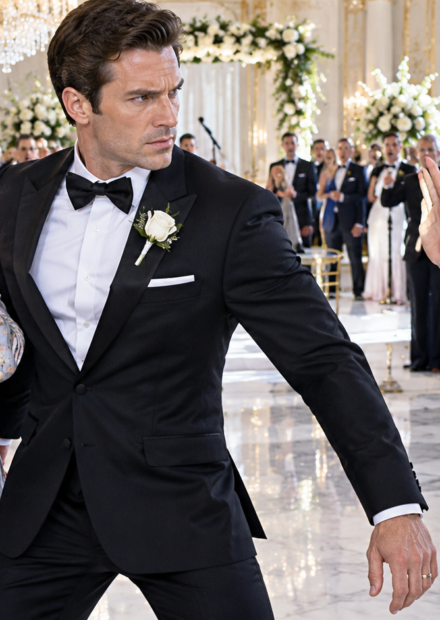
Sabrina appeared at the far end of the aisle.
She was beautiful.
I will never lie about that.
Her dress was ivory silk with hand-beaded lace.
Her dark hair fell in perfectly arranged waves.
Her father offered his arm.
Her mother dabbed her eyes.
And Sabrina smiled.
Then she looked toward me.
Only for a second.
Her eyes moved to my hair.
The smile shifted.
A tiny flicker.
Satisfaction.
She knew.
She believed the wig meant victory.
She believed I had covered the evidence because I was too ashamed to let anyone see what she had done.
Then she turned toward Michael.
My son looked at her as though she had descended from heaven.
Something inside me hurt.
Not because he loved her.
A mother should be grateful when her child finds love.
It hurt because I had begun to understand that love without character can become permission.
And Michael had given Sabrina permission for a very long time.
The ceremony passed like a dream I was watching from a distance.
Promises.
Rings.
Applause.
A kiss.
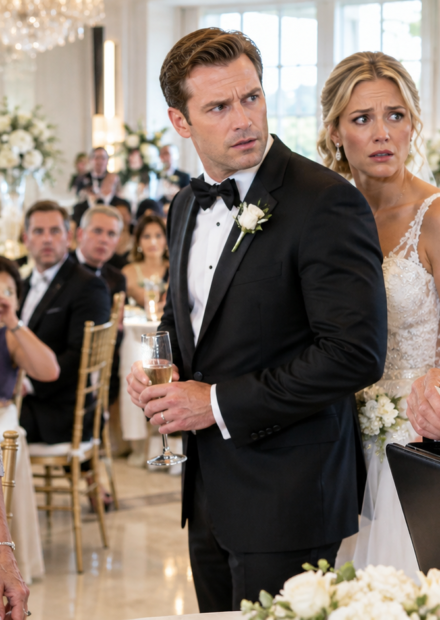
When Michael walked back down the aisle with his wife on his arm, he finally looked at me.
He smiled.
Not warmly.
Relieved.
As though my presence meant one less problem for him.
I smiled back.
And in that moment, I realized he had not called me that morning.
He knew I had stayed in the hotel suite where the bridal party had gathered the previous evening.
Sabrina had been there.
Two bridesmaids had been there.
Michael knew I had gone upstairs early.
Yet he had not checked on me once.
Maybe that meant nothing.
Maybe it meant everything.
Outside the church, guests crowded around the newlyweds.
Cameras clicked.
Sabrina laughed.
Michael kissed her cheek.
I stood near a stone pillar while people moved around me.
Then Sabrina excused herself from a photograph.
She crossed the courtyard.
Toward me.
Her heels clicked softly against the stone.
“Beatrice.”
“Sabrina.”
Her eyes went directly to my wig.
“Cute.”
I said nothing.
She leaned closer.
“Very convincing.”
My hand slipped into my purse.
Found the recorder.
Pressed one button.
A red light glowed beneath my fingers.
Then Sabrina smiled.
“You really did go through with the wedding,” she said.
“It’s my son’s wedding.”
“I thought you might hide.”
“Why?”
Her smile widened.
“You know why.”
Behind her, laughter rose from the steps.
I looked at this woman my son had just married.
“Did you come into my room last night?”
She rolled her eyes.
“Oh, please.”
“Did you?”
“You’re not going to do this here, are you?”
“I asked you a question.”
She folded her arms.
“You were sleeping.”
My heartbeat slowed.
Not faster.
Slower.
“So you admit you were in my room.”
She gave a tiny shrug.
“You sleep like the dead.”
“And you shaved my head.”
Her eyes sharpened.
“For God’s sake, Beatrice. It was hair.”
I stared at her.
“It grows back.”
“You used a razor on me while I was unconscious.”
“And you are being so dramatic already.”
I heard every word.
So did the recorder.
“You left the note.”
Her mouth curved.
“You found it?”
“Yes.”
“I thought the heart was a nice touch.”
Behind her, someone called her name.
She glanced back impatiently.
Then lowered her voice.
“I did you a favor. Your hair was ridiculous.”
I said nothing.
“You insist on making everything about you,” she continued. “You know that?”
“My shaved head?”
“The wedding. Michael’s life. The money. Every room you enter.”
There it was.
The money.
I let silence invite her forward.
It worked.
“You’ve had forty years to be Beatrice Langford,” she said. “Today is not about you.”
“So you shaved my head to make sure I understood that?”
“I wanted to see if you could take a joke.”
“A joke.”
“Yes.”
“And if I had refused to attend?”
She smiled.
“Then people would have assumed you were throwing another rich-widow tantrum.”
Another call came from the photographers.
Sabrina turned.
Then paused.
“Oh, and don’t make things weird about the gift tonight.”
My fingers tightened around the recorder.
“What gift?”
She looked back at me.
Her expression changed.
Only slightly.
“The transfer.”
I said nothing.
“Michael told me.”
Of course he had.
“We’ve already spoken to the broker about the penthouse,” she added. “So please don’t do one of those emotional things where you turn generosity into theater.”
I almost admired the sentence.
The audacity required to say it was extraordinary.
“You shaved my head while I slept,” I said. “And you are worried I might make the money emotional?”
For the first time, irritation cracked her perfect face.
“Do you know what your problem is?”
“No. Tell me.”
“You think money makes you untouchable.”
The irony was so clean I almost smiled.
She leaned closer.
“Michael chose me.”
Her voice softened.
“That’s what you can’t stand.”
Then she walked away.
The recorder remained warm in my hand.
I switched it off.
Across the courtyard, Michael placed an arm around his wife.
He did not know it yet.
But the twenty-two million dollars was no longer the most important thing he was going to lose that day.
And neither was I.