MY SON LET HIS WIFE STRAND ME AT CHRISTMAS—THEY DIDN’T KNOW WHO OWNED THE LODGE
Chapter 2 – WHAT MY SON WAS AFRAID TO SAY
Daniel followed me into a small sitting room near the library.
The room had been designed for guests who wanted privacy without leaving the main building. Two armchairs faced a stone fireplace, and a small table stood between them with a vase of winter branches.
I remembered sitting there with Daniel when he was twelve.
He had been angry because his father wouldn’t let him join a ski trip with older boys. He had insisted that everyone was treating him like a child.
I had told him that growing up meant learning to accept consequences.
He had cried.
Then he had apologized.
I wondered, now, whether I had taught him the wrong lesson.
Perhaps I had taught him that if he waited long enough, someone else would solve the consequences for him.
“Sit,” I said.
Daniel sat.
I remained standing for a moment, looking at him.
He was forty-one years old.
A grown man with a wife, a child, a career, and a home.
But there were still moments when I could see the boy he had been.
The boy who had once held my hand while we crossed an icy parking lot.
The boy who had asked me to stay beside his bed during thunderstorms.
The boy who had said, When I grow up, I’m going to take care of you.
I had never asked him to keep that promise.
I had never expected him to repay me for raising him.
But I had expected him to tell the truth.
“Did you know Madison hadn’t booked me a room?”
He looked down.
“Yes.”
The word was barely audible.
I sat across from him.
“How long?”
“A few days.”
“That’s not what I asked.”
He swallowed.
“I knew before we left.”
I nodded.
I had thought I was prepared for the answer.
I wasn’t.
The pain didn’t arrive like a blow. It arrived like cold water slowly rising around my chest.
“Why?”
Daniel rubbed his hands together.
“Mom, Madison wanted to talk to you.”
“She could have called.”
“She thought you wouldn’t listen.”
I stared at him.
“Then she should have called and allowed me to prove her wrong.”
He flinched.
I continued.
“What was the purpose of bringing me here without a room?”
Daniel’s jaw tightened.
“She wanted you to understand that things have changed.”
“What things?”
He didn’t answer.
I waited.
The silence lengthened.
Finally, he said, “You can’t keep making decisions for everyone.”
I felt a quiet disbelief settle over me.
“Which decision did I make?”
“Mom—”
“Tell me.”
He looked up.
His eyes were wet.
I hadn’t expected that.
For a second, the anger inside me faltered.
Not because I forgave him.
Because I still loved him.
And love is a strange thing when it has been wounded. It doesn’t disappear on command. It remains, sometimes, in the very place where the hurt began.
“Madison thinks you use the lodge to control us,” he said.
I leaned back.
“Do I?”
“You’ve always had something over us.”
“Something?”
“The property. The money. Your connections.”
I looked at him.
“Daniel, I haven’t asked you for a single thing in years.”
“That’s not the point.”
“Then what is the point?”
He opened his mouth, then closed it.
I recognized the expression.
He had been given an argument that sounded convincing when Madison delivered it, but he didn’t know how to make it his own.
“Your wife believes that because I own a property, I have control over your life?”
“She believes you use it to make us feel dependent.”
“Have I ever threatened to take your home?”
“No.”
“Have I ever demanded that you work for me?”
“No.”
“Have I ever told you that you owe me your career, your marriage, or your child?”
He looked away.
“No.”
“Then why are we discussing what I might do instead of what I have actually done?”
Daniel’s face tightened.
“Because you never tell us anything.”
I went still.
There it was.
The accusation beneath all the others.
Not that I had controlled him.
That I had kept him outside.
I thought of the years after my husband’s death, when I had tried to explain to Daniel that the lodge was not a treasure chest he could open whenever he needed money.
I thought of the time he had asked whether I would help him invest in a restaurant. I had said I would review his business plan, but I wouldn’t simply give him the money.
He had called me cold.
Madison had said I didn’t trust him.
Maybe I hadn’t.
Not because he was incapable.
Because I had seen how quickly money changed the way people spoke to one another.
And I had been afraid.
Afraid that if I made him dependent on me, he would never know whether he was succeeding because he was my son or because he was himself.
“Daniel,” I said quietly, “you have spent eleven years believing that I was punishing you by keeping my life private.”
He didn’t answer.
“You never asked me why I stepped away.”
“You said you wanted peace.”
“I did.”
“You said you didn’t want to be involved in the business anymore.”
“I said I didn’t want to run the business day to day.”
He looked at me.
I let the distinction remain between us.
The lodge had never stopped belonging to me.
I had simply stopped appearing at every meeting, stopped signing every routine document, stopped standing in the lobby as though I needed to prove my right to be there.
The daily operation had been placed under a management company.
Marcus had been part of that arrangement from the beginning.
The ownership structure had been carefully protected.
Daniel knew some of that.
Not all.
And Madison, apparently, knew even less.
“Why did you bring me here?” I asked.
Daniel rubbed his face.
“I didn’t know what else to do.”
“That’s not an answer.”
“Madison wanted to talk to you about the lodge.”
“About what?”
He hesitated.
“She thinks you should sell.”
I stared at him.
The fire cracked behind him.
Outside, a gust of wind lifted snow from the roof and sent it drifting past the window.
“Sell the lodge.”
“Yes.”
“To whom?”
“I don’t know.”
“Does she?”
He didn’t answer.
“Daniel.”
“She has been talking to people.”
“What people?”
“I don’t know exactly.”
I leaned forward.
“Did she ask you to help her persuade me?”
He looked down.
“Yes.”
“By humiliating me?”
His head lifted sharply.
“She didn’t say it like that.”
“Then how did she say it?”
He took a breath.
“She said you would never take her seriously if she asked directly.”
I almost laughed.
“Your wife thought that the best way to make me take her seriously was to strand me at Christmas.”
“Mom, she didn’t mean—”
“Don’t.”
He stopped.
I could hear my own breathing.
“Don’t tell me what she meant before you’ve had the courage to tell me what she did.”
Daniel’s eyes filled.
“I was afraid.”
The admission was so quiet that it almost disappeared.
I waited.
“Afraid of what?”
“She said if I didn’t support her, she’d leave with Lily.”
I closed my eyes.
There it was.
The pressure he had been carrying.
The threat that had made him choose silence.
For a moment, I felt something other than anger.
I felt pity.
Not forgiveness.
Not yet.
But pity.
Because Madison had found the place where my son was weakest and had pressed down.
And because he had allowed her to use his fear as an excuse to hurt me.
“Did you believe she would take Lily away?”
“I don’t know.”
“Did she threaten to?”
“She said she would go to her parents. She said Lily needed a more stable environment.”
I looked at him.
“Stable.”
He nodded.
“Daniel, is this what you think stability looks like? Bringing your mother across the country and leaving her without a room?”
His face crumpled.
“No.”
“Then why did you let it happen?”
He pressed both hands over his mouth.
For several seconds, neither of us spoke.
I had imagined this conversation many times since the lobby.
In some versions, I shouted.
In others, I cried.
In a few, I stood up and walked away without allowing him to explain.
But now that he was sitting in front of me, frightened and ashamed, I discovered that the hardest part wasn’t deciding whether he had betrayed me.
He had.
The hardest part was deciding what I would do with the love that remained.
“Daniel,” I said, “your wife made a choice. You made one, too.”
He looked at me.
“You could have stopped her.”
“I know.”
“You could have told me the truth before we left.”
“I know.”
“You could have said one sentence in the lobby.”
He bowed his head.
“I know.”
I looked at him for a long time.
Then I asked, “What does she want you to do now?”
His eyes moved toward the door.
“I don’t know.”
“Don’t lie to me.”
He stiffened.
“I’m not.”
“Then think carefully.”
He stared at the floor.
Finally, he said, “She wants you to sign something.”
My body went cold.
“What?”
“I don’t know exactly.”
“Daniel.”
“She said it was just an acknowledgment.”
“An acknowledgment of what?”
“I don’t know.”
I stood.
He looked up.
“Mom, I swear, I didn’t read it.”
I walked toward the window.
The snow had grown heavier.
I could see the lodge’s main entrance from here. Madison stood near the fireplace with Lily, one hand resting on the child’s shoulder.
Lily was looking toward the hallway.
Toward me.
I placed my hand against the cold glass.
“Where is the document?”
Daniel’s voice shook.
“Madison has it.”
“Where?”
“In her handbag.”
I turned.
“Then we are going to ask her to show it to me.”
His face drained of color.
“Mom, please.”
“Why?”
“Because she won’t let me see it.”
The words settled into the room.
I stared at my son.
“You’re telling me that your wife has a document she wants me to sign, and she refuses to let you read it?”
He said nothing.
I understood then that this was larger than a ruined Christmas.
Madison had not simply planned an embarrassing arrival.
She had brought me to a place where she believed she could force a decision.
She had assumed my son would help her.
And she had counted on me being too emotionally shaken to examine what she placed in front of me.
I took a slow breath.
“Daniel.”
“Yes?”
“Does the document concern Silver Pines Lodge?”
He looked at me.
And in his silence, I found the answer.
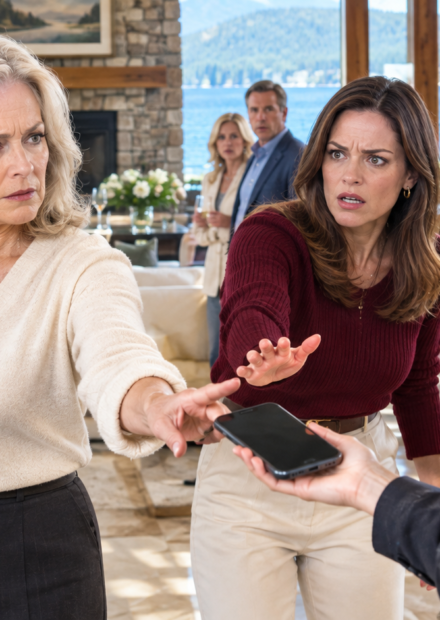
Madison was waiting when we returned to the lobby.
She had moved closer to the front desk, where the concierge was speaking with Marcus. The moment she saw Daniel’s expression, her eyes narrowed.
“What happened?”
Daniel looked at her.
“Madison, we need to talk.”
“Of course we do.”
She smiled at me.
It was the same smile she had worn when she suggested a motel.
But it was no longer convincing.
Not to me.
Not to Marcus.
Perhaps not even to Daniel.
I said, “You have a document in your handbag.”
Her smile disappeared.
Daniel took a step backward.
Madison’s eyes flashed toward him.
“What document?”
“The one you want me to sign.”
She looked at Daniel again.
He didn’t speak.
Her face changed.
It was not fear.
Not yet.
It was anger.
The anger of someone who had believed she could manage the flow of information and had suddenly discovered that the information was moving without her permission.
“Daniel,” she said quietly, “did you tell her?”
He looked at the floor.
I felt something inside me settle.
Not because I had won.
Because I had finally seen the shape of the battle.
Madison turned toward me.
“Elaine, this is not the place for this conversation.”
“You chose the place.”
“I was trying to arrange a family discussion.”
“You arranged a public humiliation.”
Her cheeks flushed.
“That’s absurd.”
“Then show me the document.”
She said nothing.
I held out my hand.
“Now.”
The lobby seemed to grow quieter.
A man near the fireplace turned his head.
The concierge stopped typing.
Marcus stood perfectly still beside the desk.
Madison looked at my extended hand.
Then at Daniel.
Then at the elevator.
For the first time since we arrived, she seemed to understand that she might not be able to leave the situation simply by walking away.
“It’s a private document,” she said.
“Then you can show it to me privately.”
“I don’t have to explain my personal affairs to you.”
“Not your personal affairs.”
I took one step closer.
“If it concerns property I own, you do.”
Her eyes hardened.
“You don’t own everything.”
“No.”
I glanced toward the bronze plaque.
“But I know what I own.”
Daniel’s head lifted.
Madison followed my gaze.
Her expression changed.
Just slightly.
But enough.
I knew then that she had been told something about the lodge.
Something incomplete.
Something that had made her believe I no longer had control.
I turned toward Marcus.
“Please arrange a room for me.”
“Of course.”
“And have someone bring my luggage upstairs.”
Madison let out a short, incredulous laugh.
“You’re staying?”
I looked at her.
“Yes.”
She shook her head.
“This is unbelievable.”
“No,” I said. “What’s unbelievable is that you brought me hundreds of miles to a resort my family founded, then expected me to beg for a place to sleep.”
Her lips parted.
No words came.
I turned away.
For the first time that evening, I walked through the lobby without feeling like a woman who had been abandoned.
I walked like someone who had remembered where she stood.
But as I reached the elevators, my phone began to ring.
The screen showed a number I didn’t recognize.
I almost ignored it.
Then I saw the area code.
It was from the same state where the lodge’s legal offices were located.
I answered.
“Hello?”
A man’s voice said, “Mrs. Caldwell, my name is Richard Hale. I’m an attorney representing a group that has been in contact with your daughter-in-law.”
I stopped walking.
Behind me, I heard Madison say my name.
Richard continued.
“We need to discuss an urgent matter regarding Silver Pines Lodge.”
I looked at the bronze plaque one more time.
And understood that the five words engraved beneath its name were only the beginning.