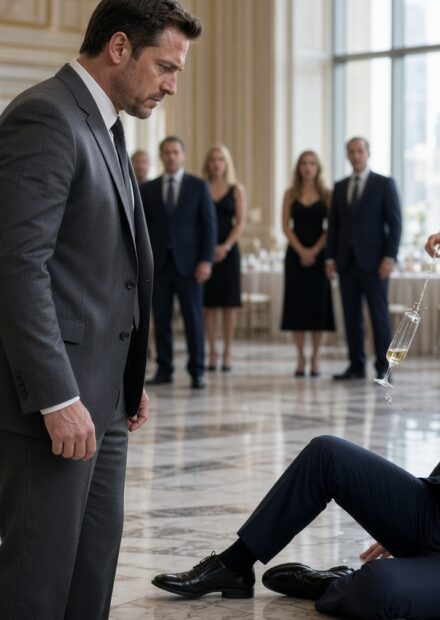
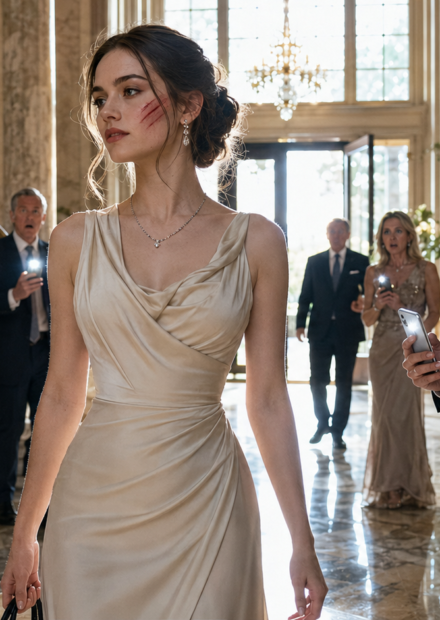
SHE KICKED THE MAID — THEN THE TRUTH ABOUT HER IDENTITY SHOCKED EVERYONE
Chapter 5 – THE WOMAN WHO STOOD UP
The next three months destroyed several empires.
Richard Vale’s collapsed first.
Accounts were frozen in four countries.
Two of his companies suspended operations.
Three executives resigned.
A former attorney turned over records.
Regulators opened investigations.
Prosecutors began interviewing people whose names had appeared in the basement files.
Politicians denied knowing him.
Business partners claimed they had always been suspicious.
People who had smiled beside him in photographs suddenly couldn’t remember ever having dinner with him.
Power is strange that way.
When someone is strong, everyone claims closeness.
When they fall, everyone claims distance.
Richard Vale disappeared for nine days.
Then authorities located him at a private property outside the country.
His attorneys insisted the accusations were politically motivated.
Nobody believed them.
Not anymore.
The documents were too detailed.
Payments matched dates.
Accounts matched companies.
Photographs matched meetings.
Victor hadn’t released one dramatic piece of evidence.
He had released a structure.
Years of transactions layered so carefully that any single page meant little.
Together, they told the story.
That was how real secrets worked.
Rarely one smoking gun.
Usually a thousand small decisions.
A thousand small lies.
A thousand people assuming nobody would ever arrange the pieces correctly.
Victor remained under investigation himself.
He had committed crimes.
Blackmail.
Illegal access.
Coercion.
Possession of stolen records.
Whatever his motives, he wasn’t a hero.
That mattered to me.
People wanted simple stories.
Victor either villain or savior.
Vanessa either monster or victim.
Daniel either foolish fiancé or wronged billionaire.
Me either abused maid or hidden warrior.
Reality resisted simplicity.
Victor had helped expose Richard Vale.
He had also manipulated people.
Vanessa had been threatened.
She had also betrayed Daniel and assaulted me.
Daniel had trusted someone he loved.
He had also ignored signs because love made him hopeful.
And me?
I had protected people for eight years because saving others felt easier than forgiving myself.
Everyone carried more than one truth.
The media discovered my identity within forty-eight hours.
Not every detail.
But enough.
Former private protection specialist.
Witness-security contractor.
Survivor of an eight-year-old convoy attack.
The mysterious maid wasn’t a maid.
That headline appeared everywhere.
I hated it.
Because I had been a maid.
For six weeks, I cleaned rooms.
Changed sheets.
Carried trays.
Scrubbed spilled makeup from marble.
I had worn the uniform.
The job had been real even if the reason wasn’t.
People kept saying Vanessa had kicked “the wrong maid.”
I understood what they meant.
But the phrase bothered me.
There shouldn’t have been a right maid to kick.
There shouldn’t have been a version of that moment where Vanessa’s behavior became acceptable simply because the woman she targeted couldn’t catch her foot.
A reporter asked me about that outside the courthouse two weeks later.
“Do you think Ms. Vale would have kicked you if she knew your true background?”
I stopped.
Cameras turned.
I said, “That’s not the question.”
The reporter blinked.
“What is?”
“Why did she think it was acceptable because she believed I was only a maid?”
That clip spread farther than the original kick.
Vanessa saw it.
She sent me a message that night.
You were right.
I didn’t respond.
Not because I wanted to punish her.
Because some conversations shouldn’t happen until both people know why they’re having them.
Vanessa disappeared from public life.
Her social media accounts went silent.
Her sponsorships vanished.
Several charities removed her name.
The invitations stopped.
So did the photographers.
For a woman who had lived in public, invisibility became punishment.
Or freedom.
I wasn’t sure which.
Daniel didn’t speak about her often.
When he did, there was no anger left in his voice.
Only disappointment.
That worried me more.
Anger has energy.
Disappointment is what remains when the future you imagined finally stops arguing for its existence.
One afternoon, about six weeks after the press conference, Daniel asked me a question while we walked through the Sterling Grand.
“Do you think she loved me?”
I stopped.
He was staring at the staircase where the photograph had fallen.
“I think she believed she did.”
“That’s not the same answer.”
“No.”
He looked at me.
“What do you think love is?”
I almost laughed.
“You’re asking the wrong person.”
“Why?”
“Most relationships in my career involved someone paying me to stand between them and a bullet.”
“That doesn’t answer the question.”
I looked toward the ballroom.
Empty now.
No flowers.
No cameras.
Just workers replacing a section of damaged flooring.
“I think love requires allowing someone to make choices with the truth.”
Daniel was quiet.
Then he nodded.
“She never gave me that.”
“No.”
He looked down.
“Neither did I.”
I frowned.
“What do you mean?”
“I knew she was frightened.”
“Not why.”
“I knew something was wrong.”
“That isn’t the same as knowing.”
“I could have asked harder.”
“You did ask.”
“Not enough.”
I understood what he was doing.
Trying to find the place where her betrayal became partly his responsibility.
I recognized the pattern.
I had lived inside it for eight years.
“Daniel.”
He looked at me.
“Don’t take ownership of someone else’s decisions because the pain feels easier if you can blame yourself.”
He stared.
I heard the words after I said them.
So did he.
A strange smile appeared on his face.
“That sounds like advice you should take.”
I looked away.
“I know.”
That night, I listened to the recovered audio from the convoy.
Victor’s attorney had turned it over during the investigation.
I almost refused.
Then I realized refusing would mean allowing my memory to remain the only evidence.
I sat alone in my apartment.
No lights.
Headphones on.
The recording began with static.
My younger voice.
“Route change confirmed.”
Then another agent.
Then Elena.
She was joking about coffee.
I had forgotten that.
I had forgotten how normal the first minutes were.
The human mind is cruel.
Trauma edits memory.
It removes ordinary details and leaves only impact.
But there she was.
Laughing because I had told her the safe house coffee could dissolve metal.
Then the first warning.
A voice over radio.
Vehicle behind us.
My voice changed.
Calm.
Focused.
Professional.
Then gunfire.
I almost pulled the headphones off.
I forced myself to continue.
Tires.
Metal.
Shouting.
The vehicle rolled.
Then breathing.
Mine.
Elena’s.
I heard myself telling her to stay awake.
“Naomi.”
Her voice.
Weak.
“I’m here.”
“Go.”
“I’m not leaving you.”
“Go.”
“I can get you out.”
Then more gunfire.
Closer.
Elena grabbed something.
Probably my wrist.
“Run.”
The word was unmistakable.
Not accusation.
Not blame.
A command.
A gift.
Run.
I pulled off the headphones.
For a long time, I sat in darkness.
Then I cried.
Not dramatically.
No screaming.
No collapsing.
Just eight years of grief finally finding a place to go that wasn’t guilt.
I cried for Elena.
For the twenty-four-year-old woman I had been.
For the years I spent thinking survival meant failure.
For every assignment I accepted because I thought if I saved enough people, eventually the math might balance.
It never would.
You can’t repay one dead person by saving strangers.
Life doesn’t keep accounts that way.
Three months after the engagement party, I returned to the Sterling house.
Not as a maid.
Not officially as security either.
Daniel had offered me both absurd amounts of money and an even more absurd title.
“Director of Strategic Security.”
I told him it sounded like something printed on a door nobody wanted to enter.
He said that was the point.
I hadn’t accepted.
Not yet.
The investigation was still active.
I had spent weeks answering questions, reviewing records, identifying names, and rebuilding pieces of an eight-year-old case.
For the first time in my adult life, I had no assignment waiting.
That terrified me more than gunfire.
Work had always given me direction.
Protect this person.
Secure this building.
Watch this exit.
Get everyone home.
Without a mission, I had to decide what I wanted.
I wasn’t used to wanting things.
Daniel found me on the terrace after sunset.
The city stretched below us.
Lights scattered across the darkness.
Wind moved through the trees in the courtyard.
“You still do that,” he said.
I didn’t turn.
“Do what?”
“Check exits.”
“There are three.”
“Four.”
I glanced at him.
He pointed toward a narrow maintenance stair partially hidden behind climbing ivy.
I stared.
He smiled.
“I’ve been learning.”
“That one barely counts.”
“It exits the terrace.”
“Into a locked service corridor.”
“Still an exit.”
I shook my head.
He sat beside me.
For a while, neither of us spoke.
Silence with Daniel had never felt uncomfortable.
Maybe because he didn’t constantly demand to be entertained.
Eventually, he said, “I owe you an apology.”
“For what?”
“For the first six weeks.”
I looked at him.
“You didn’t kick me.”
“Low standard.”
“Fair.”
His expression became serious.
“I knew you were staff.”
“Technically.”
“I mean I saw the uniform first.”
I waited.
“I was polite. I knew your name. I told myself that meant I treated people well.”
“You did better than most.”
“That’s not the same as good enough.”
He looked toward the city.
“I didn’t wonder about you.”
“What was there to wonder?”
“Who you were.”
I said nothing.
He continued.
“I never asked where you came from. What you wanted. Why you sometimes stared at reflective windows instead of the people speaking to you.”
I smiled faintly.
“You noticed that?”
“Eventually.”
“You were busy.”
“That sounds like an excuse.”
“It is.”
He laughed quietly.
Then looked at me.
“Do you regret coming here?”
I considered the question.
The humiliation.
The kick.
Victor.
The records.
Elena’s voice.
Vanessa crying at the podium.
Daniel learning the person he planned to marry had betrayed him.
The old wound reopening.
The truth underneath it.
“No.”
“Why?”
“Because if I hadn’t come here, I’d still believe the wrong story.”
“What story?”
“That I failed.”
Daniel’s expression softened.
I looked down at my hands.
“They were always steady.”
“What?”
“My hands.”
I held them up.
“I used to be proud of that. No matter what happened, my hands never shook.”
“They do now?”
“Sometimes.”
“Is that bad?”
I thought about it.
“No.”
That surprised me.
For years, control had been my proof that I was functioning.
If my voice stayed calm, I was fine.
If my hands stayed steady, I was fine.
If I could identify exits, threats, distances, and options, I was fine.
Maybe being fine wasn’t the goal anymore.
Maybe being honest was.
Daniel leaned back.
“Are you going to take the job?”
“The terrible title?”
“I can change the title.”
“Please.”
“What do you want?”
The question hit me differently than it should have.
Not what work.
Not what salary.
What do you want?
I looked toward the skyline.
“I don’t know.”
“That’s allowed.”
“Is it?”
“I hope so.”
I smiled.
For the first time in eight years, uncertainty didn’t feel like danger.
It felt like space.
Daniel reached into his pocket.
My body tensed automatically.
He stopped.
“Phone.”
“Sorry.”
“You really are impossible to surprise.”
“That’s the idea.”
He handed me the screen.
A news article showed Vanessa leaving a courthouse.
No makeup.
No designer dress.
She had testified before investigators that morning.
Her statement implicated her father’s former attorney and confirmed several account names.
“She testified,” Daniel said.
“I know.”
“You’ve been following it.”
“I follow everything.”
“Of course.”
He put the phone away.
“Do you think she’ll be okay?”
I looked at him.
“Do you want her to be?”
He took time before answering.
“Yes.”
That told me something about Daniel.
Maybe more than any conversation we’d had.
Vanessa had hurt him deeply.
He still didn’t want her destroyed.
“She’ll have to build a life that doesn’t depend on the one her father built,” I said.
“Hard.”
“Yes.”
“But possible.”
“Yes.”
He nodded.
“What about you?”
“What about me?”
“Same question.”
I frowned.
“Can you build a life that isn’t based on the attack?”
The wind moved across the terrace.
A month earlier, I would have become defensive.
Instead I looked out over the city.
“I’m trying.”
“Good.”
We sat without talking.
For the first time in years, I didn’t feel as if I were waiting for the next assignment.
Or the next threat.
Or the next sound behind me.
I didn’t feel like a protector.
I didn’t feel like a survivor.
I felt like myself.
I had almost forgotten what that meant.
Then my phone buzzed.
One message.
Unknown number.
I opened it.
Four words.
YOU THINK IT’S OVER.
My entire body went still.
Daniel noticed immediately.
“What is it?”
I stared at the screen.
No number.
No identifier.
No attachment.
Just the sentence.
Three months ago, those words would have thrown me directly back into survival mode.
Heart racing.
Every exit calculated.
Every face suspicious.
The old certainty returning.
Danger meant movement.
Fear meant control.
Instead, I read the message twice.
Then locked the phone.
“Naomi?”
I stood.
Daniel rose too.
“What happened?”
I looked at the terrace doors.
Then the windows.
Then the city beyond the railing.
Somewhere out there was another person who believed fear could move me wherever they wanted.
Maybe the message came from one of Vale’s people.
Maybe from someone exposed in the released documents.
Maybe from someone who had spent eight years believing I was a loose end.
I didn’t know.
But there was one thing I knew now that I hadn’t known the night Vanessa kicked me.
My fear wasn’t evidence of weakness.
And it wasn’t an order.
A threat didn’t always arrive carrying a weapon.
Sometimes it came as a whisper.
Sometimes a photograph.
Sometimes a lie repeated long enough that you mistook it for memory.
Sometimes it came from someone you loved.
Sometimes from someone you feared.
Sometimes from inside your own head.
And sometimes it waited patiently until you finally believed you were safe.
Daniel stepped closer.
“Naomi?”
I looked at the phone one last time.
Then at him.
He could see the change in my face.
“What did it say?”
I handed him the phone.
He read the message.
His expression hardened.
“Security.”
“No.”
He looked at me.
“No?”
“We’ll tell them.”
“Then why did you say no?”
“Because we’re not panicking.”
A faint understanding entered his expression.
“What are we doing?”
I smiled.
Not because I wasn’t afraid.
I was.
Fear was there.
Cold and familiar.
But it didn’t own the room anymore.
It didn’t own my hands.
It didn’t own my choices.
“First, we find out where it came from.”
Daniel looked at me.
“And then?”
I thought about the ballroom.
The kick.
The black envelope.
The photograph.
Victor.
Elena.
Vanessa standing behind the podium and choosing the truth when fear told her to keep lying.
I thought about the woman I had been eight years ago.
The woman who believed surviving meant failing.
I thought about the woman I was now.
Still cautious.
Still scarred.
Still learning.
But no longer carrying crimes that belonged to other people.
“Then,” I said, “we find out who sent it.”
Daniel nodded.
Together, we walked toward the doors.
Halfway inside, I stopped.
He glanced back.
“What?”
I looked at my reflection in the dark glass.
For years, I had hated reflections.
They showed what stood behind you.
That was useful in my work.
It was also a habit built around expecting danger.
Tonight, for the first time, I looked at the woman in the glass instead.
No uniform.
No blood.
No frightened twenty-four-year-old trapped on a road eight years ago.
Just me.
Naomi Carter.
The woman Vanessa Sterling had once believed was invisible.
The woman Richard Vale had once believed was disposable.
The woman Victor Hale had once believed was dead.
They had all been wrong.
I turned away from the reflection.
Daniel held the door open.
I walked through.
And for once, I wasn’t walking back inside because someone needed protection.
I wasn’t walking toward guilt.
I wasn’t walking toward the past.
I was walking toward an answer.
My answer.
My choice.
My life.
Behind us, the terrace doors closed.
Ahead of us, the house was quiet.
Somewhere in that silence waited another secret.
Maybe another enemy.
Maybe another lie.
I didn’t know.
But I knew something more important.
This time, whatever came next would not meet the woman who spent eight years believing she had failed.
It would meet the woman who finally knew the truth.
And I was done lowering my eyes.