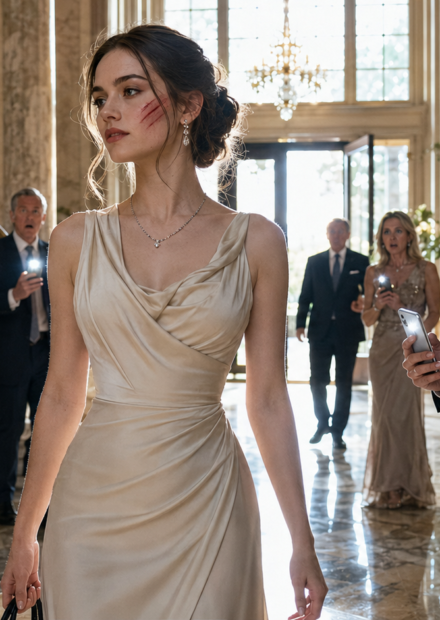
The House They Thought Was His Mother Slapped Me at Dinner. Then the Deed Came Out
Chapter 5 – WHAT BELONGED TO ME
I filed for divorce seven weeks after the dinner.
Not the morning after.
Not in rage.
Not because Thomas told me to.
Not because Marian deserved punishment.
I filed because, after seven weeks of sleeping alone in the house everyone had called Evan’s, I finally understood what I was grieving.
It was not the marriage we had.
It was the marriage I kept waiting for us to become.
The one where Evan would eventually set boundaries without me begging.
The one where Marian would eventually respect me because I had earned enough years.
The one where I could keep giving and still somehow not disappear.
I loved that imagined marriage.
It had never fully existed.
When I told Evan, we were sitting in Thomas’s conference room again.
Not because I feared him anymore.
Because difficult truth had begun there, and I wanted the ending to be equally clear.
Evan read the first page.
His eyes filled.
“So that’s it?”
“Yes.”
He looked at me.
“I thought we were making progress.”
“We are.”
He frowned.
“Then why?”
“Because your progress matters even if I do not remain your wife.”
He stared down at the papers.
“I don’t understand.”
“I believe you’re changing.”
“Then give me a chance.”
“I gave us six years.”
“That’s not fair.”
“You’re right.”
He looked up, surprised.
I continued.
“Marriage is not a reward you earn after enough therapy appointments. I don’t want to spend the next five years measuring whether you have changed enough for me to feel safe speaking in my own home.”
His jaw trembled.
“I never hit you.”
“I know.”
“Then why are you using the word safe?”
“Because safety isn’t only about whether someone’s fist reaches you.”
He looked away.
“I spent years calculating your mother’s reaction before making ordinary decisions.”
He closed his eyes.
“I spent years asking whether saying no would create another argument with you.”
My throat tightened.
“And the night she hit me, you told me that was how I was supposed to learn.”
He covered his face.
“I hate myself for saying that.”
“I know.”
“I don’t believe it.”
“I know.”
“Then why can’t that matter?”
“It does.”
I reached across the table.
For the first time since the dinner, I touched him voluntarily.
I placed my hand over his.
“It matters enough that I believe you’ll be better after this.”
He began crying.
“But I don’t want to remain married while waiting to find out.”
We sat like that for a long time.
Eventually Evan nodded.
“Are you keeping Ridgeview?”
I almost smiled.
“Yes.”
He let out a broken laugh.
“Stupid question.”
“Not stupid.”
He looked toward the window.
“I don’t want anything from the house.”
“The lawyers will handle property.”
“No.”
He turned back.
“I signed those documents. It’s yours.”
The old shame passed through his face.
“I think maybe I need to say that one more time.”
I waited.
“Ridgeview is yours.”
Not ours.
Not his.
Mine.
The words did not make me happy.
They made me tired.
“Thank you.”
The divorce was not dramatic.
That surprised nearly everyone who knew about the dinner.
People wanted a battle because the beginning had been spectacular.
There was no battle.
Evan retained his own attorney.
The house remained mine.
We divided the joint accounts.
He kept his retirement assets.
I kept mine.
Furniture was negotiated with the depressing practicality of two adults assigning ownership to objects that had once seemed inseparable from a shared life.
Evan wanted the leather chair in the study.
I let him take it.
I kept the dining table.
Not out of spite.
Because I had chosen it before we met.
Marian did not interfere.
That may have been the biggest proof of change in the entire family.
She sent me one message the day the divorce became final.
I am sorry for the part I played in ending something you once loved.
I stared at it for a long time.
Then replied.
Thank you for saying that.
Nothing more.
Nothing less.
Some relatives disappeared from my life completely.
That was fine.
Others surprised me.
Uncle James began sending Christmas cards addressed only to Rachel.
Beth called every few months.
Once she said, “I still feel ashamed that I looked away.”
I could have made her suffer.
Instead, I told the truth.
“You should.”
She went quiet.
Then I added, “But you don’t have to stay ashamed forever. Just don’t look away next time.”
She cried.
I almost did too.
People like to imagine courage arrives fully formed.
Most of the time, it arrives after regret.
I could live with that.
Thomas remained part of my life, though he grew tired of being introduced as “the man with the folder.”
“That is not a professional title,” he complained one evening at a charity dinner.
“It should be.”
“I have forty-two years of legal experience.”
“And one very memorable entrance.”
He shook his head.
I laughed.
It felt good.
Real laughter.
Not relief.
Not bitterness.
Months passed.
Ridgeview changed.
At first, I thought I needed to erase Evan from it.
I moved his books.
Rearranged the bedroom.
Repainted the hallway.
Then I stopped.
The house did not need to become proof that he had never existed.
He had.
We had been happy here sometimes.
Those memories were not lies simply because the marriage ended badly.
I kept the photograph from our trip to Colorado because I still liked the mountains.
I donated our wedding portrait because I did not want it above the stairs.
I turned Evan’s office into a reading room.
I kept the coffee machine he bought me.
Healing turned out to be less about purging and more about choosing.
What stayed.
What left.
What still belonged.
A year after the dinner, Marian asked whether she could speak with me.
We met at a café.
Neutral ground.
She had changed her hair.
Shorter.
Softer.
For some reason, that made me smile.
“What?” she asked.
“Nothing.”
“You always say nothing when there is clearly something.”
“Your hair looks nice.”
She touched it self-consciously.
“Thank you.”
We drank coffee.
For fifteen minutes, we discussed ordinary things.
Then Marian said, “Evan is seeing someone.”
My chest tightened unexpectedly.
Not devastation.
A small ache.
“Okay.”
“He didn’t want me to tell you.”
“Then why are you?”
She smiled sadly.
“Apparently I’m still learning boundaries.”
I laughed before I could stop myself.
So did she.
It was the strangest sound.
Two women who had once stood in a dining room ready to destroy each other, laughing over a mistake neither would have tolerated a year earlier.
“I’m sorry,” she said.
“It’s fine.”
“No. It’s not my information.”
“Correct.”
She nodded.
“See? Learning.”
We were quiet.
Then she said, “He talks about you kindly.”
I looked down at my cup.
“I hope he does.”
“He says losing you forced him to understand things he should have learned years earlier.”
“Good.”
“Do you ever wish—”
She stopped.
I waited.
Marian shook her head.
“Never mind.”
“No. Ask.”
“Do you ever wish you had stayed?”
The question was not manipulative.
That mattered.
I thought about it.
“Sometimes I miss him.”
She nodded.
“That’s not the same thing.”
“No.”
“I miss who we were before everything got so complicated.”
“Do you regret the divorce?”
I looked through the café window.
“No.”
The answer came easily.
That surprised me.
“I regret that it became necessary.”
Marian’s eyes filled.
“I understand.”
Before leaving, she said, “Thank you for allowing me to apologize.”
I almost corrected her.
Then realized she had chosen the word allowing carefully.
Access.
Permission.
Consent.
She had learned too.
“You’re welcome.”
We hugged.
Briefly.
Not mother and daughter.
Not family exactly.
Two women who had hurt each other unequally and managed to stand in the same room without pretending history had changed.
That was enough.
On the anniversary of the dinner, I hosted another meal at Ridgeview.
Not intentionally at first.
Thomas mentioned it when he saw the date on the invitation.
“You have an interesting sense of humor.”
I checked the calendar.
Then laughed.
“Apparently.”
This dinner was smaller.
Twelve people.
Friends.
Business partners.
My sister and her husband.
Thomas.
Beth, surprisingly.
I hired a caterer.
That felt important.
At seven, I sat down with everyone else.
No running between kitchen and dining room.
No proving I could do everything.
No one ordering me around.
Halfway through the meal, my sister lifted her wineglass.
“To Rachel.”
I narrowed my eyes.
“Why?”
“Because I want to make a toast.”
“That usually answers nothing.”
Everyone laughed.
She continued.
“To a woman who finally learned that owning the house is less important than owning her choices.”
The table became quiet.
I looked at her.
“That’s annoyingly sentimental.”
“You love it.”
“I do.”
We raised our glasses.
Later, after everyone left, I stood alone in the dining room.
The same chandelier glowed overhead.
The same walnut doors stood closed.
The same table stretched across the room.
For a moment, I could see the other dinner layered over this one.
Marian raising her hand.
My body hitting the floor.
Faces turning away.
Evan leaning back.
She’s teaching you how you’re expected to behave in this family.
I walked to the place where I had set down my ring.
Nothing marked it.
Of course not.
Furniture does not remember humiliation.
People do.
I placed my palm flat against the wood.
For months, I had thought the most important moment that night was Thomas opening the folder.
The deed.
The signature.
The sudden silence when everyone learned I owned Ridgeview.
It made a wonderful story.
People loved that part.
The arrogant family discovered the mistreated wife owned the mansion.
Perfect reversal.
Perfect justice.
But with time, I understood that was not the moment that saved me.
The deed did not save me.
Ownership did not save me.
Thomas did not save me.
The most important moment happened before those doors opened.
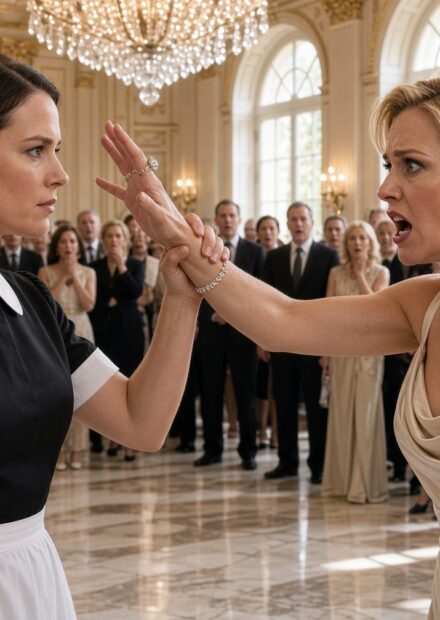
It happened when Marian raised her hand a second time.
I caught her wrist.
“Never put your hands on me again.”
That was the first boundary I enforced without checking Evan’s face to see whether he approved.
Then I removed my ring.
Then I said I was finished.
Thomas only brought paper proving something I already knew.
Ridgeview belonged to me.
The harder truth was that I belonged to me too.
I walked toward the windows.
Outside, the lawn disappeared into darkness beyond the terrace lights.
The house was quiet.
Not lonely.
Quiet.
There is a difference.
My phone buzzed.
A message.
Evan.
For months after the divorce, we had communicated only about paperwork.
Then occasionally birthdays.
A holiday.
Nothing intimate.
The message read:
I realized what tonight is. I’m sorry again.
I stared at the screen.
Then another message appeared.
Not asking for anything. Just sorry.
I sat down.
A year earlier, those words would have opened every wound.
Now they simply existed.
I typed:
I know. I hope you’re doing well.
His reply came a minute later.
I am. Therapy helped. Mom too, believe it or not.
I smiled.
That I believe less.
Three dots appeared.
Then:
You were right about something.
I waited.
The next message arrived.
I thought being the man of the house meant people had to believe the house was mine. I didn’t understand that being your husband should have meant protecting the person beside me, regardless of whose name was on anything.
My throat tightened.
I read it twice.
Then I looked around Ridgeview.
For years, Evan had wanted ownership because he thought ownership proved manhood.
Marian had wanted authority because she thought motherhood entitled her to obedience.
I had wanted peace so badly that I confused silence with generosity.
We had all given ordinary words dangerous meanings.
Family.
Respect.
Home.
Marriage.
Mine.
Ours.
I typed slowly.
I’m glad you understand now.
He replied:
Me too. I wish I had understood when it mattered.
I did not answer that.
Some truths deserve to remain where they land.
I set down the phone.
Then I walked through the house.
Past the living room.
Past the staircase.
Past the reading room that used to be Evan’s office.
I stopped at the front door.
The locks had been changed after the divorce.
Not because I expected anyone to break in.
Because I wanted to decide who had keys.
My sister had one.
Thomas had an emergency copy.
My housekeeper had another.
Marian did not.
Evan did not.
No one received one because of a title.
Not husband.
Not mother.
Not family.
Access was given.
Not assumed.
I turned off the foyer light.
Before going upstairs, I glanced once more toward the dining room.
People sometimes ask what happened to the sealed document.
I kept it.
Not framed.
Not displayed.
Nothing dramatic.
It sits in a fireproof box beside the deed.
Evan’s signature remains at the bottom.
Proof that he always knew Ridgeview was mine.
But that is not why I keep it.
I keep it because it reminds me how easy it is for people to know a fact and still behave as if the opposite is true when everyone around them cooperates.
Evan knew.
I knew.
Thomas knew.
County records knew.
Still, Marian spent six years calling Ridgeview her son’s home because nobody corrected her strongly enough.
A lie does not always require someone to invent a false story.
Sometimes it only requires enough people to benefit from silence.
That was the real lesson.
Not that I secretly owned a beautiful house.
There was nothing secret about the deed.
Not that my mother-in-law was humiliated in front of relatives.
Humiliation was never the goal.
Not even that my husband lost a marriage because he chose his mother.
Life was more complicated than that.
The lesson was simpler.
When someone tells you that keeping the peace requires you to shrink, examine whose peace you are protecting.
When someone says, “That’s just how she is,” ask why that means everyone else has to change.
When love requires you to pretend facts are different so another person can feel bigger, love is already being asked to carry something it should not.
And when somebody teaches you how you are “expected to behave” by humiliating you, frightening you, striking you, or silencing you, you are allowed to reject the lesson.
Even if everyone in the room looks away.
Especially then.
I went upstairs.
In my bedroom, I opened the jewelry drawer.
For months, my wedding ring had sat inside a small velvet box.
I had not known what to do with it.
Sell it.
Keep it.
Give it away.
That night, I took it downstairs.
I stood on the back terrace beneath the cool evening air.
For a dramatic second, I considered throwing it into the pond.
Then I laughed at myself.
Diamonds are expensive.
Healing does not require poor financial decisions.
The next week, I sold it.
I used part of the money to fund a local legal-aid program for women needing help with housing and family-property disputes.
The rest I spent on something completely unnecessary.
A long table for the back terrace.
Not because I needed another table.
Because I wanted one I chose after the marriage.
The first dinner I hosted there was in spring.
Twelve friends.
No relatives who expected service.
No one sitting while I ran around the kitchen.
Everyone brought something.
Thomas brought wine.
My sister brought dessert.
Beth arrived carrying flowers and asked me where she should put them.
“Wherever you like,” I said.
Then I stopped.
We both laughed.
“No,” I corrected. “Actually, ask me first.”
“May I put them on the sideboard?”
“You may.”
Thomas shook his head.
“You people are ridiculous.”
“Boundaries, Thomas.”
“Yes, yes. Very fashionable.”
We laughed.
As the sun disappeared behind the trees, I looked at the people around my table.
Nobody cared whose name was on the deed.
Nobody needed the house to prove anything about themselves.
They were there because I invited them.
Because I wanted them.
That was what home was supposed to feel like.
Not control.
Not entitlement.
Not a family hierarchy.
Choice.
I thought about the night Marian slapped me.
For years afterward, I knew people would tell the story in the most satisfying order.
She hit Rachel.
Evan did nothing.
Rachel removed her ring.
The lawyer arrived.
The deed came out.
The house was hers.
Evan’s signature proved he knew.
His family was stunned.
Justice.
But I know the part that mattered most.
Nobody came to help me when I fell.
So I stood up myself.
I looked at the man I loved and finally believed what his silence was telling me.
I caught the second hand before it reached me.
I took off the ring.
I said, “I’m finished.”
Everything after that was paperwork.
Necessary paperwork.
Powerful paperwork.
But paperwork nonetheless.
The decision came first.
That is what I remember whenever I walk through Ridgeview now.
Not that I won the house.
I had never lost it.
I won back the right to live inside it without asking anyone else’s permission to be respected.
And that turned out to be worth more than every room they once thought belonged to him.