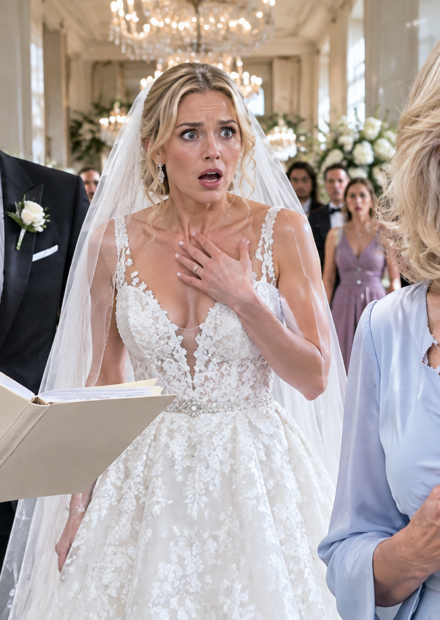
Chapter 5 – WHAT HAPPENS AFTER THE TRUTH
People imagine that when a secret is exposed, everything becomes simple.
It doesn’t.
Truth is not a magic spell.
It doesn’t repair eight lost months.
It doesn’t make a terrified child trust adults again overnight.
It doesn’t restore muscles weakened by injury.
It doesn’t erase paperwork, appointments, arguments, or consequences.
It only gives you solid ground to start from.
And after Ryan’s wedding collapsed, that was what we finally had.
Solid ground.
Vanessa ended the marriage before it truly began.
Whatever legal status the ceremony ultimately had became something for attorneys to sort out, especially once the truth about Emily became impossible to ignore.
Vanessa contacted me once.
Only once.
Her message was short.
She said she hadn’t known Emily was alive.
She apologized for what she had said to Lily.
She didn’t ask for forgiveness.
I respected that more than I expected to.
I never learned exactly when her relationship with Ryan crossed the line from friendship into something else.
Emily decided she didn’t need to know either.
Some answers change what you do next.
Others only give pain a more precise shape.
The important facts were already clear.
Ryan had planned to leave his wife.
Then she was catastrophically injured.
Instead of dealing honestly with a complicated marriage, her recovery, and their daughter, he built a lie that allowed him to step into a new life while Emily remained isolated.
Whether he told himself he was protecting Lily at first almost didn’t matter.
Eventually, he knew exactly what he was doing.
And when Lily kept asking for her mother, he didn’t correct the lie.
He punished her for refusing to make it comfortable.
That was the part Emily struggled with most.
Not Vanessa.
Not the wedding.
Not even the lie he told the world.
Lily.
“He made her grieve me,” she said one night.
We were sitting on the rehabilitation center patio three weeks later.
Lily had fallen asleep inside during a movie.
Emily was walking short distances with a cane now.
Her progress was fast enough that the therapists were optimistic, but not so fast that anyone pretended life would return exactly to what it had been.
“He made my daughter mourn me while I was twenty miles away.”
I didn’t know what to say.
So I didn’t say anything.
Emily stared out at the parking lot.
“I used to lie awake wondering why she wouldn’t come.”
I looked at her.
“I thought maybe Ryan was right. Maybe she saw me and got scared. Maybe she really was happier remembering me the way I used to be.”
“She never stopped asking for you.”
“I know that now.”
She wiped her cheek.
“But there were days I believed she had.”
That was Ryan’s real cruelty.
Not simply that he lied.
He made each of us doubt the love of the others.
He made Lily think her mother had disappeared forever.
He made Emily think her daughter was better without her.
He made me think my niece wanted nothing to do with the uncle who reminded her of the mother she had lost.
Isolation had been the mechanism.
Love was the thing he used against us.
The family-court process that followed was not dramatic in the way movies make such things dramatic.
There was no single speech that solved everything.
No judge banged a gavel and declared one person evil.
There were interviews.
Records.
Medical documentation.
Statements.
Questions about Ryan’s decisions.
Questions about Emily’s recovery.
Questions about what Lily had been told.
And questions about the slap at the wedding.
Several guests had witnessed it.
Some had recorded the moments afterward.
Ryan could no longer control the story because, for the first time, too many people had seen pieces of the truth themselves.
Lily spent most of that period with me while Emily prepared to leave inpatient rehabilitation.
For a man who had spent his adult life avoiding responsibility for anything that required glitter glue, packed lunches, or remembering school-theme days, becoming temporary full-time caretaker to a seven-year-old was humbling.
I learned three things quickly.
First, children wake up earlier on weekends than weekdays purely out of spite.
Second, ponytails are significantly more difficult than they appear.
Third, grief does not leave because the person you grieved turns out to be alive.
Lily still had nightmares.
Sometimes she woke crying because she dreamed Emily had disappeared again.
Other nights she crawled into the guest bed and asked me the same question.
“Mommy is still there, right?”
“Yes.”
“You talked to her?”
“Yes.”
“Today?”
“Three times.”
Then she would sleep.
For several weeks, she refused to let Emily out of her sight during visits.
If Emily went to physical therapy, Lily waited.
If Emily went to the restroom, Lily asked where she was going.
If a nurse wheeled Emily down another hallway, Lily followed until someone stopped her.
One afternoon, Emily finally understood.
She knelt carefully beside Lily.
“Bug.”
Lily looked up.
“I need you to listen.”
“Okay.”
“I am not going to disappear without telling you.”
Lily stared at her.
“Promise?”
“I promise.”
“What if you get hurt?”
“Then Uncle James tells you.”
Lily looked at me.
I nodded.
“What if you go to the hospital?”
“You get told.”
“What if you have to stay somewhere?”
“You get told.”
“What if Daddy says—”
She stopped.
Emily’s face changed.
“What if Daddy says what?”
Lily looked down.
“What if Daddy says you’re gone again?”
Emily took her hands.
“Then you ask to speak to me.”
“What if he says no?”
“Then you call Uncle James.”
Lily looked at me again.
“Even at night?”
“Especially at night.”
That finally made her smile.
A month later, Emily left the rehabilitation center.
She wasn’t ready to live entirely alone, so she and Lily stayed with me in Austin temporarily.
My two-bedroom house became a disaster within forty-eight hours.
There were crayons under my couch.
Physical-therapy bands hanging from a kitchen chair.
Three kinds of cereal on the counter because Lily insisted each one served a different emotional purpose.
Emily’s cane leaned beside the front door.
And every morning, I woke to the sound of mother and daughter talking in the kitchen.
Sometimes laughing.
Sometimes arguing.
Sometimes crying.
All of it sounded like life.
Ryan was permitted contact with Lily under conditions determined by the people handling the case, but rebuilding that relationship was slow.
Emily never told Lily to hate him.
Neither did I.
That surprised some people.
It surprised me, too.
But Lily loved her father.
Children can love someone who hurts them.
Adults can, too.
Pretending otherwise doesn’t help them heal.
What mattered was that Lily finally understood she was allowed to be angry.
Allowed to ask questions.
Allowed to love her mother without protecting her father from the consequences of his choices.
Months after the wedding, Ryan asked to speak with me alone.
I nearly refused.
Emily said, “Go.”
“Why?”
“Because you want to.”
“I want to punch him.”
“That is still technically wanting to see him.”
So I met him at a coffee shop halfway between Dallas and Austin.
He looked older.
Not ruined.
Not transformed into some storybook monster.
Just tired.
Human.
That almost irritated me more.
He stared into his coffee.
“I know you hate me.”
“I don’t spend enough time thinking about you to hate you every day.”
He nodded.
“I deserved that.”
“I didn’t come for your self-pity.”
“I want you to know I never meant for it to become this.”
I leaned back.
“What did you mean for it to become?”
He rubbed his face.
“At first, I told Lily Emily was too sick to visit.”
“I know.”
“She kept asking questions.”
“That’s what children do.”
“I couldn’t answer them.”
“So you told her Emily died.”
His eyes filled.
“Yes.”
“Why?”
“Because death was something I could explain.”
I stared at him.
“And recovery wasn’t?”
“Recovery had no end.”
For the first time, I understood the temptation he had surrendered to.
Emily’s situation had been uncertain.
Would she walk again?
Work again?
Live independently?
Remember everything?
Would their failing marriage survive?
Would Lily cope?
There had been no neat answer.
Death, by contrast, was final.
Clean.
A closed door.
Ryan had taken an uncertain reality and replaced it with a certainty that benefited him.
“That’s the difference between you and Emily,” I said.
He looked at me.
“She had to live with uncertainty. You decided you shouldn’t have to.”
Ryan looked down.
“I know.”
“No, I don’t think you did. Not then.”
He didn’t argue.
After a while, he said, “Does Lily hate me?”
I thought about my niece.
“No.”
His eyes lifted.
“But she doesn’t trust you.”
That hurt him.
It should have.
“Can she ever?”
“I don’t know.”
“What do I do?”
I almost laughed.
For once, Ryan was asking a question nobody could answer for him.
“You tell the truth.”
He nodded slowly.
“Even when it makes you look bad?”
“Especially then.”
We sat in silence.
Then he asked, “How is Emily?”
“Ask her when she decides she wants to hear from you.”
He nodded again.
I stood.
“James.”
I turned.
“I really did love her once.”
I looked at him for a long moment.
“I believe you.”
He seemed surprised.
Then I added, “That’s why what you did was worse.”
I left.
Almost a year after the wedding, Emily moved into a small house ten minutes from mine.
She still had occasional headaches.
Her left leg tired easily.
She kept lists because her memory wasn’t perfect.
But she was working part-time again.
Driving short distances.
Cooking terribly.
Laughing too loudly.
Being Emily.
On the anniversary of the phone call that brought her back into our lives, I went to her house for dinner.
Lily opened the door.
She was eight now.
“Uncle James!”
She hugged me, then immediately grabbed my wrist.
“Come see.”
She dragged me into the living room.
Pictures covered one wall.
Not expensive portraits.
Regular photographs.
Emily and Lily making pancakes.
Lily asleep beside her mother in a hospital chair.
Emily standing with her cane outside the rehabilitation center on discharge day.
The three of us at the zoo.
A terrible selfie of me wearing a princess crown.
And in the middle was the photograph Lily had carried out of Ryan’s wedding.
Emily holding her at the beach.
The frame still had a small crack in one corner from when Lily dropped it at the rehabilitation center.
I pointed to it.
“You kept the broken frame?”
Lily looked offended.
“Of course.”
“Why?”
She shrugged.
“Because it’s part of what happened.”
I looked at Emily.
She was standing in the kitchen doorway.
She smiled.
Later that night, after Lily went upstairs, Emily and I sat on the porch.
“You know what she asked me yesterday?” Emily said.
“What?”
“She asked if I wished the accident never happened.”
I turned toward her.
“What did you say?”
“The truth.”
“Which is?”
“Of course I wish it never happened.”
She looked toward the upstairs window.
“But I told her wishing something didn’t happen isn’t the same as wishing away everything that came after.”
I understood.
There was no gratefulness for the wreck.
No magical lesson that justified the pain.
Some things are simply terrible.
But what came afterward belonged to us.
The rebuilding.
The honesty.
The ordinary mornings.
The chance to know each other again.
“I spent eight months believing you were dead,” I said.
Emily nodded.
“I spent eight months believing you didn’t want me.”
We sat with that.
Then she reached over and squeezed my hand.
“But you answered the phone.”
I laughed softly.
“You called.”
“And you came.”
Inside, we heard Lily running down the stairs.
“Mom!”
Emily sighed.
“I told you to stay in bed.”
“I forgot something!”
She appeared in the doorway wearing pajamas covered in stars.
“What?”
Lily ran onto the porch and wrapped her arms around Emily.
“This.”
Emily closed her eyes.
Then she hugged her back.
“Okay. Now bed.”
Lily turned to me.
“You too.”
I opened my arms.
She hugged me.
Before going inside, she looked at both of us.
Her expression suddenly became serious.
“Mom?”
“Yes?”
“You’re going to be here tomorrow?”
Emily didn’t hesitate.
“Yes.”
“And Uncle James?”
“Unless your mother finally changes the locks.”
Emily rolled her eyes.
Lily smiled.
Then she ran upstairs.
I looked at my sister.
“She still asks?”
“Not every night.”
Emily stared toward the staircase.
“But sometimes.”
I nodded.
Maybe one day she wouldn’t need to.
Maybe some part of her always would.
Either way, she would get an answer.
A real one.
That was the promise we had all made after Ryan’s lie.
No more disappearing people.
No more comfortable stories replacing difficult truths.
No more teaching a child to doubt what she knew in her own heart.
Eight months after we were told Emily had died, Lily stood at her father’s wedding and screamed for her mother.
Ryan slapped her because he wanted the truth to stay quiet.
Instead, that was the moment everything became impossible to hide.
People sometimes ask me what I remember most about that day.
They expect me to say the slap.
Or Ryan falling onto the dance floor.
Or Vanessa’s champagne glass shattering after I said Emily was alive.
I remember all of those things.
But they aren’t what stayed with me.
What stayed with me happened hours later.
A seven-year-old girl ran down a plain rehabilitation-center hallway.
Her mother opened her arms.
And for the first time in eight months, nobody was standing between them with a lie.