PART 1: CHRISTMAS IN MY HOUSE
The first thing I saw was a Christmas tree glowing through my cabin window.
I hadn’t put one up.
For almost four years, I hadn’t put up a Christmas tree anywhere.
Not since Robert died.
I sat behind the wheel of my Subaru with the engine running,
staring through the windshield as snow drifted through the headlights.
The cabin stood where it always had, halfway up a wooded Blue Ridge slope, cedar siding dark against the white ground, chimney smoking into the December sky.
Except it didn’t look like my cabin.
Warm golden lights filled every downstairs window.
A wreath hung on the front door.
Colored bulbs had been wrapped around the porch rails.
Someone had even put Robert’s old wooden reindeer in the yard.
My wooden reindeer now.
I hadn’t seen them since the Christmas before he got sick.
For several seconds, I thought I had driven to the wrong house.
Then I saw the stone chimney Robert and I had spent one miserable August repairing ourselves because he’d insisted we were perfectly capable of doing masonry.
I saw the crooked porch post we’d always meant to replace.
I saw the brass number 142 on the mailbox.
My house.
My Christmas decorations.
Not my Christmas.
I turned off the engine.
That was when I noticed the cars.
Six of them.
None familiar.
A white Lexus.
A black SUV.
A silver Honda.
A pickup with Tennessee plates.
Two more cars crowded along the gravel turnaround.
My heart began beating faster, but not from fear.
Not yet.
Confusion came first.
Maybe Michael Reynolds had brought people to inspect the property.
But Michael was the property manager I’d hired only three weeks earlier, after finally deciding I was ready to rent the cabin instead of letting it sit empty most of the year.
He knew I was coming that afternoon.
He knew our inspection wasn’t scheduled until December twenty-sixth.
And Michael didn’t travel with six cars.
I stepped outside.
Cold air hit my face.
Somewhere inside the cabin, people were laughing.
I heard music too.
Christmas music.
Bing Crosby.
Robert’s favorite.
I stood beside my car listening to strangers laugh inside the mountain home my husband and I had owned for twenty-two years.
Then I heard someone shout, “Larry, don’t eat all the shrimp!”
More laughter.
I knew that voice.
Brenda Collins.
My daughter-in-law Sarah’s mother.
I walked toward the porch.
With every step, another detail appeared.
Two sleds leaned against the side of the house.
Boot prints covered the porch.
A plastic container full of firewood sat beside the door even though Robert’s old rack was less than six feet away.
Through the front window, I could see wrapped presents beneath the tree.
My tree.
It was the seven-foot artificial Douglas fir Robert and I had bought after our real tree shed half its needles before Christmas morning in 2013.
Someone had decorated it with our ornaments.
I could see the little ceramic cardinal Robert had bought me on our twenty-fifth anniversary.
The wooden train Jason had painted when he was eight.
The silver bell from our first Christmas after buying the cabin.
My hand went to the key in my coat pocket.
But before I used it, I tried the door.
Unlocked.
Of course it was.
I pushed it open.
Warm air, cinnamon, roasted meat, perfume, pine-scented candles, and voices rushed over me.
For one strange second, nobody noticed.
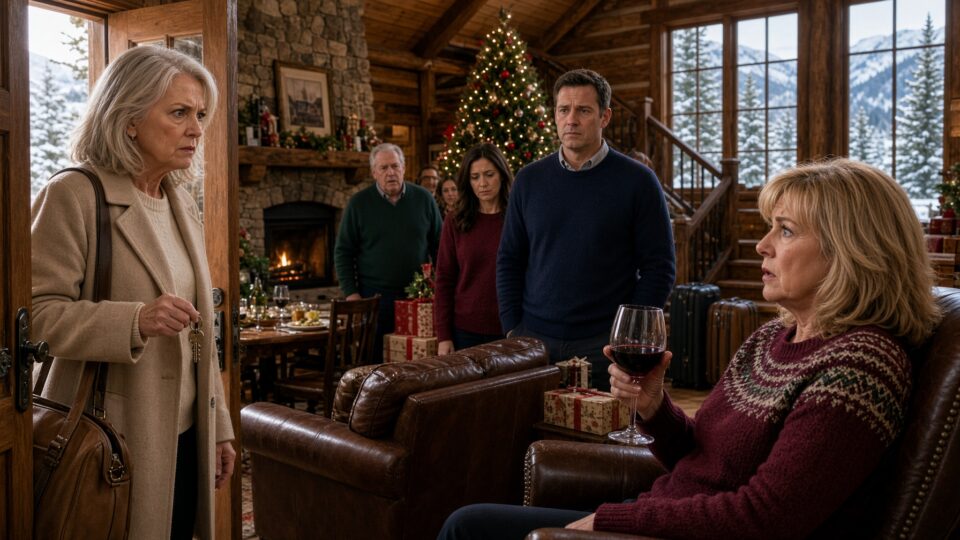
There were at least ten people in my living room.
A woman I vaguely recognized as Brenda’s sister stood near the fireplace holding a plate.
Two teenagers were sprawled on the rug playing cards.
A gray-haired man I had never seen before was asleep beneath Robert’s wool blanket.
Someone had moved the coffee table to make room for folding chairs.
Someone else had hung stockings from my mantel.
Then Brenda looked up.
She was sitting in my chair.
Not simply a chair I happened to own.
My chair.
The blue wingback Robert had bought after my back surgery because he’d spent two weekends visiting furniture stores until he found one I could sit in without pain.
Brenda was curled into it with her shoes off, a glass of red wine in one hand.
“You’re blocking the door,” someone said behind me.
I stepped farther inside automatically.
Then I saw Larry.
Brenda’s husband was stretched across Robert’s brown leather sofa with one ankle crossed over the other, watching football with the volume muted.
He looked at me.
His expression changed.
Brenda’s didn’t.
She blinked once.
Then frowned.
“Diane?”
The room gradually quieted.
“What are you doing here?”
I remember the exact question because for several seconds I truly thought I had misunderstood her.
I looked behind me.
At my front door.
At the brass key still between my fingers.
Then back at her.
“What am I doing here?”
An awkward laugh escaped Brenda.
She put down her glass.
“Well, I mean—we weren’t expecting you.”
“Clearly.”
Somebody lowered the music.
A little girl near the tree stopped shaking a present.
Brenda stood, smoothing her green sweater.
“Sarah didn’t tell you?”
“Tell me what?”
“We’re staying here through New Year’s.”
She said it casually.
As though she were telling me it might snow tomorrow.
I looked toward the stairs.
Five suitcases stood beside them.
At least five.
Two more bags rested near the hallway.
Someone had placed family photos on top of my piano, covering the framed picture of Robert and me at Jason’s wedding.
I turned back to Brenda.
“How did you get inside?”
Her face tightened.
“Sarah gave us the code.”
The words took a second to settle.
There was a keypad beside the mudroom door.
Robert had installed it years earlier after Jason locked himself out during a ski weekend.
After Robert died, I changed the code.
I gave the new one to exactly two people.
Michael Reynolds.
And my son.
“Sarah gave you the code.”
“Yes.”
“Where did Sarah get it?”
Another pause.
“Jason, I assume.”
Jason.
My only child.
The person I’d trusted with the code in case something happened to me.
My fingers tightened around my keys.
“Did Sarah ask me whether you could stay here?”
Brenda rolled her eyes.
Actually rolled them.
“Diane, come on.”
“Did she ask me?”
“Family is family.”
I waited.
Apparently that was supposed to be an answer.
Larry sat up now.
“Brenda,” he murmured.
She ignored him.
“We didn’t think you’d mind. You’re never up here anymore.”
“I’m here now.”
“Well, yes. Obviously.”
One of Brenda’s relatives coughed.
I took another slow look around the room.
Our decorations weren’t the only things they’d unpacked.
My mother’s china was on the dining table.
Twelve place settings of cream porcelain with tiny blue flowers around the rim.
My mother had used those dishes every Christmas until arthritis made them too heavy for her to carry.
After she died, I packed them myself.
Robert had wrapped every plate in newspaper and written MOM’S CHRISTMAS CHINA on the box.
That box had been stored in the locked cabinet beneath the stairs.
Open now.
My chest tightened.
“Who took out the china?”
Brenda glanced toward the table.
“Oh. I did. Isn’t it beautiful? Sarah said you had nice holiday things here.”
“That cabinet was locked.”
“The little key was in the desk.”
Of course it was.
Because I had never imagined needing to hide it from family.
My gaze moved to the kitchen counter.
There were trays of appetizers.
A ham.
Two pies.
Three wine bottles.
Then I saw the bottle in Brenda’s hand.
Not the glass.
The bottle she’d just lifted from the floor beside my chair to refill it.
I knew the label before I could read it.
Dark cream paper.
Gold crest.
2018 Napa Valley Cabernet.
Robert had bought it for our fortieth anniversary.
We were supposed to drink it at dinner.
Instead, two days before our anniversary, he had gone to the emergency room because the pain in his back had become unbearable.
We learned the cancer had spread.
The bottle came home unopened.
Three months later, Robert was dead.
I had never been able to open it.
Not on our anniversary the following year.
Not on his birthday.
Not even when I’d finally packed his clothes for donation.
It had remained on the highest shelf of the kitchen wine rack, gathering dust like an appointment we had missed.
Brenda followed my stare.
“Oh,” she said. “Was this special?”
I couldn’t speak immediately.
She looked at the label.
“We found it upstairs. Larry said Cabernet gets weird if you keep it forever anyway.”
Larry closed his eyes.
That was the moment something inside me became very still.
I had been angry when I saw the lights.
Shocked when I saw the strangers.
Furious when Brenda said Sarah had given them my code.
But the bottle was different.
It was small.
Meaningless, probably, to everyone else in that room.
To me it was the last anniversary Robert and I never got to have.
And Brenda had opened it because she was thirsty.
“Put it down,” I said.
She blinked.
“What?”
“The bottle.”
“Diane—”
“Put it down.”
Something in my voice finally reached her.
She set it carefully on the side table.
I walked over, pushed the cork back into the neck as far as it would go, and carried the bottle into the kitchen.
I didn’t know why.
The wine couldn’t be made unopened again.
Some things could not be returned to the condition you had trusted them to remain in.
I placed it on the counter.
Then Brenda came after me.
“Look, I understand you’re surprised.”
I turned.
“Surprised?”
“This was supposed to be a family Christmas.”
“Whose family?”
Her lips pressed together.
“That’s unnecessary.”
“Is it?”
“We thought you were spending Christmas in Charlotte.”
“I was.”
There.
That was what bothered me.
Not just that they had assumed I wouldn’t come.
They had known I wouldn’t come.
Someone had told them.
I had originally planned to spend Christmas with an old college friend whose daughter had just had a baby. Two days earlier, the baby came down with RSV, so the family canceled visitors. I decided instead to drive to the cabin early and begin sorting linens and supplies before Michael’s inspection.
Only Jason knew my original Christmas plans.
I looked at Brenda.
“Who told you I’d be in Charlotte?”
She crossed her arms.
“Sarah mentioned it.”
Of course she did.
“And how long had you planned this?”
“Weeks.”
Weeks.
Not a misunderstanding.
Not a spontaneous decision.
Weeks.
I reached for my phone.
Brenda frowned.
“Who are you calling?”
“The property manager.”
Her expression changed.
“Why?”
“Because this cabin is being prepared as a rental.”
She stared at me.
Then actually laughed.
“Oh, Diane. You’re not renting this place over Christmas.”
“I didn’t say I was renting it over Christmas.”
“Well, whatever. The twenty-sixth, the twenty-seventh—surely that can wait.”
“Michael is scheduled to come December twenty-sixth.”
“You’ll have to postpone him.”
“No.”
“We’re already here.”
She said those words with remarkable confidence.
As if possession truly were nine-tenths of the law.
As if unpacking luggage had transformed her into a tenant.
As if hanging ornaments had transferred title.
“I’m preparing this cabin for rental,” I repeated.
Her expression hardened.
“You would seriously throw family out at Christmas for some property inspection?”
“I would seriously expect people who want to use my house to ask me first.”
Her sister had stopped pretending not to listen.
So had everyone else.
Brenda glanced around, embarrassed now.
Not by what she’d done.
By the fact I was challenging her publicly.
“Sarah said this place wasn’t being used.”
“Sarah doesn’t decide whether it’s being used.”
“You’re one person, Diane.”
I stared at her.
“I’m aware.”
“I mean, you’ve got your house in Asheville. You hardly come here. It seems ridiculous to let a beautiful place like this sit empty.”
“Then perhaps you should buy one.”
Larry whispered, “Brenda.”
She snapped her head toward him.
“What?”
“Maybe we should pack.”
“No.”
Then she looked at me with a strange little smile.
One I would remember later.
It was the smile of someone who thought she knew more about my future than I did.
“Oh, come on,” she said. “Let’s not turn this into a war. Sarah said this place is basically going to be hers and Jason’s someday anyway.”
The room went silent.
Even the television seemed suddenly loud despite being muted.
“What?”
Brenda shrugged.
“Jason’s your only child.”
I kept looking at her.
She must have seen something in my face, because her smile faltered.
But only for a second.
Then she lifted her wineglass.
“We’re just getting a little head start on the inheritance.”
A head start.
On my inheritance.
While I was standing alive in front of her.
I thought of Robert.
Not the sick Robert.
The healthy one.
Standing on the porch in an old Georgia Tech sweatshirt, holding a level while we built the railing.
Robert teaching Jason to split firewood.
Robert dancing badly in the kitchen with me on New Year’s Eve.
Robert saying, the day we signed the mortgage, “Someday we’ll be old up here.”
He only got to be seventy-two.
I was seventy now.
Apparently that was old enough for other people to begin dividing my things.
I unlocked my phone.
Brenda’s smile disappeared.
“Seriously?”
I called Michael.
He answered on the third ring.
“Merry Christmas, Diane.”
“Michael, I’m sorry to bother you.”
Something in my voice must have told him this wasn’t holiday small talk.
“What’s wrong?”
“Are you in town?”
“About fifteen minutes away.”
“I need you at the cabin.”
A pause.
“Now?”
“If you can.”
“I can.”
I looked directly at Brenda.
“Bring the property file.”
Twenty-two minutes later, Michael Reynolds walked through my front door carrying a leather folder and wearing a dark wool coat dusted with snow.
He was in his early fifties, calm by nature, and one of those men who could make a sentence sound official without ever raising his voice.
I’d chosen him because Robert had trusted him.
Michael had managed three properties for one of Robert’s former business partners.
When I finally admitted I didn’t want to sell the cabin but also couldn’t justify leaving it empty eleven months a year, Michael helped me plan a limited rental schedule.
He looked around.
Then at me.
Then at Brenda.
“I take it these aren’t your guests.”
“They are family,” Brenda said immediately.
Michael looked at her.
“I asked Diane.”
“No,” I said. “They aren’t my guests.”
He nodded.
That was all.
No judgment.
No theatrics.
He opened the folder.
Brenda folded her arms.
“This is absurd.”
Michael addressed me.
“You asked me to bring the ownership and management paperwork?”
“Yes.”
He took out a copy of the deed.
“My understanding is the property is titled solely in your name.”
“It is.”
“Is there any lease agreement with anyone currently inside the property?”
“No.”
“Any written permission granting occupancy?”
“No.”
He turned toward Brenda.
“Then Mrs. Collins, with respect, neither your daughter nor anyone other than Diane Mercer has authority to grant you occupancy of this property.”
Brenda’s face flushed.
“We were invited.”
“By the owner?”
“You know we weren’t.”
“Then you weren’t legally invited to occupy the property.”
Her sister stood immediately.
“Brenda, I’m packing.”
“Sit down.”
“I’m not getting in the middle of this.”
The room erupted into quiet movement.
A suitcase appeared from upstairs.
Someone began gathering coats.
Larry shut off the television.
Brenda stared at them as if betrayed.
“You’ve got to be kidding me.”
I didn’t move.
Neither did Michael.
Finally she faced me.
“So that’s it? You’re evicting us on Christmas Eve?”
“I’m asking you to leave a home you entered without my permission.”
“Same thing.”
“No, it isn’t.”
Her mouth tightened.
“You know what? Fine.”
She marched toward the stairs.
For the next twenty minutes, the cabin filled with the sounds of hurried packing.
Drawers opening.
Closet doors slamming.
Children asking questions in whispers.
Larry carrying coolers to the car.
Brenda’s sister apologizing to me quietly near the kitchen.
“I thought you knew,” she said.
I believed her.
Most of them had probably believed this was arranged.
That was the worst part.
Sarah and Brenda had made my consent unnecessary by pretending it already existed.
When Brenda came downstairs with her suitcase, she stopped in front of me.
Her coat was unzipped.
Her cheeks were bright with anger.
“You are going to destroy your relationship with your son over a cabin.”
I looked at her.
“No.”
Then I opened the door.
Cold wind blew snow across the threshold.
“If my relationship with Jason depends on surrendering control of my property, we have a much bigger problem than a cabin.”
She stood there another second.
Then walked past me.
Larry followed.
He paused.
“I’m sorry, Diane.”
Brenda snapped, “Larry.”
He left.
One by one, the cars disappeared down the mountain.
Their taillights moved through the trees until there was nothing but darkness.
Then silence.
Real silence.
The cabin looked violated.
Half-eaten food covered the kitchen.
Wet rings marked the coffee table.
My mother’s china sat everywhere.
Someone had broken one of the small dessert plates.
There was wine on the carpet.
My Christmas ornaments hung from branches at angles I would never have chosen.
I stood in the middle of it and felt suddenly exhausted.
Michael took off his coat.
“Want help cleaning?”
I almost said no.
Then I saw Robert’s anniversary bottle again.
“Yes,” I said.
So the two of us spent an hour putting my house back together.
Not completely.
Just enough that I could breathe.
Michael loaded the dishwasher.
I returned my mother’s china to the cabinet.
I collected Robert’s ornaments into a box.
Then, while unplugging the tree, I saw something underneath it.
One present remained.
Large.
Flat.
Wrapped in expensive silver paper with a white ribbon.
I thought Brenda had forgotten it.
Then I saw the tag.
TO SARAH AND JASON
FOR YOUR FUTURE MOUNTAIN HOME
I didn’t touch it at first.
Michael came over.
“What is it?”
I pointed.
He read the tag.
His expression changed.
I took out my phone and photographed it.
Then I called my son.
Jason answered almost immediately.
“Mom? Merry Christmas.”
My throat tightened at the normality of his voice.
“Did you know Sarah’s parents were staying at the cabin?”
Silence.
That was my answer.
“Jason.”
He exhaled.
“Mom, I was going to call you.”
“When?”
“Sarah said you weren’t using it.”
I closed my eyes.
“If I leave my car in the garage for a week, does it become yours?”
“No.”
“Then why does that logic work with my house?”
“It doesn’t. I know.”
“Did you give Sarah the security code?”
Another pause.
“She had it from when we stayed there in October.”
That meant he hadn’t deliberately handed it over for this trip.
It didn’t make me feel much better.
“Did you tell her she could give it to her parents?”
“No.”
“Did you know they planned to spend Christmas here?”
“She mentioned they were thinking about it.”
“Thinking about it?”
“I thought she was asking you.”
“Did you ever ask whether I said yes?”
He didn’t answer.
“Jason.”
“No.”
I looked at the silver present.
“Your mother-in-law opened the Cabernet your father bought for our fortieth anniversary.”
His voice dropped.
“What?”
“She said wine goes bad if you keep it too long.”
“Mom…”
“Then she told me they were getting a head start on the inheritance.”
This time, the silence was different.
Not defensive.
Sick.
“She actually said that?”
“Yes.”
“Jesus.”
“There’s something else.”
I sent him the photograph.
He opened it while I stayed on the call.
I heard him inhale.
“What the hell is that?”
“I haven’t opened it.”
“Is Sarah there?”
“No. Her parents left.”
“I mean here. At home.”
I realized he and Sarah weren’t together.
“No?”
“She’s at her parents’ place. I was supposed to meet everyone tomorrow morning. I had work today.”
He sounded stunned.
Then angry.
“Mom, don’t open it.”
“Why?”
“I want Sarah there.”
For the first time that night, I heard something in my son’s voice that reminded me of Robert.
Not the anger.
The certainty.
“I’ll come tomorrow morning.”
“Jason—”
“With Sarah.”
He ended the call.
Michael stood beside the fireplace.
“I’ll come too, if you’d like.”
“For the inspection?”
“Yes.”
He hesitated.
“And there’s something else I want to check.”
“What?”
“Probably nothing.”
I looked at him.
“Michael.”
He glanced toward the silver package.
“When I was preparing the rental file, I ran across a contractor note attached to an older property inquiry. I assumed it was unrelated.”
“What kind of inquiry?”
“I need to verify it before I tell you.”
Normally, I would have pushed.
That night, I didn’t have the energy.
After Michael left, I locked every door.
Changed the keypad code.
Then changed it again because the first new number felt too obvious.
The Christmas tree remained in the living room.
I didn’t turn it back on.
I sat in my blue chair with Robert’s opened bottle on the table beside me.
Outside, snow covered the tracks Brenda’s family had left.
I thought about Jason.
About Sarah.
About the present.
About Michael’s unfinished sentence.
For four years, grief had made me reluctant to change anything Robert had loved.
I hadn’t sold the cabin.
Hadn’t moved furniture.
Hadn’t touched certain boxes.
Somewhere along the way, perhaps that reluctance had looked to other people like absence.
Like weakness.
Like surrender.
I reached over and touched the wine bottle.
“I should’ve opened you myself,” I whispered.
Then my eyes returned to the silver package under the tree.
For your future mountain home.
Not someday.
Not maybe.
Your.
Future.
Home.
At seven thirty the next morning, headlights swept across the windows.
Two cars pulled into the driveway.
Jason climbed out of the first.
Sarah climbed out of the second.
They had driven separately.
That told me something before either of them reached the door.
Jason came inside first.
His face looked gray with exhaustion.
“Mom.”
He hugged me.
I let him.
Then Sarah entered.
Her eyes traveled across the room.
To me.
To Jason.
Then beneath the Christmas tree.
She saw the silver package.
And went pale.
“You found that?”
I watched her face carefully.
Not surprise.
Recognition.
“Open it,” I said.
She didn’t move.
Jason turned toward her.
“Sarah.”
Nothing.
“Open it.”
Slowly, she crossed the room.
Her fingers shook as she untied the white ribbon.
And when the silver paper fell away, I understood why.
Inside was a framed architectural rendering.
A beautifully renovated mountain cabin.
My cabin.
The porch extended across the front.
The kitchen windows were larger.
The upstairs dormer had been changed.
A new stone patio curved around the side.
And printed beneath the drawing, in elegant black letters, were six words.
JASON & SARAH’S BLUE RIDGE RETREAT.
Jason stared at it.
Then at his wife.
“What the hell is this?”
Sarah swallowed.
“My mother had it made.”
“I can see that.”
“It was a joke.”
“No,” I said quietly.
Both of them looked at me.
“Jokes are funny.”
Sarah’s eyes filled.
“I didn’t know she was going to wrap it like that.”
“Like what?” Jason demanded. “A deed?”
“Don’t yell at me.”
“I’m not yelling.”
“You are.”
He lowered his voice.
“Fine. Tell me what this is.”
Sarah looked toward me.
“Mom has always loved this cabin.”
“Your mother isn’t the one in the picture.”
Jason pointed to the caption.
“Our names are.”
“It was supposed to be motivational.”
“Motivational for what?”
Sarah didn’t answer.
The knock came at eight fifteen.
Michael.
He entered carrying the property folder.
But this time, it was much thicker.
He took one look at the three of us and seemed to understand the conversation had already started.
“Morning.”
I pointed toward the dining table.
“Put everything there.”
Sarah turned sharply.
“What everything?”
Michael removed his coat.
“Documents related to the property.”
Her face changed again.
Just slightly.
But I saw it.
So did Jason.
Michael opened the folder.
“Diane, before we do the rental inspection, I need to ask you something.”
“Go ahead.”
“Did you authorize anyone to request renovation estimates for this cabin?”
“No.”
Sarah stopped breathing.
Not metaphorically.
I watched her chest go still.
Michael placed several pages on the table.
Contractor letterheads.
Measurements.
Rough design notes.
Estimated material costs.
I read the first page.
NEW KITCHEN CONFIGURATION.
The second.
EXPANDED PRIMARY BEDROOM.
The third.
LOFT CONVERSION.
Then bathrooms.
Flooring.
Replacement windows.
One proposal even included preliminary estimates for removing the interior wall between the kitchen and dining room.
The wall Robert and I had argued about for years because he loved it and I wanted it gone.
The irony almost made me laugh.
Jason picked up the first estimate.
“What is this?”
Michael pointed near the bottom.
“Read the requestor information.”
Jason did.
His jaw tightened.
Future Property Owners — Jason & Sarah Mercer.
He looked at his wife.
“I’ve never seen these.”
“I know.”
“You used my name?”
“They asked who the future owners would be.”
“Who is they?”
“The contractors.”
“Why were you talking to contractors about my mother’s house?”
“It wasn’t like that.”
Michael remained silent.
I did too.
Sarah looked at me.
“Diane, please.”
“Answer him.”
Her lips trembled.
“My mom and I were just exploring possibilities.”
“For my house.”
“For later.”
The word landed harder than if she’d shouted it.
Later.
Later, when?
Later, after I gave it to them?
Later, after I died?
Later, after someone convinced me the cabin was too much responsibility?
Jason dropped the estimate onto the table.
“How long has this been going on?”
Sarah wiped under one eye.
“Not long.”
Michael turned another page.
“There’s also a financing inquiry.”
My stomach tightened.
Sarah stared at him.
Jason looked confused.
“A what?”
Michael slid the document forward.
It wasn’t a loan application.
Not quite.
It was an inquiry submitted to a regional lender asking about potential borrowing options following a future family transfer of real property.
Estimated value of cabin.
Existing ownership.
Projected renovation cost.
Potential equity.
And beside the renovation line:
$185,000.
Jason read it slowly.
Then looked up.
“You were planning to borrow against Mom’s cabin?”
“No!”
His finger hit the page.
“Then what is this?”
“Nothing was finalized.”
The room went completely still.
I heard the words.
Jason heard them too.
Nothing was finalized.
Not:
I didn’t do it.
Not:
I would never do it.
Nothing was finalized.
I moved closer to the table.
“When was this submitted?”
Michael pointed to the date.
August eighteenth.
Four months earlier.
Long before Christmas.
Long before Brenda walked into my house carrying casseroles and entitlement.
Long before Sarah claimed her parents had merely wanted to use an empty cabin for the holidays.
I looked at my daughter-in-law.
“How long have you been planning around this house becoming yours?”
She opened her mouth.
Closed it.
Her eyes filled.
She said nothing.
Michael didn’t move for several seconds.
Then he reached into the folder.
“There is one more thing.”
Sarah’s chair scraped against the floor.
“What?”
Michael pulled out a single sheet.
“This is the part I think your attorney needs to see.”
He put it in front of me.
Across the top:
PRELIMINARY PROPERTY TRANSFER INSTRUCTIONS.
My name appeared as current owner.
DIANE MERCER.
Below it:
PROPOSED FUTURE RECIPIENTS:
JASON MERCER
SARAH MERCER
And beside my name, written by hand:
OWNER CONSENT EXPECTED — FAMILY TRANSFER.
I stared at the sentence.
Expected.
Not obtained.
Not confirmed.
Expected.
My son picked up the page.
Read it once.
Then again.
He looked at his wife.
“Sarah?”
She wouldn’t meet his eyes.
And that was when I understood.
Christmas Eve had not been the beginning.
Brenda’s family hadn’t simply behaved badly because they expected to inherit my cabin someday.
Someone had already begun building financial plans around a future in which I was no longer its owner.
The only part of that future nobody had bothered to discuss—
was me.
PART 2: THE FUTURE OWNERS
I didn’t scream.
That surprised everyone.
Maybe it surprised me most.
There are moments when anger is too large for noise.
It becomes cold instead.
Precise.
I sat down at the dining table Robert had built from reclaimed oak and read the document again.
PRELIMINARY PROPERTY TRANSFER INSTRUCTIONS.
The wording was vague enough to be unofficial.
Nothing had been executed.
No signature from me.
No notarization.
No actual deed transfer.
But that almost made it worse.
This wasn’t a forged completed transaction.
It was preparation.
Planning.
People discussing my property as though my consent were a technicality that would arrive when needed.
“Where did this come from?” I asked.
Michael pulled out another chair.
“It was attached to the financing inquiry.”
“Who wrote the note?”
“I don’t know yet.”
“Can you find out?”
“Probably.”
Sarah finally spoke.
“This is getting blown out of proportion.”
Jason laughed once.
There was no humor in it.
“Out of proportion?”
“I never filed anything.”
“You contacted contractors.”
“Yes.”
“You asked a bank about borrowing against Mom’s cabin.”
“I asked questions.”
“You put my name on paperwork.”
“It wasn’t paperwork like that.”
Jason lifted the page.
“What kind is it?”
“Preliminary.”
“That word isn’t helping you.”
Sarah folded her arms as though she were cold.
She was wearing a cream sweater I’d given her the previous Christmas.
For some reason, noticing that made the entire situation feel more personal.
I had liked Sarah.
That was what people never understood when family betrayals became stories told later.
They imagined villains had always looked like villains.
Sarah hadn’t.
She’d been part of our family for eleven years.
She called me on Mother’s Day.
She remembered my birthday.
She had sat beside me at Robert’s funeral and held my hand through the graveside service because Jason had been carrying the urn.
She’d brought groceries during the weeks after his death.
She’d texted me photographs of flowers she planted because I had once told her I missed gardening.
I hadn’t merely tolerated her.
I’d trusted her.
That was why my voice shook when I asked, “Did you think I was giving you this cabin?”
She looked at me.
“Eventually.”
The word cut cleanly.
“Why?”
“Because Jason is your son.”
I stared at her.
“That is not an answer.”
She looked toward Jason for help.
He didn’t give any.
“I mean,” she said, “we always assumed—”
“We?”
“My parents. Me. I thought Jason did too.”
Jason’s face hardened.
“Don’t.”
“What?”
“Do not drag me into this.”
“You’ve said the cabin would probably be yours someday.”
He took a step back as though she’d slapped him.
“When?”
“Years ago.”
“When?”
“You said your mom would never sell it because your dad loved it, so eventually it would stay in the family.”
“That is not the same as saying I own it now.”
“I never said we owned it now.”
I pointed at the contractor estimates.
“You called yourselves future property owners.”
Her cheeks reddened.
“Because that was the simplest explanation.”
“For people redesigning my kitchen?”
“I wasn’t redesigning it.”
“You priced the redesign.”
She turned to me.
“I wanted to know what it would cost.”
“Why?”
“Because the place needs work.”
There it was.
Not apology.
Evaluation.
My home reduced to a list of improvements.
I looked around the dining room.
Robert’s handmade shelves.
The pine flooring we refinished ourselves.
The exposed beams we had refused to paint because Robert loved the grain.
“Which part needs work?”
Sarah rubbed her forehead.
“Diane, please don’t do this.”
“Which part?”
“The kitchen is outdated.”
I almost smiled.
“So you were planning to modernize it.”
“Someday.”
“And knock out a wall.”
“Maybe.”
“Expand my bedroom.”
“The primary bedroom.”
“My bedroom.”
No answer.
“Turn the loft into what?”
Sarah looked down.
“A bunk room.”
“For?”
“Kids. Guests.”
Jason shut his eyes.
They didn’t have children.
They’d been undecided about children since they married.
That word—kids—had apparently become part of Sarah’s imagined future before I’d been informed my house was in it.
I turned toward Michael.
“How did you find this?”
“When you hired me, I entered the property address into our management system. It pulled some prior public-facing contractor references and an inquiry attached to the address. Most of it wasn’t confidential financial data. More like intake notes. Yesterday I remembered the contractor reference when I saw that gift.”
“Why would there be property transfer instructions?”
“My guess is someone was trying to understand what documentation might be necessary if ownership changed in the future.”
“Can anyone transfer my house without me?”
“No.”
His answer came immediately.
“Absolutely not.”
I needed that.
Even though I knew it.
Even though the deed was in my name.
Hearing another person say it steadied me.
“No one can legally transfer this property without valid authority and properly executed documents,” Michael continued. “What concerns me isn’t that a transfer occurred. It didn’t. What concerns me is that multiple people were acting as though one was anticipated.”
Jason sat beside me.
“Mom, I swear to you, I didn’t know.”
I looked at him.
He was forty-three years old.
Still my child.
But no longer a child.
That distinction mattered.
“I believe you didn’t know about these papers.”
Relief moved across his face too quickly.
I hadn’t finished.
“But you knew Sarah’s parents were coming.”
His shoulders dropped.
“Yes.”
“And you didn’t call me.”
“No.”
“You knew she had the code.”
“Yes.”
“You knew they hadn’t heard from me directly.”
“I assumed Sarah handled it.”
“That is the problem.”
He looked down.
I had spent years making excuses for him because he was a good man.
And he was a good man.
But good people could still be careless.
Good people could let other people cross boundaries because confrontation was uncomfortable.
Good people could become part of harm through silence.
“Jason,” I said, “you didn’t plan this. But you helped make it possible.”
He swallowed.
“I know.”
Sarah stared at him.
“So you’re just taking her side?”
He looked at her slowly.
“My mother’s property is not a side.”
“This isn’t about property anymore.”
“No,” I said. “It isn’t.”
Sarah stood.
Her face crumpled.
“I can’t do this while everyone is attacking me.”
Nobody stopped her when she walked upstairs.
A bedroom door shut.
Jason didn’t follow.
That told me more than any argument could have.
Michael closed the folder.
“I should probably give you some privacy.”
“Before you go,” I said, “can you finish the rental inspection?”
He looked surprised.
“Today?”
“Yes.”
“Mom,” Jason said gently, “you don’t have to think about that right now.”
I turned toward him.
“That is exactly what I need to think about.”
Because something had become clear.
For years, I had treated the cabin as a mausoleum.
Robert’s mug stayed beside the coffee maker.
His fishing boots remained beneath the mudroom bench.
I had told myself I was preserving memories.
But preservation had consequences.
The emptier the cabin became, the easier it was for other people to imagine it belonged to nobody.
Or worse.
That it was waiting.
Waiting for its next owners.
I stood.
“Michael, check everything.”
He nodded.
We started in the kitchen.
Cabinet hinges.
Appliances.
Smoke alarms.
Plumbing.
Electrical outlets.
Jason followed quietly.
Sarah remained upstairs.
Michael noted a loose faucet and a warped cabinet door.
We went through the living room.
Then the downstairs bath.
Then the bedrooms.
When we reached the primary bedroom, the bed was unmade.
Brenda and Larry had used it.
My bed.
Robert’s side.
I stopped in the doorway.
The pillow on the right still had an indentation.
I knew it wasn’t Robert’s.
That didn’t stop my heart from reacting as though time had played a cruel trick.
For a moment I saw him there.
Reading glasses low on his nose.
A mystery novel in his hands.
Complaining that I had stolen the blankets.
Then the image disappeared.
Jason touched my shoulder.
“I’m sorry.”
I nodded.
“I know.”
We stripped the sheets.
Every one of them.
I carried the laundry downstairs myself.
By noon, Michael had a list of minor repairs.
Nothing major.
The cabin was structurally sound.
Rentable.
Mine.
When he left, he promised to contact the companies named on the documents and determine exactly who had requested what.
“No action beyond information gathering,” I told him.
“Understood.”
“I don’t want accusations. I want facts.”
He nodded.
After he drove away, Jason and I sat in the kitchen.
The silver-framed rendering leaned against the wall.
I had turned it backward.
Sarah came downstairs twenty minutes later.
Her eyes were swollen.
“I called Mom.”
I said nothing.
“She’s furious.”
Jason rubbed his face.
“About what?”
“Being kicked out.”
He stared at Sarah.
“That’s what she’s furious about?”
“She thinks Diane humiliated her.”
“I didn’t invite twelve people into her house.”
“There were ten.”
He looked at her.
“That’s your defense?”
“I am not defending it.”
“You keep defending it.”
“I’m explaining.”
“No, you’re shrinking it until you can live with it.”
Sarah’s face twisted.
“You think I’m some kind of monster now?”
“No.”
“Then stop looking at me like one.”
He stood.
“I don’t know how to look at you right now.”
The words silenced her.
I wanted to leave the room.
This was their marriage.
But I was also the reason the argument existed.
More precisely, my property was.
My life was.
My future was.
Sarah sat opposite me.
“Diane, I am sorry about my parents.”
“Are you sorry they came or sorry I came?”
She flinched.
“That’s not fair.”
“Answer.”
“I wish they hadn’t come.”
“Because?”
“Because obviously this became a disaster.”
I waited.
Still not an answer.
She pushed her hair behind one ear.
“I thought you’d say yes if they asked.”
“Then why didn’t they?”
“Mom said it would make things awkward.”
I nearly laughed.
“So instead of risking the awkwardness of asking permission, she risked the awkwardness of being caught without it.”
“She thought family shouldn’t need formal invitations.”
“And you?”
Sarah looked at the table.
“I thought you’d be okay with it.”
There.
A smaller truth.
But still incomplete.
“Why?”
“Because you’ve let us use the cabin.”
“You and Jason.”
“Yes.”
“Not your entire extended family.”
“I know.”
“Did you tell your mother she could use my china?”
“No.”
“My decorations?”
“No.”
“Open our anniversary wine?”
“No.”
“I believe you.”
She looked up hopefully.
“But you gave her the thing that made all of it possible.”
“The code.”
“Yes.”
“I’m sorry.”
This time, the apology sounded real.
I almost let myself relax.
Then I remembered the financing inquiry.
“What about the rest?”
Her expression closed.
Jason leaned against the counter.
“Yeah. Let’s talk about the rest.”
Sarah looked between us.
“I started thinking about the cabin after your dad died.”
My stomach tightened.
She hurried on.
“Not immediately. I don’t mean it like that.”
“Then tell it accurately,” I said.
She nodded.
“After a couple of years, you still weren’t coming here much. Jason and I talked about whether you’d keep it.”
“I remember,” Jason said. “We talked about Mom renting it or selling it.”
“Right.”
“But I never said she’d give it to us.”
“You said you hoped it stayed in the family.”
“I hoped she stayed alive too. Hope isn’t a property transfer.”
Sarah pressed her palms against the table.
“I started looking at renovation ideas. That’s all.”
“Why contact contractors?”
“Because online estimates are useless.”
“So you gave them the address.”
“Yes.”
“And my ownership information.”
“It was public.”
“And described yourselves as future owners.”
Her voice dropped.
“Yes.”
“Then contacted a lender.”
“Only for information.”
“About borrowing $185,000 against a property you didn’t own.”
“After a transfer.”
“What transfer?”
She said nothing.
I leaned toward her.
“Sarah, listen carefully. What transfer?”
Her eyes filled again.
“I thought you might give it to Jason.”
“Why?”
“Because of taxes.”
I frowned.
Jason did too.
“What taxes?” he asked.
“Estate planning. Mom read something about transferring property before death.”
Of course Brenda had.
I felt tired all over.
“Did you ever ask me whether I planned to do that?”
“No.”
“Did you ask Jason?”
“Not exactly.”
Jason laughed bitterly.
“So you researched loans against property we don’t own based on a hypothetical gift Mom never offered because your mother read something about estate planning?”
“When you say it like that—”
“How else is there to say it?”
Sarah began crying.
Not loudly.
She pressed her fingers to her mouth.
“I wasn’t trying to take anything.”
I believed that she believed this.
That was what frightened me.
Maybe in her mind she hadn’t been taking.
She had only been preparing.
Only planning.
Only getting estimates.
Only making it easier for a future she already considered inevitable.
Entitlement rarely announced itself as theft.
It sounded like practicality.
Efficiency.
Family.
I sat back.
“Who prepared the transfer instructions?”
“I don’t know.”
“Sarah.”
“I really don’t.”
Michael hadn’t been able to identify it yet.
I watched her face.
“Did your mother have anything to do with it?”
She hesitated too long.
Jason stepped forward.
“Sarah.”
“She talked to someone.”
My skin went cold.
“Who?”
“A financial planner she knows.”
“Name?”
“I don’t remember.”
“Try.”
She closed her eyes.
“Maybe Warren. Warren Pike.”
Jason grabbed his phone.
I stopped him.
“No.”
He looked at me.
“Why?”
“Because we’re not calling random people angry. Michael will verify it.”
“Mom—”
“I want facts.”
He lowered the phone.
Sarah whispered, “Mom was trying to help us.”
“No,” I said. “Your mother was trying to help herself imagine a future with my property available to her family.”
“That’s not fair.”
“She spent Christmas Eve drinking my anniversary wine in my chair after entering my house without permission, then told me she was getting a head start on my inheritance.”
Sarah looked away.
“You don’t get to tell me what’s fair.”
Nobody spoke for a while.
Outside, snow slipped from the roof in a heavy sheet.
The sound startled all three of us.
Then Jason asked the question I’d been avoiding.
“What happens now?”
Sarah looked at him.
He wasn’t asking me about the cabin.
He was asking about them.
I refused to answer for either.
“That is between you two.”
Then I stood.
“But this is between me and both of you.”
They looked at me.
“The cabin code has been changed. Neither of you will receive the new one.”
Sarah’s face fell.
Jason nodded once.
“Okay.”
“No one enters this property without my direct permission. Not through you. Not through someone else.”
“Understood.”
“The rental plan moves forward.”
Sarah wiped her cheeks.
“What does that mean?”
“It means Michael will list selected dates beginning in January.”
“You’ll let strangers stay here?”
I stared at her.
She heard herself.
Her cheeks reddened.
“That’s not what I meant.”
“It sounded exactly like what you meant.”
“I’m sorry.”
“Strangers who sign a contract, pay, and are granted permission will have more right to be here than family members who enter without asking.”
Jason nodded slowly.
“That’s true.”
Sarah looked devastated.
Maybe because she finally understood the difference.
Or maybe because the future she’d pictured was changing in front of her.
I wasn’t done.
“Tomorrow I’m calling my attorney.”
Her eyes snapped up.
“For what?”
“To review my estate plan.”
Silence.
Jason looked uncomfortable.
“Mom, you don’t have to make decisions while you’re angry.”
“I agree.”
His eyebrows lifted.
“So I won’t.”
I picked up the contractor estimates.
“But I am going to make sure everyone understands one thing.”
I looked first at Sarah.
Then Jason.
“My death is not a financial event you get to rehearse while I’m alive.”
PART 3: WHAT SARAH THOUGHT WOULD HAPPEN
The day after Christmas, I called my attorney.
Her name was Evelyn Hart.
She was sixty-six, wore silver-framed glasses, and had the reassuring habit of letting people finish a sentence before she spoke.
Robert had hated lawyers as a category but loved Evelyn personally, which told you something about her.
I explained everything.
The unauthorized Christmas gathering.
The contractor estimates.
The financing inquiry.
The preliminary transfer note.
She listened without interrupting.
When I finished, she said, “Do you believe anyone has forged your signature?”
“No.”
“Have you signed anything related to transferring the property?”
“No.”
“Given anyone power of attorney over it?”
“No.”
“Added Jason or Sarah to the deed?”
“No.”
“Then the cabin is yours.”
I closed my eyes.
“I know.”
“I know you know. I’m saying it because after something like this people can make you feel as though facts have become negotiable.”
That was exactly it.
“Could they do anything without me?”
“Not legitimately based on what you’ve described. But I would like copies of everything.”
“I’ll send them.”
“Good. And Diane?”
“Yes?”
“Estate planning is not the same as surrendering control. We can review your documents without making any decision about disinheritance, transfer, sale, or anything else.”
“I don’t want to punish Jason for something he didn’t do.”
“Then don’t.”
“I also don’t want anyone treating the cabin as guaranteed.”
“Then make sure it isn’t.”
Simple.
Not easy.
But simple.
Evelyn scheduled me for the following week.
Meanwhile, Michael began making calls.
The first contractor remembered Sarah.
The conversation had been ordinary, he said.
A woman planning a “future family renovation.”
She’d emailed photographs.
Measurements.
A rough wish list.
The contractor had assumed ownership was forthcoming because she described herself as one of the property’s future owners.
The second contractor said almost the same thing.
Neither had been told I had approved renovations.
Neither had begun work.
Neither had accepted money.
That mattered.
I didn’t want to turn imagination into a crime.
But facts didn’t make the behavior harmless.
They made it clearer.
Sarah had spent months rehearsing ownership.
And every rehearsal made the next step feel more normal.
Michael tracked the financing inquiry to a mortgage broker Sarah had contacted online.
Again, no application.
No credit pull.
No attempt to pledge my house.
Just questions.
How much equity might be available after a transfer?
How soon after receiving property could a new owner borrow against it?
What documentation would be needed?
Could renovation costs be rolled into financing?
Planning.
Always planning.
The handwritten note came from the office of a financial planner.
Warren Pike.
Brenda’s acquaintance.
He called me himself after Evelyn contacted him.
He sounded terrified.
“Mrs. Mercer, I want to be completely clear. I did not prepare a deed or attempt a transfer.”
“I know.”
“Mrs. Collins asked a hypothetical question.”
“What question?”
He hesitated.
“About a parent transferring a vacation property to an adult child.”
“And you wrote owner consent expected.”
“That was based on the information I received.”
“What information?”
Another hesitation.
“That the owner had discussed keeping the property in the family and was expected to consent eventually.”
I felt my grip tighten around the phone.
“Who told you that?”
“Mrs. Collins.”
Of course.
“Were you told I had agreed?”
“Not in those exact words.”
That answer irritated me more than a direct lie.
“What words were used?”
He sighed.
“She said it was understood.”
Understood.
Expected.
Eventually.
Family.
The vocabulary of entitlement was remarkably soft.
Nobody said steal.
Nobody said take.
Nobody said ignore Diane.
They used words that made my consent seem like paperwork catching up to destiny.
I thanked Warren and ended the call.
Then I sat in my kitchen at home for a long time.
Robert’s photograph stood near the window.
He was holding a trout.
I hated that photograph.
He looked unbearably alive in it.
“I should’ve seen this coming,” I told him.
The photograph did not answer.
Robert would have.
He probably would have said something infuriatingly reasonable like, You saw it when there was something to see.
Then he’d have made coffee.
I missed him with an intensity that felt physical.
For years, the cabin had been where I went to feel closer to him.
Now Sarah and Brenda had contaminated that too.
Or so I thought.
But grief had taught me something unpleasant.
No one else could actually contaminate a memory unless I let their actions become more important than what came before them.
Brenda opening the wine did not erase why Robert bought it.
Sarah pricing renovations did not erase the twenty-two years Robert and I owned the place.
Their assumptions did not reach backward through time.
The cabin was still ours.
And now mine.
Three days after Christmas, Jason came to see me alone.
He looked terrible.
I made coffee anyway.
Motherhood is strange that way.
You can be furious with your child and still notice whether he’s eaten.
“Where’s Sarah?” I asked.
“At her parents’.”
I set a mug in front of him.
“By choice?”
“Mine.”
I sat opposite him.
He rubbed both hands over his face.
“We haven’t separated.”
“I didn’t ask.”
“I know.”
He stared into the coffee.
“I asked her to stay with them for a few days.”
“Okay.”
“Mom, I need to tell you something.”
My stomach tightened.
“What?”
“Sarah showed me the emails.”
“What emails?”
“The ones with Brenda.”
He unlocked his phone.
“I asked her to show me everything related to the cabin.”
I didn’t reach for it.
“Do I want to see them?”
“I think you should.”
He slid the phone across the table.
I read.
At first, the messages were exactly what I expected.
Brenda sending kitchen photos.
Sarah replying with renovation links.
Brenda suggesting a larger dining area.
Sarah saying, We don’t know what Mom will do yet.
That line mattered.
She knew.
She knew I hadn’t decided.
Then Brenda replied:
She won’t sell. Robert loved that place too much.
Sarah:
Probably not.
Brenda:
Then Jason gets it eventually. Better to have a plan than scramble later.
My throat tightened.
Another thread from September.
Brenda:
If Diane transferred it sooner you could renovate while prices are still manageable.
Sarah:
She’d never do that now.
Brenda:
Why not?
Sarah:
She’s attached to it.
Brenda:
She barely uses it.
Sarah:
It’s not about use.
That stopped me.
I reread it.
It’s not about use.
Sarah had understood more than I wanted to admit.
Jason watched me.
“Keep going.”
Another message.
Brenda:
You two have to start thinking long-term. Jason is too passive about money.
Sarah:
Please don’t say that.
Brenda:
I’m not insulting him. He just assumes everything will work out.
Sarah:
The cabin isn’t ours.
Brenda:
Not yet.
Sarah:
Mom, stop.
For the first time since Christmas Eve, the picture became less simple.
Not better.
But less simple.
I kept reading.
October.
Sarah had sent Brenda a renovation estimate.
Brenda replied:
See? That’s why I told you to know the numbers now.
Sarah:
This is getting ahead of ourselves.
Brenda:
Planning is not a crime.
Sarah:
I know. But Diane hasn’t said anything.
Brenda:
She doesn’t have to. Everyone knows Jason inherits.
Sarah didn’t respond for six hours.
Then:
I don’t want to talk about this anymore.
I put the phone down.
Jason said quietly, “There’s more.”
I looked at him.
“Do I need more?”
“Yes.”
November.
A message from Sarah.
Mom, do not contact anyone else about Diane’s house. Jason doesn’t know about the contractor stuff and I don’t want him thinking we’re planning behind his back.
Brenda:
Then tell him.
Sarah:
There’s nothing to tell yet.
Brenda:
Exactly.
Sarah:
That’s not what I mean.
Brenda:
You’re too sensitive.
Sarah:
I’m serious.
Brenda:
Fine.
Three days later, Brenda sent the architectural rendering.
At least a digital version of it.
Sarah responded:
What is this?
Brenda:
Christmas present.
Sarah:
Absolutely not.
Brenda:
Relax.
Sarah:
Do not give us this in front of Diane.
Brenda:
Diane isn’t coming.
Sarah:
Still weird.
Brenda:
You worry too much.
I sat back.
Jason looked exhausted.
“So Sarah didn’t know about the wrapped picture?”
“She knew it existed. She told Brenda not to give it to us.”
“That’s different.”
“Yeah.”
“Not enough. But different.”
“I know.”
I slid the phone back.
“What about the financing inquiry?”
“Sarah did that.”
“And the contractor estimates.”
“She did those too.”
“Then we still have a problem.”
“I know.”
He met my eyes.
“But not exactly the problem we thought.”
No.
Brenda had pushed.
Sarah had resisted sometimes.
Then participated anyway.
That distinction mattered because motives mattered.
But consequences mattered too.
“What did Sarah say?”
“That she got scared.”
“About what?”
“Money.”
I frowned.
Jason stared into his cup.
“I didn’t know how worried she was.”
“About your finances?”
He nodded.
“My company froze promotions last spring. We were planning to buy a bigger house eventually. Mortgage rates, prices, everything… Sarah started thinking we’d never be able to.”
“You own a house now.”
“A small one.”
“Three bedrooms.”
“I know.”
He gave a tired smile.
“I’m not saying we’re suffering.”
“Then what?”
“Sarah grew up worried about money.”
I knew Brenda and Larry weren’t poor.
But there were kinds of financial insecurity that had little to do with actual poverty.
Status could produce its own panic.
Comparison too.
Jason continued.
“Brenda has always been obsessed with having a plan. Retirement. Investments. Property. Everything. She convinced Sarah the cabin was basically the one asset that would solve our long-term housing problem.”
I felt anger rise again.
“My house is not their solution.”
“I know.”
“Does Sarah?”
He hesitated.
“She does now.”
I stood and walked to the window.
It had begun raining.
Gray winter rain that erased the last snow from the lawn.
“Jason, I need you to understand something.”
“I do.”
“No. I don’t think you do.”
He looked up.
“This isn’t really about whether Sarah intended to steal the cabin.”
“I know.”
“It is about the fact she allowed herself to build a future on something she had no right to count.”
He nodded.
“And you—”
“I know.”
“You keep saying that.”
“Because I do.”
“Then tell me your part.”
He went quiet.
For several seconds he looked twelve years old again.
Then he said, “I avoid conflict.”
I waited.
“Sarah would bring up the cabin sometimes. Not the contractor stuff. Just what might happen eventually. And I’d say I didn’t want to talk about it.”
“Why?”
“Because talking about inheriting from you means talking about you dying.”
That softened something in me.
Only slightly.
He rubbed his thumb against the mug.
“I hated it. So I’d shut the conversation down. I guess Sarah heard that as me not caring about the details.”
“And Brenda?”
“I don’t like fighting with Brenda.”
“No one likes fighting with Brenda.”
That made him laugh.
Just once.
Then the laugh disappeared.
“I should’ve called you about Christmas.”
“Yes.”
“I knew they were going. I believed Sarah when she said you’d be fine with it because it meant I didn’t have to get involved.”
There it was.
The truth I needed from him.
Not an excuse.
Not “I assumed.”
Not “Sarah handled it.”
A choice.
He had chosen comfort.
“I failed you there,” he said.
My throat tightened.
“I appreciate you saying that.”
“I don’t expect you to give me the code again.”
“Good.”
He almost smiled.
Then looked serious.
“Are you changing the will?”
“I am reviewing it.”
He looked down.
I watched him carefully.
“Does that scare you?”
He considered the question.
“Yes.”
“Because of the money?”
“No.”
“Then why?”
“Because it means you don’t trust me.”
I sat again.
“Jason, trust isn’t a switch.”
He looked at me.
“I trust that you didn’t plan those renovations.”
He nodded.
“I trust that you didn’t contact that lender.”
Another nod.
“I trust that you love me.”
His eyes reddened.
“But I no longer trust you to automatically protect my boundaries when doing so makes your life uncomfortable.”
He swallowed.
“That’s fair.”
Hearing him accept it hurt more than hearing him argue would have.
I reached across the table.
He put his hand in mine.
“You can earn that back.”
He squeezed my fingers.
“I will.”
That evening, Sarah called.
I almost didn’t answer.
Then I did.
“Diane?”
“Yes.”
“Jason showed you the messages.”
“He did.”
Silence.
“I’m not going to ask you to forgive me.”
“Good.”
She exhaled shakily.
“But I want to explain something.”
“I’m listening.”
“My mother gets inside my head.”
I said nothing.
“I know that sounds pathetic.”
“It sounds incomplete.”
She gave a small, broken laugh.
“That’s fair.”
Then she told me something I’d never known.
When Sarah was seventeen, Larry lost his business.
For two years, the Collins family almost lost their house.
Brenda hid the worst of it from everyone, including relatives.
She clipped coupons at night and wore designer clothes to church on Sunday.
She told Sarah constantly that security came from property.
Property couldn’t disappear like a paycheck.
Property meant safety.
By the time Larry recovered financially, Brenda’s fear had become philosophy.
“When Robert died,” Sarah said, “Mom started saying Jason would have the cabin someday. At first I told her to stop.”
“I saw.”
“Then housing got more expensive. Jason’s work got uncertain. And I started thinking… maybe she was right. Not about it being ours. But about needing to prepare.”
“You crossed that line anyway.”
“I know.”
“Did you think about how it would feel to me?”
“No.”
The answer was immediate.
Honest.
And terrible.
“No,” she repeated. “I thought about numbers. Renovation costs. Interest. Timing. I turned it into a spreadsheet in my head because that made it not feel like I was thinking about you dying.”
I closed my eyes.
There it was again.
Death translated into planning.
Grief translated into equity.
“What did you think would happen?” I asked. “Exactly.”
She cried quietly before answering.
“I thought someday you might decide the cabin was too much. I thought you’d give it to Jason because it was his father’s. I thought we’d renovate it. Maybe use it on weekends. Maybe retire there. And I thought if we knew the costs ahead of time, we’d be ready.”
“And if I sold it?”
“I didn’t think you would.”
“If I left it to charity?”
“I never thought about it.”
“If I lived there?”
Silence.
That answer hurt the most.
“You didn’t think about me living there.”
“No.”
I opened my eyes.
Rain tapped against the window.
“Sarah, you imagined my future only far enough to remove me from the cabin.”
She began sobbing.
“I’m sorry.”
“I believe you.”
She became quiet.
It was the first time I’d said that.
But believing an apology did not erase what required it.
“I don’t know what happens with you and Jason,” I continued. “That is your marriage.”
“I know.”
“But there is something you can do for me.”
“Anything.”
“Do not say anything unless you mean it.”
She inhaled.
“Okay.”
“Stop planning around my death.”
“I will.”
“And tell your mother the same.”
A pause.
Then, more firmly:
“I will.”
What happened next surprised me.
Because Brenda called before Sarah had the chance.
PART 4: FAMILY IS FAMILY
Brenda called at 8:12 the next morning.
I knew because I was looking at the clock when her name appeared.
I almost sent it to voicemail.
Instead, I answered.
“Diane.”
No greeting.
No apology.
“Brenda.”
“I think we need to clear the air.”
I looked at Robert’s photograph on my desk.
“Go ahead.”
She exhaled.
“First of all, I’m sorry about the wine.”
Of all possible openings, that one surprised me.
“Are you?”
“Yes. Sarah told me what it was.”
“You didn’t ask before opening it.”
“I know.”
“That was the problem with more than the wine.”
Silence.
Then her tone changed.
“Diane, I don’t want this to destroy our family.”
Neither did I.
But I had begun noticing how often people used “family” when they wanted the injured person to make things easier.
“I didn’t bring ten people into someone else’s house without permission.”
“You’re still stuck on that.”
“Yes.”
“Why?”
The question was so absurd I laughed.
A real laugh.
Brenda didn’t like it.
“I don’t see what’s funny.”
“You entered my house without permission and want to know why I’m stuck on it.”
“We believed Sarah had cleared it.”
“No. You knew she hadn’t.”
“She said you’d probably be fine.”
“Probably is not permission.”
“We’re related.”
“There it is again.”
“What?”
“Family.”
She sighed dramatically.
“Oh, for God’s sake.”
“No. Explain it to me.”
“Explain what?”
“What family means in this situation.”
“Diane—”
“Does it mean you can enter my house without asking?”
“No.”
“Use my belongings?”
“No.”
“Open sentimental things?”
“I already apologized.”
“Plan renovations?”
“That wasn’t me.”
“You contacted the financial planner.”
Silence.
For the first time, Brenda seemed genuinely surprised.
“Who told you that?”
“The financial planner.”
Her voice sharpened.
“He had no right to discuss private conversations.”
“They stopped being private when my property became the subject.”
“I asked hypothetical questions.”
“About my actual house.”
“For my daughter.”
“Using my actual name.”
She didn’t answer.
I continued.
“And you told him my consent was understood.”
“I said I didn’t think you’d oppose keeping the cabin in Robert’s family.”
“Jason is Robert’s family.”
“So is Sarah.”
“Sarah became our family when she married Jason. That did not make her owner of my property.”
“You twist everything.”
“No, Brenda. I am untwisting it.”
Her breathing changed.
I pictured her in the immaculate kitchen of her suburban home, pacing beside the granite island, furious that a woman she considered passive had stopped cooperating.
“You know what I think?” she said.
“I suspect you’re about to tell me.”
“I think you’ve been lonely since Robert died, and you’ve become overly attached to objects because you’re scared of change.”
For one second, I couldn’t speak.
Not because she was entirely wrong.
That was what made it cruel.
I had been lonely.
I had been attached to objects.
I had been scared of change.
But she had taken pieces of truth about my grief and turned them into evidence that I should have less authority over my own life.
“Maybe I am,” I said.
She went quiet.
I continued.
“Maybe I’m too attached to the cabin. Maybe I kept Robert’s shoes too long. Maybe I should have opened that wine years ago.”
My voice steadied.
“But none of those things make the cabin yours.”
“That isn’t what I’m saying.”
“It is exactly what you’re saying. You’re arguing that because you disapprove of how I use my property, your daughter gets to plan for it.”
“I am arguing that you should think about the future.”
“I do.”
“Jason is your future.”
“No.”
She went silent.
“My son is part of my future. He is not my entire future. I’m still in it.”
That was the sentence I had needed for four years without knowing it.
I’m still in it.
Not just surviving Robert.
Not waiting for my life to become someone else’s inheritance.
Still here.
Still making decisions.
Still allowed to want things.
Brenda’s voice became icy.
“You’ve made your point.”
“I don’t think I have.”
“What else could you possibly want?”
“An answer.”
“To what?”
“Why were you so certain I would give them the cabin?”
“Because it makes sense.”
“To you.”
“To anyone.”
“No. To you.”
She snapped, “Jason is your only child.”
“So?”
“So who else would get it?”
There it was.
The assumption beneath every other assumption.
She didn’t merely expect Jason to inherit.
She couldn’t imagine my property having a purpose beyond inheritance.
“I might sell it.”
“You wouldn’t.”
“I might.”
“Robert loved that cabin.”
“So did I.”
“Exactly.”
“And Robert loved me more.”
Silence.
I surprised myself with the sentence.
But it was true.
Robert would never have wanted me trapped by a building because he once loved it.
He had loved the cabin.
He had also told me, during one of our final coherent conversations, “Don’t make a shrine out of me, Di.”
I had been furious with him.
“What a ridiculous thing to say.”
“I know you.”
“Then you know I’ll do whatever I want.”
He had smiled.
“That’s my girl.”
I hadn’t thought about that conversation in months.
Maybe years.
Now Brenda had somehow returned it to me.
“I am allowed to sell the cabin,” I told her. “Rent it. Live in it. Paint every wall purple. Give it away. Leave it empty. None of those decisions require your approval.”
“I never said they did.”
“Your behavior did.”
She inhaled sharply.
Then she said something quieter.
“I was trying to help my daughter.”
For the first time, there was no arrogance in her voice.
Just fear.
I recognized it.
Not because I agreed with it.
Because I had been a mother too.
“By planning my death?”
“Don’t be dramatic.”
“I am not being dramatic.”
“You know everyone dies.”
“Yes.”
“So planning inheritance isn’t wishing someone dead.”
“No. But treating inheritance as available before death is something else.”
She went quiet.
I let the silence remain.
Eventually she said, “Sarah told me you hired a lawyer.”
“I’ve had a lawyer for years.”
“Are you cutting Jason out?”
The speed of the question told me everything.
She wasn’t worried only about the relationship.
She was worried about the asset.
I almost became angry again.
Instead I felt strangely calm.
“That is between Jason, me, and my attorney.”
“He’s your son.”
“Yes.”
“You can’t punish him because Sarah made a mistake.”
“I am not discussing my estate with you.”
“I’m just saying—”
“I know.”
I ended the call.
My hand shook afterward.
Not because I regretted it.
Because confrontation had always cost me more energy than I liked admitting.
Robert had been the one who enjoyed direct conflict.
He could return bad food at a restaurant without apologizing to the waiter.
I once ate an entire burned steak to avoid making a scene.
Marriage balances people in odd ways.
Without Robert, I had spent four years believing I had to either become him or stay silent.
That morning, I discovered a third option.
I could be myself and still say no.
A week later, I met Evelyn at her office.
We reviewed my estate plan line by line.
I did not disinherit Jason.
I had never wanted to.
But I changed the way certain assets would be handled.
The cabin would not automatically be treated as a guaranteed future residence for anyone.
My estate documents made clear that any decision about keeping, selling, or distributing it would be made according to the instructions I chose, not assumptions people made.
More important to me, I signed updated powers of attorney and property instructions that made my wishes unmistakable while I was alive.
No transfer.
No co-owner.
No authority to encumber the property.
No one acting on my behalf unless formally appointed.
When we finished, Evelyn removed her glasses.
“How do you feel?”
I considered the question.
“Less dead.”
She smiled.
“Good.”
I laughed.
It sounded strange in a law office.
But it was true.
This entire disaster had forced me to recognize something uncomfortable.
I had spent four years behaving like a caretaker of the life Robert and I had built instead of the continuing owner of my own.
That wasn’t Brenda’s fault.
It wasn’t Sarah’s.
That part belonged to me.
But what I did next belonged to me too.
I called Michael.
“List the cabin.”
“For sale?”
“No.”
I smiled.
“For rental.”
The first booking came three days later.
A couple from Raleigh wanted a long weekend in February.
Then a family booked spring break.
Then two sisters reserved four nights in April.
Each notification made me feel surprisingly happy.
Not because of the money.
Because the cabin had a future that didn’t require my disappearance.
I began making changes.
Small ones.
I removed the towels Robert hated but refused to throw away.
I replaced the old toaster.
I bought new sheets.
I moved his fishing magazines into a box.
Then one afternoon, I stood in the primary bedroom holding his flannel shirt.
The blue one.
I had kept it hanging behind the door for four years.
I pressed it to my face.
It no longer smelled like him.
Of course it didn’t.
That had disappeared long ago.
What remained was cotton.
Memory.
Love.
And the illusion that keeping the shirt in that room somehow kept the past from moving.
I folded it.
Not for donation.
I wasn’t ready for that.
But I put it in a cedar chest.
That night, I opened another bottle of Cabernet.
Not Robert’s anniversary bottle.
That one was gone.
Half had been consumed by Brenda.
The rest had turned after sitting open.
I poured it down the sink on December twenty-sixth.
I cried while doing it.
Then I washed the bottle.
I kept the cork.
No grand reason.
I simply wanted to.
This new bottle cost twenty-eight dollars.
I poured one glass and took it to the porch.
The mountains were dark shapes beneath the winter sky.
I raised the glass.
“To not becoming an inheritance before I’m dead.”
I could almost hear Robert laughing.
My phone rang.
Sarah.
I considered letting it go.
Then answered.
“Hi.”
Her voice sounded tired.
“Diane. Can I come see you?”
“Where are you?”
“About twenty minutes away.”
I looked at the glass in my hand.
“Jason with you?”
“No.”
That made me hesitate.
“What do you want to talk about?”
“My mother.”
Of course.
“All right.”
Twenty-five minutes later, Sarah arrived alone.
No makeup.
Hair pulled into a loose ponytail.
She looked younger than thirty-nine.
And older.
I let her inside.
She stood in the living room and immediately noticed the changes.
New throw pillows.
Fewer photographs.
No Christmas tree.
The architectural rendering was gone.
I’d given it to Jason.
He said he didn’t want it.
I told him to destroy it himself.
“I like the pillows,” Sarah said.
“They’re washable.”
That almost made her smile.
We sat.
She clasped her hands.
“I told Mom she isn’t allowed to discuss your property with me anymore.”
“Good.”
“She thinks you’re manipulating me against her.”
“I’m not.”
“I know.”
“Does she?”
“No.”
I waited.
Sarah looked toward the fireplace.
“Jason still hasn’t asked me to come home.”
“I’m sorry.”
“I don’t blame you.”
“I didn’t ask him to make you leave.”
“I know.”
She swallowed.
“He says the cabin isn’t the reason.”
“What is?”
“Trust.”
That sounded familiar.
“He says he keeps wondering what else I can justify if I convince myself I’m only planning.”
I didn’t know what to say.
Sarah rubbed her palms together.
“I told him everything.”
“Everything?”
“The contractor calls. The broker. Warren. The conversations with Mom. All of it.”
“And?”
“There wasn’t anything else.”
I believed her.
Not because trust had magically returned.
Because the story finally fit.
There was no hidden deed.
No secret forged signature.
No criminal conspiracy.
Just something more ordinary.
And in its own way, more unsettling.
A boundary had been crossed in small steps.
Each step was easy to explain.
Looking at renovation photos.
Calling a contractor.
Asking a financing question.
Talking to a planner.
Giving a mother a door code.
Not correcting assumptions.
Avoiding uncomfortable conversations.
Until Brenda sat in my chair, drinking my wine, celebrating Christmas in a house she had already started considering part of her daughter’s future.
That was the mystery.
There wasn’t one giant betrayal.
There were dozens of tiny permissions nobody had asked me to give.
Sarah looked at me.
“I need to apologize for something I haven’t said yet.”
I waited.
“I thought your grief made you temporary.”
The sentence stunned me.
Tears filled her eyes.
“I don’t mean your life. God. That sounds horrible.”
“Then explain.”
She took a shaking breath.
“After Robert died, you stopped coming to the cabin as much. You stopped hosting holidays. You didn’t want to travel. You didn’t talk about new plans. Every conversation was about what used to be.”
I looked away.
She continued carefully.
“And I started seeing your life like everything was winding down.”
The words hurt.
But they were not entirely unfair.
“I never wished you dead.”
“I know.”
“I just…” She cried now. “I stopped imagining you beginning things.”
That was it.
The deepest wound.
Not that Sarah wanted my cabin.
That somewhere along the way, she had stopped imagining I could still have a future.
I looked around the room.
The new pillows.
The rental binder on the coffee table.
A paint sample Michael had left near the kitchen.
“I stopped imagining it too,” I admitted.
Sarah looked at me.
“That’s not an excuse for what I did.”
“No.”
“I know.”
“But it’s true.”
We sat quietly.
Then I said, “I forgive you for being wrong about my future.”
Her face crumpled.
I held up a hand.
“I have not said I trust you with my property.”
She gave a wet laugh.
“Fair.”
“Those are different things.”
“I know.”
“And forgiveness does not mean we pretend Christmas didn’t happen.”
“I don’t want to pretend.”
“Good.”
She nodded.
Then looked toward the window.
“Can I ask you something?”
“You can ask.”
“Are you really renting the cabin?”
“First guests arrive in February.”
Her eyebrows rose.
“You moved fast.”
“I’ve been slow for four years.”
She smiled.
A real one this time.
“I’m glad.”
I studied her.
“Are you?”
“Yes.”
Then she added, “Even if Mom thinks you’ve lost your mind.”
I laughed.
“So does she still think it should be yours and Jason’s?”
Sarah’s smile disappeared.
“Probably.”
“What do you think?”
She looked around the cabin.
Then back at me.
“I think it’s yours.”
Nothing more.
No someday.
No eventually.
No inheritance.
Just yours.
It was the first answer she’d given me that felt completely clean.
PART 5: THE HOUSE I WAS STILL LIVING IN
Jason and Sarah did not magically repair their marriage.
I wouldn’t have trusted the story if they had.
Real damage takes time.
For nearly two months, Sarah remained with her parents.
Then, ironically, she moved out of their house and rented a small apartment before Jason ever asked her home.
She later told me she needed to know she could make decisions without Brenda narrating every possible disaster in her ear.
Brenda blamed me.
For several months, she refused to speak to me.
This was less of a punishment than she imagined.
Larry called once.
“I’m sorry about all of it,” he said.
“I know.”
“I should’ve stopped Brenda.”
“Could you have?”
He considered that.
“Probably not.”
“Then you could’ve left.”
Another pause.
“You’re right.”
It was remarkable how much simpler people became when they stopped defending themselves.
By March, the cabin had hosted seven groups.
Michael’s management company handled nearly everything.
The first renters were the couple from Raleigh.
They left a note in the guest book.
Beautiful place. We watched snow fall from the porch and didn’t turn on the television once.
I read it three times.
Robert would have liked that.
The spring-break family left another:
Our children learned to play checkers by the fireplace.
For some reason, that one made me cry.
Not sad tears.
Not exactly.
The cabin was alive again.
People cooked in the kitchen.
They laughed in the living room.
They slept in the rooms.
They left.
Then I returned.
That distinction mattered.
They came because I allowed it.
They stayed under terms I chose.
They treated the property as borrowed space, not advance inheritance.
In April, I spent an entire week there alone.
I repainted the downstairs bathroom.
Badly.
Robert had always done the edges because I was terrible with painter’s tape.
I got blue paint on the baseboard.
For ten minutes, I stared at it in horror.
Then I laughed so hard I had to sit on the floor.
“See?” I told the empty room. “This is what happens when you die and leave me unsupervised.”
I heard no ghostly answer.
There was no sign.
No miracle.
Just sunlight through the window.
And that was enough.
I began driving more.
Not far.
A weekend in Charleston with my college friend.
Three days in Savannah.
A pottery class I was terrible at.
I joined a hiking group for people over sixty.
At seventy, I was not the oldest.
That offended me for reasons I couldn’t explain.
Jason started visiting every other Sunday.
Sometimes Sarah came.
Sometimes she didn’t.
We learned not to force recovery into a schedule.
One afternoon in May, Jason helped me replace a porch board at the cabin.
He was terrible at measuring.
Robert had been terrible too.
Apparently incompetence could be hereditary.
“You’re cutting it too short,” I told him.
“I’m not.”
“You are.”
He cut it.
It was too short.
He stared at the gap.
I folded my arms.
“Interesting.”
“Don’t.”
“Genetics are fascinating.”
He laughed.
Then became quiet.
We sat on the porch steps drinking iced tea.
After a while he said, “I used to think Dad would leave this place to me.”
There it was.
I waited.
“When I was younger.”
“Why?”
“He told me once it would always be a Mercer place.”
My chest tightened.
Robert had said things like that.
Carelessly.
Lovingly.
Without imagining someone might later treat them as legal promises.
“What did that mean to you?”
“I don’t know. That I’d bring my kids here.”
“You don’t have kids.”
“I know.”
“Do you want them?”
He laughed.
“Mom.”
“I’m seventy. I don’t have time for subtle transitions.”
He shook his head.
“Sarah and I are talking about it.”
“Good.”
“That’s actually part of why all this got so weird.”
He looked out over the trees.
“She wanted a future. House. Kids. Security. I kept refusing to talk about anything uncomfortable. Dad dying. Money. What happens to you someday. All of it.”
“I noticed.”
He smiled faintly.
“I thought not discussing things made me different from Brenda.”
“It did.”
“Not always better.”
I touched his shoulder.
“That’s an adult sentence.”
“Thanks.”
“You’re welcome.”
He looked at me.
“Did you change the will?”
I had been wondering when he’d ask.
“Yes.”
His face gave nothing away.
“Do you want to know how?”
He thought.
Then shook his head.
“No.”
That answer meant more to me than any apology.
“Why not?”
“Because whatever happens after you die isn’t my property while you’re alive.”
My throat tightened.
He looked embarrassed.
“I should’ve known that before.”
“Yes.”
“But I know it now.”
I nodded.
“Good.”
He glanced toward the cabin.
“You could sell this tomorrow.”
“I could.”
“Would you?”
“Maybe.”
He laughed.
“I don’t believe you.”
“That’s your problem.”
He grinned.
For the first time since Christmas, the space between us felt normal.
Not identical to before.
Better than that.
More honest.
In June, Sarah asked if she could take me to lunch.
She arrived with a folder.
I stared at it.
She immediately laughed.
“Bad choice, I know.”
“What is it?”
“Nothing about property.”
“Open it yourself.”
That made her laugh harder.
Inside were copies of written cancellation confirmations from both contractors and the mortgage broker.
She had already emailed them months earlier, but she wanted me to have paper copies.
“I know they weren’t contracts,” she said. “But I wanted everything closed.”
“Thank you.”
She hesitated.
“There’s one more thing.”
“That phrase has not gone well for me lately.”
“It’s okay.”
She took out a photograph.
Not the architectural rendering.
A photograph of the cabin from years earlier.
Robert stood near the porch with Jason.
Jason looked about sixteen.
I was in the doorway behind them.
I didn’t remember anyone taking it.
“Where did you get this?”
“Mom had it.”
That surprised me.
“Why?”
“From our wedding slideshow. She printed some family photos.”
I looked at Robert.
His hair was still mostly brown.
My own face appeared younger than I remembered ever being.
Sarah tapped the picture lightly.
“I kept thinking about what I wrote on those contractor forms.”
Future property owners.
I said nothing.
“I hate it now.”
“You should.”
“I know.”
She looked embarrassed.
“But when I saw this picture, I realized something.”
“What?”
“I was thinking of inheritance like property moving forward.”
I frowned.
She continued.
“But this place already had a whole life before me.”
I looked down at the photograph.
“Yes.”
“And it still has one now.”
“Yes.”
“I think that’s what I didn’t understand.”
I put the photograph back in the folder.
“Maybe.”
She smiled slightly.
“I also started therapy.”
That surprised me more than the picture.
“For what?”
“My relationship with Mom. Anxiety. Money. Control.”
“That sounds exhausting.”
“It is.”
“Good therapy usually is.”
She looked at me.
“Jason and I are going together too.”
“I’m glad.”
“Diane?”
“Yes?”
“Thank you for not telling him to leave me.”
“I never considered it.”
“Mom would have.”
“I know.”
She laughed.
Then grew serious.
“I’m still ashamed.”
“You probably will be for a while.”
“Does that go away?”
“Hopefully it turns into something useful.”
She nodded.
That was all I could offer.
I wasn’t interested in becoming wise because someone had hurt me.
Pain did not automatically create wisdom.
Sometimes it created pain.
The useful part came from what you did with it.
By autumn, Jason and Sarah were living together again.
Carefully.
They sold their house.
Not because they needed to.
Because they decided they wanted a fresh start.
They bought another house twenty minutes farther from Brenda.
I pretended not to notice that detail.
Sarah started correcting her mother publicly when Brenda used phrases like “when Diane’s cabin becomes yours.”
The first time happened at Jason’s birthday dinner.
I was there.
So was Brenda.
We had reached a fragile truce by then.
Polite greetings.
Neutral topics.
No property.
Then Larry mentioned hiking near the Blue Ridge.
Brenda said, “Well, once you two have Diane’s place, we’ll all have somewhere to stay.”
The table went silent.
A year earlier, Sarah might have laughed nervously.
Jason might have changed the subject.
I might have swallowed the irritation.
This time, Sarah put down her fork.
“Mom.”
Brenda blinked.
“What?”
“It’s Diane’s cabin.”
“I know that.”
“Then say that.”
Brenda flushed.
“I was talking about the future.”
“You don’t know the future.”
“I think we all know—”
“No.”
Sarah’s voice remained calm.
“We don’t.”
Brenda looked at Jason.
He took a drink of water.
“Sarah’s right.”
Then Brenda looked at me.
Perhaps expecting triumph.
I gave her none.
I didn’t need it.
That was the difference.
Boundaries were not revenge.
They were architecture.
You didn’t build them to punish people outside.
You built them to define what was yours.
That December, one year after the Christmas invasion, I faced a decision.
The cabin had a rental booking through December twenty-second.
Nothing after.
Michael asked whether I wanted to open Christmas week.
I almost did.
The rates were excellent.
Then I looked at the calendar.
And realized I wanted the cabin myself.
Not because Robert had always loved Christmas there.
Not because Jason expected it.
Not because I needed to reclaim something.
I simply wanted to spend Christmas in the mountains.
So I did something I hadn’t done in years.
I invited people.
My college friend Elaine.
Her daughter and baby.
Jason.
Sarah.
I even invited Larry and Brenda.
That last invitation took me two days to send.
Not because I wanted to prove I was generous.
I wasn’t interested in moral performances.
I invited them because by then Brenda had apologized.
A real apology.
It came in October.
She drove to my house and sat at my kitchen table without wine, financial plans, or explanations.
“I treated your life like something that was ending,” she said.
I looked at her.
She continued.
“I don’t know whether it was fear or arrogance.”
“Both can be true.”
“I suppose.”
She swallowed.
“When Larry lost his business, I promised myself Sarah would never be insecure. I think I became so obsessed with protecting her future that I started stealing pieces of everyone else’s.”
That was the closest Brenda ever came to understanding exactly what she’d done.
“I am sorry, Diane.”
I believed her.
Again, believing didn’t erase.
But it allowed something new.
So she and Larry came for Christmas.
This time, they arrived at three in the afternoon.
Not before.
Not with a code.
Brenda knocked.
I opened the door.
“Merry Christmas,” she said.
“Merry Christmas.”
She held out a bottle.
Cabernet.
I stared at it.
Her face went pale.
“Oh God. I didn’t even think—”
I started laughing.
She covered her face.
“I’m an idiot.”
“It’s fine.”
“No. I can take it back.”
“Brenda.”
She looked at me.
“It’s wine.”
For a second, neither of us moved.
Then she laughed too.
Not everything needed to remain symbolic forever.
Inside, Jason was hanging ornaments.
Sarah was setting my mother’s china on the table.
She had asked first.
That mattered.
Elaine’s granddaughter was crawling beneath the tree.
Larry was pretending he knew how to light a fire.
He did not.
I stood in the kitchen and watched them.
The room looked almost like the Christmas I’d walked into one year earlier.
Tree.
Laughter.
Food.
Wine.
Family.
But everything was different.
Because I was not an intruder in my own life.
I had chosen this.
That evening, after dinner, Jason handed me a small present.
“I told Sarah not to buy you anything property-related.”
Sarah groaned.
“Can we retire that joke?”
“No.”
I opened the package.
Inside was a wooden sign.
Not expensive.
Probably handmade.
It read:
DIANE’S BLUE RIDGE RETREAT
I stared at it.
Jason smiled nervously.
“Too much?”
My eyes filled.
“No.”
Sarah leaned toward me.
“We thought you could hang it by the porch.”
I ran my thumb over the carved letters.
Diane’s.
Not Jason’s.
Not Sarah’s.
Not future owners.
Mine.
I looked at my son.
“You know the cabin already has a name.”
“It does?”
“Your father called it The Money Pit.”
Jason burst out laughing.
Sarah did too.
Even Brenda.
I laughed until tears ran down my face.
For one beautiful second, Robert was everywhere.
Not in a painful way.
Not like a ghost.
Like a foundation.
Something beneath us.
Something that had held.
Later, everyone went to bed.
I stayed downstairs.
Snow had begun falling.
I turned off the kitchen lights and sat in my blue chair.
My chair.
The Christmas tree glowed near the window.
A year earlier, seeing those lights from the driveway had made my stomach drop.
Now they reflected in the glass.
Soft.
Golden.
Peaceful.
I thought about the strange chain of events that had brought me there.
An unlocked bottle of wine.
A silver package.
A renovation drawing.
Contractor estimates.
A financing inquiry.
A handwritten note.
OWNER CONSENT EXPECTED.
Those three words had once made me feel as though people were standing at the edge of my life waiting for me to leave it.
Now I understood something I hadn’t understood then.
Consent wasn’t something other people got to expect.
Neither was access.
Neither was inheritance.
Neither was forgiveness.
Those things belonged to the person giving them.
I had forgiven Sarah.
I had forgiven Jason.
Eventually, I had even forgiven Brenda.
But none of them received the old version of me back.
That woman was gone.
Not because she had been weak.
Because she had been grieving.
And grief had made her forget that she was still entitled to occupy space in her own future.
I wouldn’t forget again.
The next morning, I woke before everyone else.
Snow covered the porch.
I made coffee and stepped outside wearing Robert’s old coat.
The mountains stretched beyond the trees.
Blue.
White.
Endless.
For years, I’d thought the cabin belonged to our marriage.
Then I thought it belonged to my grief.
Sarah and Brenda had assumed it belonged to Jason’s future.
We had all been wrong in different ways.
A house doesn’t belong to memory.
It doesn’t belong to expectation.
It belongs to whoever owns it now.
And I was still here.
That spring, I made one final change.
I had the small wooden sign Jason and Sarah gave me mounted beside the front door.
DIANE’S BLUE RIDGE RETREAT.
Michael saw it during an inspection.
“Nice.”
“I think so.”
He glanced at me.
“Planning to keep the cabin, then?”
I looked through the open door.
At the staircase Robert refinished.
At the sofa Larry had once claimed for Christmas.
At the kitchen Sarah once planned to replace.
At the blue chair where Brenda had sat with my anniversary wine.
At all the rooms that had somehow stopped feeling haunted and started feeling like mine again.
“Today?” I said. “Yes.”
Michael smiled.
“And tomorrow?”
I looked toward the mountains.
“We’ll see.”
That was the freedom none of them had understood.
I didn’t need to know what would happen to the cabin ten years from now.
I didn’t need to promise it to anyone.
I didn’t need to preserve it forever because Robert loved it.
I didn’t need to sell it to prove I was independent.
I didn’t need to rent it to prove I was practical.
I could decide today.
And then decide again tomorrow.
Because I was not a preliminary transfer.
I was not an estate.
I was not a future inheritance.
I was Diane Mercer.
Seventy years old.
Widowed.
A mother.
A mother-in-law.
A woman who still missed her husband every single day.
A woman who had once been so afraid of changing the life they built that she had nearly stopped building anything at all.
But not anymore.
Christmas Eve hadn’t ended with me losing my family.
It hadn’t ended with Sarah stealing my cabin.
It hadn’t ended with some dramatic courtroom battle or secret crime.
It ended with something quieter.
And, to me, more important.
Everyone finally understood where the boundary was.
My son learned that silence could become permission if he wasn’t careful.
My daughter-in-law learned that preparing for another person’s future without them could become a form of erasing them.
Brenda learned that protecting her daughter did not entitle her to assign other people’s belongings.
And I learned the hardest thing of all.
I did not have to become dead before other people could inherit my life.
I also did not have to wait until death to start living it again.
One summer evening, nearly two years after that Christmas, I returned to the cabin after a group of renters checked out.
They had left the place spotless.
On the guest book’s final page, someone had written:
Thank you for sharing your beautiful home with us.
I stood there looking at the sentence.
Your beautiful home.
Not a future home.
Not a family asset.
Not an inheritance.
Mine.
For now.
And for the first time, “for now” didn’t frighten me.
It felt like enough.
I opened the kitchen cabinet and took out a wineglass.
Then I reached for a bottle I’d bought on the drive up.
Cabernet.
Nothing rare.
Nothing saved for an anniversary.
Nothing waiting for the perfect moment.
I carried it outside while the sun disappeared behind the mountains.
I poured one glass.
And drank it.
Not for Robert.
Not against Brenda.
Not to prove anything to Jason or Sarah.
For me.
Because the bottle was mine.
The cabin was mine.
The evening was mine.
And most importantly—
so was the future.