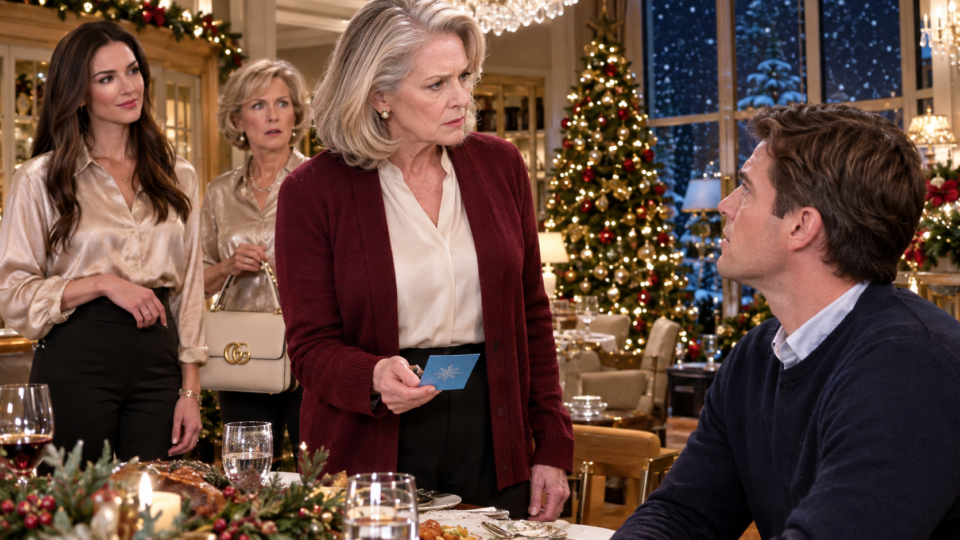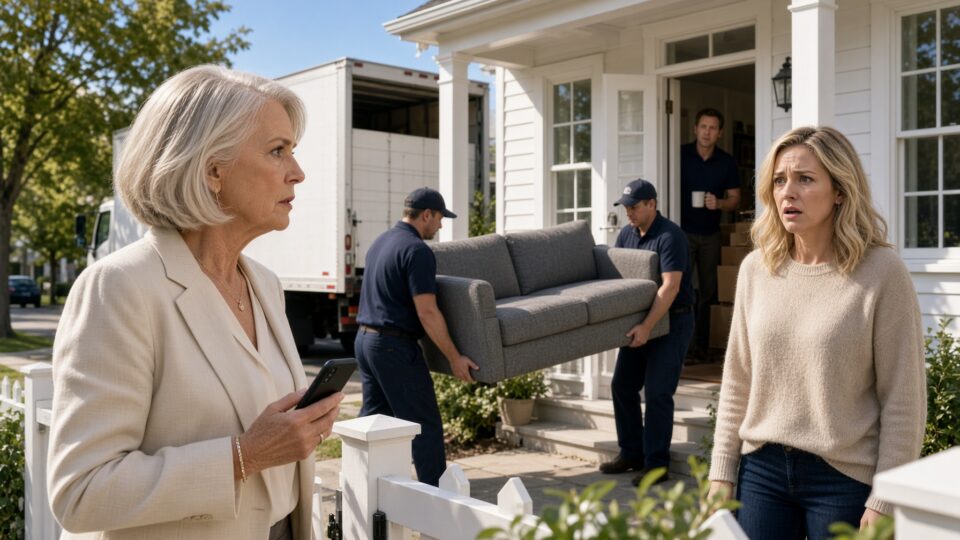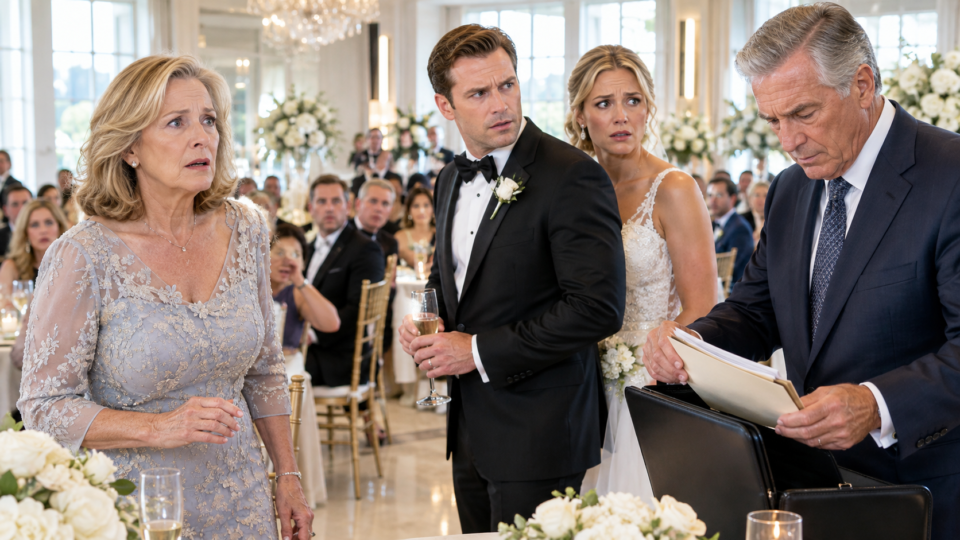
CHAPTER 1 : THE SLAP
I heard my bride slap my mother before I saw it happen.
The sound cracked across the marble ballroom like a gunshot.
One second, two hundred people were talking beneath crystal chandeliers, champagne glasses chiming against one another while a string quartet played near the altar.
The next, there was nothing.
No music.
No laughter.
No conversation.
Just silence.
I was standing near the ballroom entrance with the venue coordinator, arguing quietly about a problem with the seating arrangement, when every head in the room turned toward the center of the dance floor.
Then I saw my mother.
And I forgot how to breathe.
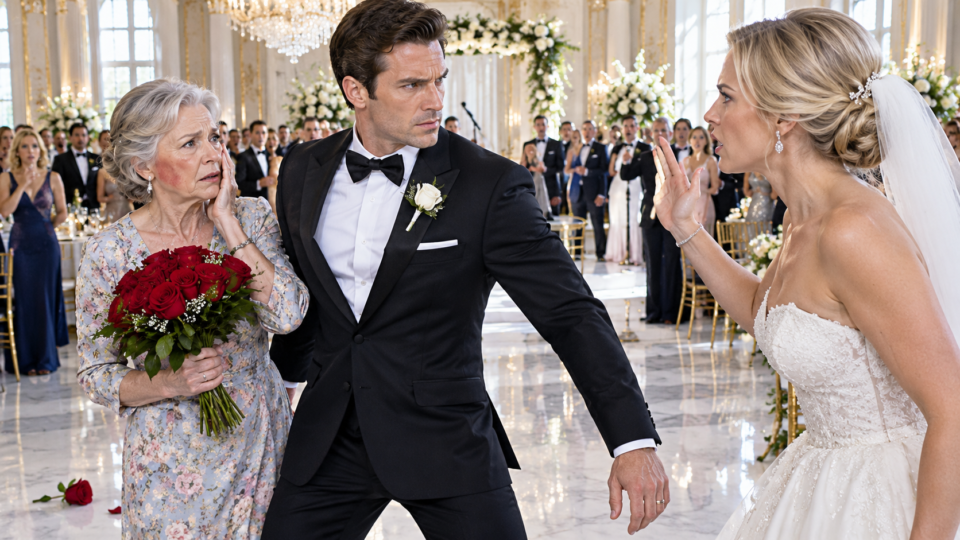
She stood several feet from Lauren, one hand pressed against her cheek.
Bright red roses trembled in her other hand.
One rose lay on the marble floor.
Lauren’s jeweled shoe was crushing it.
For half a second, my mind refused to understand what my eyes were showing me.
My mother was sixty-eight years old.
She was five feet three inches tall.
She had arthritis in both knees, carried peppermints in her purse for children she didn’t know, apologized to furniture when she bumped into it, and still called me every Sunday evening to ask whether I had enough groceries.
There was a red handprint spreading across her face.
And my bride was standing in front of her.
My bride.
Lauren Whitmore.
The woman I was supposed to marry that afternoon.
“You useless old woman!” Lauren snapped.
My stomach dropped.
“You almost stained my dress!”
Someone near the front whispered, “Oh my God.”
A champagne glass hit the floor.
It shattered.
Nobody moved.
Neither did I.
Not immediately.
There are moments in life when your mind divides itself into two pieces.
One part understands exactly what has happened.
The other desperately searches for some explanation that will make it less terrible.
Maybe Margaret had stumbled.
Maybe Lauren had reached out.
Maybe I’d misunderstood the sound.
Maybe—
Then Mom slowly touched her cheek.
And I saw tears filling her eyes.
That was when my body started moving before my mind caught up.
“Mom.”
I barely recognized my own voice.
I pushed between tables, ignoring the chairs and startled guests in my path.
People moved aside.
I reached her and put my arm around her shoulders.
She flinched.
That tiny movement nearly destroyed me.
Then she realized it was me.
“Oh, Daniel.”
She leaned into my side.
I looked at her face.
The mark was already darkening.
“What did she do to you?”
Mom shook her head.
“It’s all right.”
“No.”
“Daniel.”
“What happened?”
Her fingers tightened around the bouquet.
“Please,” she whispered. “Not today.”
Not today.
As if today were somehow too important for what had happened to her to matter.
As if she could swallow humiliation because I had spent months preparing to marry the woman who had caused it.
Then I looked at the roses.
I recognized them.
Not because they were expensive.
They weren’t.
Mom had grown them herself.
They came from the narrow strip of garden behind the little house where she’d raised me.
When I was ten, I’d helped her build the first flower bed using warped pieces of lumber somebody had thrown away.
When I was fifteen, I’d complained that the roses attracted too many bees.
When I left for college, Mom cut three of them and wrapped them in wet paper towels because she couldn’t afford to buy me a proper going-away gift.
Years later, during one of my first dates with Lauren, she had asked me what smell reminded me most of home.
“Red roses,” I’d said.
I’d told her why.
She knew.
And now one of those roses was beneath her shoe.
Lauren finally looked at me.
Her anger shifted almost instantly into something else.
Unease.
“Daniel,” she said. “She almost ruined my dress.”
I stared at her.
“So you hit her?”
“She came too close.”
“She’s my mother.”
“I know who she is.”
The words were sharper than they needed to be.
Mom tugged weakly at my sleeve.
“Daniel, please.”
But I couldn’t stop looking at Lauren.
The ivory silk gown.
The diamonds at her throat.
The veil we’d paid extra to have altered because the original lace hadn’t photographed well enough.
Everything about her looked perfect.
For months, that had been the point.
Perfect flowers.
Perfect venue.
Perfect lighting.
Perfect invitations.
Perfect photographs.
Lauren had spent nearly a year building this day.
And suddenly all I could see was the red mark on my mother’s cheek.
Lauren glanced around.
For the first time, I think she realized what everyone else was seeing too.
Not a bride defending her wedding gown.
A woman who had struck an elderly lady carrying flowers.
“She startled me,” Lauren said.
Mom lowered her eyes.
“I only wanted to give her the roses.”
Lauren’s jaw tightened.
“You walked directly toward me.”
“I thought—”
“You didn’t ask.”
Mom stopped speaking.
That hurt worse than the shouting.
My mother had spent most of her life making herself smaller whenever she believed she was causing someone inconvenience.
My father died when I was nine.
There was no insurance policy worth mentioning. No hidden savings. No relatives with money.
There was only Mom.
She worked mornings in a school cafeteria and evenings cleaning offices.
She wore the same winter coat for eleven years because every time she’d saved enough to replace it, something in our house broke or I needed something for school.
She never told me we were poor.
She called us “careful.”
When I wanted basketball shoes we couldn’t afford, she found an extra Saturday shift.
When I got accepted to college, she cried at the kitchen table and then spent three nights helping me search for scholarships.
When I graduated, she stood in the back row of the auditorium because she’d arrived late after working a shift she couldn’t afford to miss.
That woman was now apologizing for bringing flowers to my wedding.
And the woman I had intended to spend the rest of my life with was letting her.
Something inside me changed.
Not exploded.
Changed.
Quietly.
Permanently.
I looked at Lauren.
“Apologize.”
Her eyebrows lifted.
“What?”
“Apologize to my mother.”
“Daniel, can we not do this here?”
“You did it here.”
Her face flushed.
“People are watching.”
“I know.”
“You’re humiliating me.”
For a second, I genuinely thought I’d misheard her.
“I’m humiliating you?”
Lauren stepped closer and lowered her voice.
“Stop making a scene.”
I laughed once.
There was no humor in it.
My mother had been slapped in front of two hundred people.
And Lauren thought the problem was the scene.
That was the moment I understood something I should have understood much earlier.
The slap wasn’t an accident.
Maybe the movement itself had been impulsive.
But the cruelty behind it wasn’t.
Cruelty like that doesn’t appear from nowhere.
It waits.
It hides behind excuses.
It shows itself in smaller ways until one day the person doing it believes everyone else has learned to tolerate it.
And suddenly I remembered things.
Little things.
Lauren rolling her eyes when Mom called during dinner.
Lauren complaining that Mom’s Christmas gifts were “sweet but cheap.”
Lauren asking why my mother needed to sit with us at a restaurant instead of at the other end of the table with distant relatives.
Lauren laughing when Mom mispronounced the name of an expensive wine.
Every incident had seemed too small to fight over.
Every time, I’d found an explanation.
Stress.
Wedding planning.
Different backgrounds.
Miscommunication.
I had explained away so many things that I had almost explained away the woman herself.
Until she slapped my mother.
Lauren reached for my arm.
“Daniel.”
I stepped backward.
Her hand closed around air.
The musicians had stopped playing.
The photographer had lowered his camera.
Our officiant stood near the altar holding his ceremony folder against his chest.
Two hundred guests waited.
Lauren looked toward them and then back at me.
“Can we please talk privately?”
“No.”
“Daniel.”
“You made it public.”
Her expression changed.
For the first time, real fear entered her eyes.
“What are you doing?”
I looked at Mom.
She was holding those roses against her chest as if they were the only things keeping her upright.
Then I looked at the microphone near the altar.
I knew exactly what I was doing.
I walked toward it.
Lauren followed.
“Daniel, stop.”
I kept walking.
“Please.”
I reached the microphone stand.
My hands were shaking.
Not because I doubted myself.
Because I didn’t.
I removed the microphone.
Static cracked through the speakers.
I looked at the guests.
Then at Lauren.
Then at my mother.
And I pulled the wedding ring from my finger.
I placed it beside the microphone.
Lauren went completely still.
“This wedding,” I said, “is canceled immediately.”
A gasp moved through the ballroom.
Lauren stared at me.
For several seconds, she didn’t seem to understand the sentence.
Then she whispered, “What?”
I had spent eleven months planning that wedding.
I ended it in six words.
And for the first time all day, I felt certain I had done something right.
CHAPTER 2 : WHAT EVERYONE HAD BEEN PRETENDING NOT TO SEE
Nobody cheered.
I’m glad they didn’t.
This wasn’t a victory.
My mother was still standing in the middle of a ballroom with a handprint on her face.
My fiancée was still staring at me as if I’d driven a knife into her.
And two hundred people were still trapped inside one of the most uncomfortable moments any of us had ever experienced.
Lauren found her voice first.
“You can’t be serious.”
I kept the microphone lowered.
“I am.”
“We’re getting married in twenty minutes.”
“No.”
“My parents paid deposits for this.”
“I’ll deal with the money.”
“The guests are here.”
“I know.”
“People flew in from California.”
“I know.”
She stared at me.
Then she laughed.
It was a frightened, brittle sound.
“This is insane.”
Maybe it was.
But I had never felt more awake.
Lauren stepped toward me.
“Your mother surprised me. I reacted. I shouldn’t have, but you’re going to throw away four years because of one mistake?”
There it was.
One mistake.
I looked at Mom again.
She was trying to disappear.
That was when anger finally reached me.
Not the wild kind.
Something colder.
“One mistake would be bumping into her.”
Lauren’s mouth tightened.
“Daniel—”
“One mistake would be knocking the flowers out of her hand.”
“Lower your voice.”
“One mistake would be saying something rude and regretting it.”
I pointed toward my mother’s cheek.
“You hit her.”
“I said I reacted.”
“And then you called her useless.”
Lauren said nothing.
I could see people looking at one another.
Some had heard it.
Maybe Lauren had forgotten.
I hadn’t.
“You didn’t apologize,” I continued. “You blamed her.”
“Because she shouldn’t have—”
She stopped herself.
Too late.
I stared at her.
There was the truth.
Not remorse.
Annoyance.
She still believed Mom had caused the problem.
Lauren’s father, Richard Whitmore, came quickly across the ballroom.
He was a broad man in his early sixties who had spent most of the past year treating the wedding like a corporate merger.
“Daniel,” he said quietly, “let’s go somewhere private.”
“No.”
His expression tightened.
“Son, emotions are running high.”
“I’m not your son.”
The words came out harsher than I intended.
His face changed.
I didn’t apologize.
Lauren’s mother appeared behind him.
“Margaret,” she said, “I’m sure Lauren is terribly sorry.”
My mother immediately shook her head.
“No, please. I don’t want trouble.”
That sentence broke my heart.
Because Mom believed trouble was something she could prevent by accepting whatever people did to her.
I stepped down from the small stage.
“Mom, look at me.”
She did.
“You didn’t cause this.”
“Daniel—”
“You brought flowers.”
Her mouth trembled.
“I thought she’d like them.”
I took the bouquet carefully.
Several stems had bent.
I straightened one without thinking.
“They’re beautiful.”
Mom finally cried.
Not loudly.
One tear escaped and moved down the cheek Lauren hadn’t struck.
I hugged her.
And then I remembered something.
Three weeks before the wedding, Mom had called me.
“Do you think Lauren likes me?”
I’d laughed.
Not because it was funny.
Because the question had seemed ridiculous.
“Of course she likes you.”
“Sometimes I think I make her uncomfortable.”
“Mom, Lauren is stressed. The wedding is making everybody crazy.”
“Maybe.”
“Don’t worry.”
I remembered the pause.
Then Mom had said, “All right, sweetheart.”
I had heard doubt in her voice.
I’d ignored it.
Now I hated myself for that.
Lauren approached us.
“Margaret.”
Mom stiffened in my arms.
Lauren noticed.
So did I.
“I’m sorry,” Lauren said.
The apology sounded painfully rehearsed.
Mom immediately answered, “It’s all right.”
“No,” I said.
Both women looked at me.
“It’s not.”
Lauren’s eyes flashed.
“I apologized.”
“Because the wedding is canceled.”
“What do you want from me?”
I almost answered.
Then I realized that was the wrong question.
It wasn’t about what I wanted.
It was about what she’d done.
“I want you to understand why we’re not getting married.”
Her voice dropped.
“Because I slapped your mother.”
“Because you believe you were entitled to.”
That landed.
Lauren stared at me.
I continued.
“You still think the real problem is that people saw you.”
Her face changed again.
And I knew I’d finally said the thing neither of us could avoid.
Around us, guests began moving.
Not leaving exactly.
Just shifting.
Whispering.
The spell of silence had broken.
My best man, Marcus, came toward me.
“Dan.”
I looked at him.
He glanced at Mom’s face.
His expression hardened.
“You need anything?”
“Get Mom some ice.”
“I’m fine,” Mom protested.
Marcus ignored her.
“On it.”
My cousin Emily appeared next.
“I’ll stay with her.”
Mom looked overwhelmed.
“Please, everybody, don’t make such a fuss.”
Lauren let out a breath.
“You see? Even Margaret wants everyone to calm down.”
I turned toward her.
“Don’t use my mother’s kindness to excuse what you did.”
Lauren recoiled.
For the first time, anger disappeared completely.
What remained was panic.
“Daniel, please.”
I had heard that exact word from Mom minutes earlier.
But they meant entirely different things.
Mom had been asking me to protect the day.
Lauren was asking me to protect her from the consequences.
I looked around the ballroom.
All those white roses.
Hundreds of them.
Lauren had rejected red roses months earlier because she said they looked “too aggressive” against the ivory decorations.
I’d never thought about the irony.
Mom had brought the only red flowers in the room.
Now one lay crushed on the floor.
I walked over and picked it up.
The stem was broken.
Several petals were bruised.
I held it carefully.
Lauren stared at the flower.
Something passed across her face.
Maybe shame.
Maybe fear.
Maybe both.
“Daniel,” she whispered, “I love you.”
That sentence should have mattered.
Four years earlier, it would have stopped me cold.
Four hours earlier, it might have.
Now I asked the only question I could think of.
“Then why couldn’t you love the person who raised me?”
She had no answer.
The wedding never happened.
But leaving turned out to be harder than canceling it.
There were vendors demanding instructions.
Guests asking whether they should stay.
Family members arguing over luggage, transportation, gifts, hotel rooms.
The venue manager wanted signatures.
The photographer wanted to know whether we still wanted the reception photographed.
That question almost made me laugh.
“No.”
“What about the dinner?”
I looked around.
Two hundred meals had already been prepared.
Food didn’t deserve to be wasted because my life had just collapsed.
“Serve it.”
The manager blinked.
“Sir?”
“Serve dinner. Anyone who wants to stay can eat.”
Lauren stared at me.
“You want people to have a party?”
“No. I don’t care what they do.”
Her father stepped forward.
“We paid for part of this reception.”
“Then eat.”
“Daniel.”
“I’m taking my mother home.”
Lauren grabbed my wrist.
“You’re leaving me here?”
I looked down at her hand.
Slowly, she released me.
“Yes.”
Her face crumpled.
For the first time that afternoon, she looked less like the flawless bride she’d worked so hard to become and more like the woman I’d once fallen in love with.
That hurt.
It would have been easier if I had stopped loving her instantly.
I hadn’t.
Love doesn’t obey morality with convenient speed.
Part of me still remembered Lauren barefoot in my apartment kitchen at two in the morning, laughing while we burned pancakes.
Part of me remembered her sitting beside me in the emergency room when I’d fractured my wrist.
Part of me remembered the night I proposed and the way she’d covered her mouth with both hands before saying yes.
Those memories didn’t disappear.
They simply became impossible to reconcile with the woman standing in front of me.
That was worse.
“I made one terrible mistake,” she whispered.
I shook my head.
“No.”
“Daniel—”
“The slap was one moment.”
I looked toward Mom.
“The way you’ve treated her wasn’t.”
Lauren went pale.
She understood.
I remembered.
Not everything.
But enough.
And suddenly she did too.
CHAPTER 3 : THE THINGS I SHOULD HAVE SEEN
Mom lived forty minutes from the venue.
She sat beside me in the passenger seat while Marcus drove my car.
I couldn’t.
My hands wouldn’t stop shaking.
Emily followed us in her own car.
For the first ten minutes, nobody spoke.
Mom held an ice pack against her cheek.
The bouquet rested in her lap.
I stared at it.
“I’m sorry,” I finally said.
Mom looked at me.
“For what?”
I laughed bitterly.
“For asking that.”
“Daniel.”
“I should’ve seen it.”
She lowered the ice pack.
“Seen what?”
“The way Lauren treated you.”
Mom turned toward the window.
That told me more than an answer would have.
“Mom.”
“It wasn’t always bad.”
I closed my eyes.
That sentence is one of the saddest things people say about someone who hurts them.
Not always.
“Tell me.”
“There’s nothing to tell.”
“Please.”
She sighed.
“Lauren and I are different.”
“That’s not an answer.”
“She’s sophisticated.”
“So?”
“She grew up differently.”
“So?”
Mom looked at me.
“I never wanted you caught between us.”
And there it was.
The reason she’d said nothing.
Me.
She had protected my relationship by absorbing things I should have stopped.
“When did it start?”
Mom hesitated.
“Daniel—”
“When?”
She looked back out the window.
“Maybe after you became engaged.”
I felt sick.
Little memories began arranging themselves differently.
Our engagement dinner.
Lauren had chosen an expensive restaurant.
Mom arrived wearing a blue dress I’d seen dozens of times.
Lauren smiled and told her, “You look comfortable.”
I’d thought it was harmless.
Later, Lauren complained that Mom had asked the waiter the price of a bottle of sparkling water.
“She embarrasses herself,” Lauren had said.
I told her to relax.
Christmas.
Mom knitted Lauren a cream scarf.
Lauren thanked her warmly.
Three days later, I found it still folded inside the gift box.
“Cashmere makes me itch,” Lauren said.
It wasn’t cashmere.
She knew that.
Then there was the dress fitting.
Mom came home early.
She’d told me she was tired.
Lauren said Mom seemed bored.
Now I asked, “What happened at the fitting?”
Mom went still.
“Nothing.”
“Mom.”
She rubbed the edge of the bouquet paper.
“One of Lauren’s friends asked whether I was part of the alterations staff.”
My jaw tightened.
“What did Lauren do?”
“She laughed.”
I stared at her.
Mom rushed to soften it.
“Everyone laughed. It was awkward.”
“What happened after that?”
“Nothing.”
“That’s not true.”
She sighed.
“Lauren said maybe I should wear something more formal to the wedding.”
“You bought that dress because she approved it.”
“I know.”
“What exactly did she say?”
Mom looked embarrassed.
That was when I knew it had been bad.
“She said she didn’t want people thinking the groom’s mother had wandered in from a church picnic.”
Marcus swore under his breath.
I felt something twist inside my chest.
“Why didn’t you tell me?”
“Because you loved her.”
“So you let her humiliate you?”
Mom’s eyes flashed.
“Don’t speak to me like I’m helpless.”
I stopped.
She was right.
“I chose not to tell you,” she said. “That was my choice.”
“I’m sorry.”
Her expression softened.
“I knew you were happy. At least I thought you were.”
“I was.”
That was the painful truth.
I had been happy because other people had been paying the price for keeping my happiness uncomplicated.
Mom touched my arm.
“I never expected this.”
“The slap?”
She nodded.
“Neither did I.”
And that was what frightened me.
If Lauren had never slapped her, would I have married her?
Probably.
That question followed me all the way home.
Mom’s house looked exactly as it always had.
Small.
Clean.
Familiar.
The brass numbers beside the door leaned slightly to the left because I’d installed them badly when I was seventeen.
Behind the house was the garden.
I stood in the kitchen while Mom changed clothes.
My tuxedo suddenly felt ridiculous.
I loosened the bow tie and pulled it off.
Marcus put coffee on.
Emily found a vase for the roses.
She carefully trimmed the damaged stems.
When Mom returned wearing gray sweatpants and an old cardigan, I almost cried again.
This was her.
Not the woman standing beneath chandeliers trying desperately not to embarrass her son.
Just Mom.
She sat at the kitchen table.
I sat across from her.
My phone had been vibrating almost continuously.
Lauren.
Lauren.
Lauren.
Then Richard.
Then Lauren again.
Messages piled across the screen.
Please answer.
We need to talk.
Daniel, don’t do this.
I’m sorry.
Please.
My mother watched me turn the phone facedown.
“You should speak to her.”
“No.”
“Eventually.”
“Maybe.”
“Daniel.”
I looked at her.
“Are you trying to save my relationship with the woman who hit you?”
“No.”
“Sounds like it.”
“I’m trying to make sure you don’t make the biggest decision of your life while you’re angry.”
“I already made it.”
“You canceled a wedding.”
“Yes.”
“Marriage is bigger than a wedding.”
“Exactly.”
She went quiet.
That was when she understood.
I hadn’t canceled because Lauren had ruined the ceremony.
I had canceled because the ceremony had shown me the marriage.
“I can’t marry her,” I said.
Mom’s eyes filled.
“Don’t say that because of me.”
“I’m saying it because of me.”
She shook her head.
“You love her.”
“I do.”
It hurt to admit.
“But love isn’t enough.”
Mom looked at me for a long time.
Then she reached across the table.
I took her hand.
“I used to think Dad and I had nothing,” she said quietly.
“You had each other.”
“Exactly.”
She smiled sadly.
“When your father died, people thought the hardest thing was money. It wasn’t. Money was terrible, but I could count it. I knew what we had and what we didn’t.”
Her thumb moved over my knuckles.
“The hardest thing was losing the person I trusted to be gentle with me.”
I couldn’t speak.
She looked toward the roses.
“Never marry someone you have to teach to be gentle after they’ve already decided cruelty is acceptable.”
That sentence settled into me.
My phone vibrated again.
This time I picked it up.
Not to answer.
To turn it off.
Lauren came to the house two hours later.
Of course she did.
Marcus saw her car first.
“You want me to handle it?”
“No.”
I stood.
Mom did too.
“Stay here.”
She frowned.
“This is my house.”
Despite everything, I almost smiled.
“Right.”
The doorbell rang.
I opened it.
Lauren stood on the porch.
She had changed out of her wedding gown.
She wore a beige coat over a white silk slip and had wiped away most of her makeup.
Her eyes were swollen.
She looked exhausted.
Human.
For one dangerous second, I wanted to hold her.
Then I remembered Mom flinching when I touched her shoulder.
“Can I come in?” Lauren asked.
“No.”
Her face tightened.
“Daniel, please.”
“What do you want?”
“To talk.”
“We’re talking.”
“Not on the porch.”
“My mother is inside.”
Lauren closed her eyes.
“I know.”
“Then you know why you’re staying outside.”
She looked past me.
“I’m sorry.”
“Tell her.”
“I will.”
Mom appeared behind me.
“Daniel.”
I stepped aside enough for them to see each other.
Lauren’s eyes immediately dropped to Mom’s cheek.
The mark was darker now.
Her face collapsed.
“Oh my God.”
Mom said nothing.
Lauren covered her mouth.
“I did that.”
It was the first thing she’d said all day that sounded like real understanding.
Not she startled me.
Not she came too close.
Not the flowers.
I did that.
Lauren started crying.
“Margaret, I’m so sorry.”
Mom stood quietly.
“I don’t know what happened to me.”
Mom answered in a voice gentler than Lauren deserved.
“You were angry.”
Lauren wiped her face.
“I would never normally—”
“But you did.”
Lauren froze.
Mom rarely interrupted anyone.
Especially not like that.
“You hit me,” Mom continued. “And I think the worst part was that for several minutes afterward, you seemed to believe I deserved it.”
Lauren looked down.
“I didn’t.”
“You called me useless.”
“I was upset.”
“So was I.”
Silence.
Lauren looked at me.
“I know I was horrible.”
I said nothing.
“I know I’ve been difficult.”
Still nothing.
“I’ve been under pressure for months.”
There it was again.
An explanation reaching toward an excuse.
She seemed to hear it herself.
She shook her head.
“No. That’s not fair.”
I waited.
“My mother kept telling me everything had to be perfect. The photographers, the flowers, the dress. People were posting pictures before the ceremony. I felt like every person there was judging me.”
Mom asked, “So you judged me first?”
Lauren flinched.
“No.”
But the answer was yes.
We all knew it.
Lauren turned toward me.
“I can change.”
Maybe she could.
People do.
Sometimes.
But marriage isn’t supposed to be a wager placed against someone’s worst behavior.
“I hope you do,” I said.
Her eyes brightened with desperate hope.
“But I won’t marry you while I’m waiting to find out.”
The hope vanished.
“Daniel.”
“I can’t.”
“Four years.”
“I know.”
“Our apartment.”
“I know.”
“Our plans.”
“I know.”
“Children.”
That one hit me hardest.
We had talked about them.
Two, maybe three.
Lauren wanted a girl first.
I’d joked that biology didn’t take requests.
We had names saved in a note on her phone.
A whole imaginary future disappeared in that doorway.
I gripped the frame.
“I know.”
She stared at me.
Then her voice became almost inaudible.
“Is there anything I can say?”
I thought about it.
I owed her that much.
“No.”
She nodded.
Slowly.
Painfully.
Then she looked at Mom.
“I’m sorry.”
Mom answered, “I hope someday you’re sorry for the right reason.”
Lauren cried harder.
She turned and walked back toward her car.
I watched until she drove away.
Only then did I close the door.
And only then did I let myself fall apart.
CHAPTER 4 : AFTER THE PERFECT DAY ENDED
People imagine dramatic decisions feel powerful.
They don’t.
Not afterward.
Afterward, they feel like paperwork.
Calls.
Deposits.
Canceled reservations.
Returned gifts.
Confused relatives.
Embarrassing explanations.
Our apartment lease had both names on it.
Our bank accounts were separate, thankfully, but wedding expenses weren’t.
There were invoices everywhere.
Flowers.
Photography.
Catering.
Music.
Decorations.
Hotel rooms.
Transportation.
A cake large enough to feed two hundred people who never watched us become husband and wife.
For three weeks, my life became an administrative autopsy of a marriage that never happened.
Lauren moved out of our apartment first.
She went to stay with her parents.
I returned two days later.
Half the closet was empty.
Her perfume still lingered in the bedroom.
There was a note on the kitchen counter.
I almost threw it away.
Instead, I read it.
Daniel,
I know saying sorry cannot undo what I did.
I keep replaying that moment.
I keep trying to understand how I became someone who could do that.
I don’t expect forgiveness.
I think part of me believed that because the wedding mattered so much to me, everyone around me had an obligation to protect it.
I treated people like decorations in a day that was supposed to be about love.
Your mother did not deserve what I did.
Neither did you.
I’m going to get help.
Not to win you back.
Because I don’t want to be that person again.
Lauren.
I sat at the counter for a long time.
Then I folded the note.
I didn’t call her.
But I didn’t throw it away either.
Because that was the first apology that asked for nothing.
The video appeared online four days after the wedding.
I had known somebody would post it.
Two hundred guests.
Dozens of phones.
It was inevitable.
The clip began seconds before the slap.
Mom walking toward Lauren.
The roses.
Lauren stepping backward.
The hand.
The sound.
Then me arriving.
The video ended shortly after I canceled the wedding.
Within a day, strangers were discussing our lives.
Some praised me.
Some attacked Lauren.
Some accused the entire thing of being staged.
People found our social media accounts.
They found Mom’s.
That frightened me most.
I called her immediately.
“Don’t read anything.”
“What things?”
“Online.”
“I’m sixty-eight, Daniel, not dead.”
“Mom.”
She sighed.
“Emily already changed my privacy settings.”
“Good.”
“Someone sent me three hundred rose emojis.”
I closed my eyes.
“Please don’t respond.”
“I wasn’t going to.”
Then she added, “One woman offered to mail me a casserole.”
I laughed.
It was the first genuine laugh I’d had since the wedding.
Mom laughed too.
For a few seconds, everything felt normal.
Then she said, “Lauren must be having a terrible time.”
My smile disappeared.
“Probably.”
“People can be cruel.”
I almost said she deserves it.
But I stopped.
Because Mom was right.
Holding Lauren accountable didn’t require enjoying her destruction.
I had ended the relationship.
That was my decision.
I didn’t need strangers to punish her for me.
I posted one statement.
It was short.
What happened at our wedding was painful for everyone involved. My mother is safe and recovering. The wedding was canceled, and Lauren and I are no longer together. I ask people not to harass Lauren, her family, or my mother. This is a private family matter, and we will not be discussing it publicly.
Then I deleted the apps from my phone.
I didn’t want applause.
I wanted peace.
A month passed.
Then two.
Mom’s cheek healed faster than either of us did.
She kept insisting she was fine.
I knew better.
She stopped bringing flowers anywhere.
That was how I knew.
At Easter, she bought a bouquet from a grocery store for my aunt instead of cutting flowers from her garden.
I noticed.
“Why didn’t you bring your roses?”
She looked at me.
“They’re not ready.”
They were.
I’d seen them blooming behind the house.
I didn’t push.
The next Sunday, I went to her house early.
I found her kneeling beside the rose bed wearing gardening gloves.
“Need help?”
“No.”
I picked up the pruning shears anyway.
“You always cut them too short,” she complained.
“Then supervise.”
She sighed dramatically.
We worked for nearly an hour.
The garden smelled exactly as I remembered.
Soil.
Leaves.
Roses.
Home.
Eventually I said, “Mom.”
“Hmm?”
“Why did you bring them to the wedding?”
She didn’t answer immediately.
Then she sat back on her heels.
“Because I knew Lauren didn’t really like me.”
The honesty surprised me.
“I thought maybe I could change that.”
“With flowers?”
She smiled.
“It sounds silly when you say it like that.”
“No.”
“I knew she liked expensive things. I couldn’t give her anything expensive.”
My throat tightened.
“So I thought I’d give her something personal.”
She touched one of the blossoms.
“Something from our family.”
I stared at the roses.
“You were welcoming her.”
“Yes.”
“And she thought you were ruining her dress.”
Mom looked down.
“I suppose we were thinking about very different things.”
That sentence explained the entire wedding.
Mom had been thinking about family.
Lauren had been thinking about perfection.
And I had been standing somewhere between them, pretending the difference didn’t matter.
Until it did.
Lauren called me three months after the wedding.
I almost didn’t answer.
Then I did.
“Hello?”
“Hi.”
Her voice sounded different.
Quieter.
“Hi.”
“I won’t keep you.”
“Okay.”
A pause.
“I’ve been seeing a therapist.”
I leaned against my kitchen counter.
“I’m glad.”
“I’ve learned some things I don’t like about myself.”
I didn’t know what to say.
She continued.
“I was angry at your mother long before the wedding.”
That surprised me.
“Why?”
“Because she made me feel insecure.”
“Mom?”
“I know how ridiculous that sounds.”
It did.
But I stayed quiet.
“She never cared about the things I cared about,” Lauren said. “Not in a dismissive way. She just… didn’t need them.”
I thought about Mom’s small house.
Her old cardigan.
Her roses.
Lauren continued.
“My family always cared about appearances. What school you attended. What neighborhood you lived in. What people thought. My mother planned parties like they were military operations.”
I remembered.
“I learned early that if everything looked right, people assumed everything was right.”
“And Mom?”
“She could walk into a room wearing a twenty-year-old dress and be completely herself.”
Lauren gave a sad laugh.
“I hated that.”
“Why?”
“Because I couldn’t.”
The answer silenced me.
It didn’t excuse anything.
But for the first time, I understood something.
Lauren hadn’t looked down on Mom because Mom was weak.
Part of her had resented Mom because she wasn’t.
My mother didn’t need expensive clothes to know who she was.
Lauren had spent her entire life building herself out of things other people could admire.
And on our wedding day, when one imperfect detail moved toward her ivory dress, all that fear became violence.
“I’m sorry,” Lauren said.
“I know.”
“I don’t expect another chance.”
I closed my eyes.
“Good.”
She inhaled sharply.
I hated hurting her.
But kindness and dishonesty aren’t the same thing.
“I loved you,” I said.
“Past tense?”
I looked around the apartment we’d chosen together.
“I don’t know.”
She cried quietly.
“So there’s no hope?”
I could have softened the answer.
I didn’t.
“Not for us.”
A long silence followed.
Then she whispered, “Okay.”
“Lauren.”
“Yes?”
“I hope you become the person you want to be.”
She cried harder.
“Thank you.”
We hung up.
That was the last private conversation we had for almost a year.
CHAPTER 5 : THE ROSE SHE NEVER GOT TO GIVE
A year after the canceled wedding, Mom asked me to drive her somewhere.
“Where?”
“It’s a surprise.”
“I hate surprises.”
“You loved them when you were seven.”
“When I was seven, surprises were usually ice cream.”
“Stop complaining and drive.”
She directed me across town.
We eventually pulled into the parking lot of a community center.
I looked at her.
“What are we doing here?”
“Come inside.”
The building was hosting a spring charity lunch.
Nothing fancy.
Paper decorations.
Folding chairs.
A buffet arranged by volunteers.
Mom had started helping there several months earlier.
I hadn’t known how involved she’d become.
The moment we entered, people greeted her.
“Margaret!”
“There she is!”
“Did you bring them?”
Mom grinned.
“I did.”
She opened the back seat.
Inside were six buckets filled with red roses from her garden.
I stared at them.
“You cut all these?”
“Not all. I left plenty.”
“For what?”
“We’re putting one on every table.”
Something tightened in my chest.
She was bringing roses again.
It shouldn’t have mattered.
It did.
I carried two buckets inside.
Mom carried one.
I tried to take it from her.
She slapped my hand away lightly.
“I have arthritis, not glass bones.”
“Yes, ma’am.”
We placed roses in small vases.
There was no ivory silk.
No chandeliers.
No photographers.
Nobody worried about stains.
Just ordinary people eating lunch together beneath fluorescent lights.
And Mom looked happier than I’d seen her in a long time.
Halfway through the afternoon, she approached me holding one rose.
“For you.”
I took it.
“Why?”
“Because you finally learned not to cut the stems too short.”
I laughed.
Then she became serious.
“Daniel.”
“Yeah?”
“Are you happy?”
The question caught me off guard.
I thought about it.
A year earlier, I would have answered instantly.
I would have measured happiness through plans.
Career.
Apartment.
Wedding.
Future.
Now I understood the question differently.
“I think I’m getting there.”
Mom smiled.
“Good.”
“I still think about her.”
“I know.”
“Sometimes I wonder whether I overreacted.”
Mom didn’t answer immediately.
She adjusted one of the vases.
Then she said, “Do you want me to tell you that you didn’t?”
“Maybe.”
“I won’t.”
I frowned.
She looked at me.
“You made a choice. You’re the one who has to live with it. If I tell you what you should feel, I’m no better than anyone else trying to run your life.”
I smiled slightly.
“That’s annoyingly wise.”
“I’m old. We’re required to become annoying eventually.”
I laughed.
Then she touched my arm.
“But I will tell you this.”
“What?”
“You didn’t cancel your wedding because I asked you to.”
I knew that.
“You didn’t cancel because the guests were shocked.”
I nodded.
“And you didn’t cancel because you stopped loving Lauren in that moment.”
My throat tightened.
“No.”
“You canceled because you saw something you couldn’t pretend not to see anymore.”
I looked at the rose in my hand.
“Yeah.”
“Then trust the man who saw it.”
I saw Lauren again three months later.
Not intentionally.
Marcus was getting married.
Life has a sense of humor.
His wedding was smaller than mine had been.
Outdoor ceremony.
About eighty guests.
No chandeliers.
No marble floors.
No elaborate decorations.
Just trees, string lights, and a wooden arch covered in wildflowers.
I knew Lauren might be there.
Marcus’s fiancée had remained friendly with one of Lauren’s cousins.
Still, seeing her was different from expecting to.
She stood near the far side of the lawn wearing a simple navy dress.
Her hair was shorter.
She saw me at almost the same moment.
Neither of us moved.
Then she walked toward me.
“Hi.”
“Hi.”
“You look good.”
“So do you.”
Awkward silence.
Then her eyes shifted past me.
Mom had just arrived.
Lauren froze.
Mom saw her.
For a second, I was back in that ballroom.
Roses.
Silence.
A red mark.
But this wasn’t that day.
Lauren walked toward Mom.
Slowly.
She stopped several feet away.
Not too close.
“Margaret.”
“Hello, Lauren.”
“I didn’t know you’d be here.”
“Neither did I.”
Lauren nodded.
Then she said something I didn’t expect.
“I’m not going to apologize again.”
Mom raised an eyebrow.
Lauren smiled nervously.
“I mean, I am sorry. I always will be. But I’ve apologized so many times in my head that I think eventually apologies become another way of asking the other person to make you feel better.”
Mom studied her.
“That’s probably true.”
“So I just wanted to say hello.”
“Hello.”
Another silence.
Then Mom smiled.
Not warmly.
Not coldly.
Just honestly.
“Take care of yourself, Lauren.”
Lauren’s eyes glistened.
“You too.”
She walked away.
I watched her go.
Mom nudged me.
“Stop staring.”
“I wasn’t staring.”
“You were.”
“Mom.”
She smiled.
Then she reached into her handbag.
“You won’t believe this.”
“What?”
She pulled out a peppermint.
I laughed so loudly that several people turned toward us.
And something inside me finally loosened.
Later that evening, I stood beneath the string lights while Marcus danced with his new wife.
I watched them.
I expected sadness.
Instead, I felt something closer to gratitude.
Not gratitude for what happened.
I would never be grateful that Mom was hurt.
I would never turn that slap into some beautiful necessary event.
It was ugly.
Cruel.
Wrong.
But I was grateful I had listened to what it revealed.
Because the dangerous moments in life aren’t always the ones that destroy something.
Sometimes they’re the ones that show you what was already broken.
For months after the wedding, strangers told me I was brave.
I never felt brave.
I felt late.
I had missed signs.
I had excused things.
I had allowed the woman I loved to make the woman who raised me feel unwelcome.
The slap forced me to see all of it at once.
But Mom had seen it long before I did.
And she’d carried it quietly because she wanted me to be happy.
That knowledge changed me more than the canceled wedding ever could.
I learned that love without respect eventually becomes permission.
That silence can protect peace for an afternoon while destroying it over years.
That forgiveness does not always mean reconciliation.
That understanding why someone hurts people does not require volunteering to be hurt by them again.
And I learned something else.
There is no wedding beautiful enough to make an ugly marriage worth entering.
Two years after the wedding that never happened, Mom’s rose garden became enormous.
I helped expand it along the back fence.
By “helped,” I mean Mom gave orders while I dug holes.
“Deeper.”
“This is deep.”
“Another inch.”
“You can’t possibly tell from there.”
“I raised you. I know when you’re being lazy.”
I dug another inch.
“Happy?”
“Almost.”
I threw a handful of dirt toward her shoes.
She gasped.
“Daniel Bennett.”
“Sorry.”
“No, you’re not.”
She was right.
We planted six new rose bushes.
When we finished, we sat on the back steps drinking lemonade.
The late afternoon sun stretched across the yard.
Mom looked older.
I noticed that more now.
The silver in her hair.
The fine lines around her eyes.
The careful way she lowered herself onto the step.
For most of my life, I’d believed my mother was permanent.
Children do that.
Even adult children.
Then one day you notice their hands shaking slightly while they hold a glass.
And suddenly time becomes visible.
“You know,” she said, “I almost didn’t bring those roses.”
I looked at her.
“To the wedding?”
She nodded.
“Why?”
“I thought Lauren might think they were too simple.”
I laughed softly.
“You were right.”
“Apparently.”
She smiled.
Then her expression became thoughtful.
“I stood in the garden that morning for twenty minutes deciding.”
“Seriously?”
“Seriously.”
“What made you bring them?”
Mom looked across the yard.
“You.”
“Me?”
“You once told me they smelled like home.”
I remembered.
Of course I remembered.
“So I thought if Lauren was becoming family, she should have something from home.”
I couldn’t answer.
Mom took a sip of lemonade.
For her, it had been that simple.
A bouquet wasn’t decoration.
It was an invitation.
Welcome to our family.
Welcome to our history.
Welcome to the small house and the narrow garden and the woman who worked two jobs to raise the man you are marrying.
Lauren hadn’t understood what was being offered.
At the time, neither had I.
I looked toward the roses.
“Do you regret bringing them?”
Mom considered the question.
“No.”
“Really?”
“Really.”
“Even after everything?”
She nodded.
“I regret being slapped.”
I laughed despite myself.
“Fair.”
“But I don’t regret offering kindness.”
She looked at me.
“Someone else’s reaction doesn’t get to decide whether your kindness was a mistake.”
That sounded exactly like my mother.
Simple.
Stubborn.
True.
That summer, I cut a bouquet myself.
The stems were uneven.
Mom complained.
I ignored her.
I wrapped them in brown paper and brought them to her front door.
She opened it and stared at them.
“What’s this?”
“Flowers.”
“I can see that.”
“For you.”
She took them.
Then inspected the stems.
“You cut these terribly.”
“I knew you’d say that.”
“Half of them won’t fit properly in a vase.”
“Just say thank you.”
“Thank you.”
She smiled.
I kissed her cheek.
The same cheek Lauren had struck two years earlier.
There was no mark now.
Of course there wasn’t.
Skin heals.
But some moments remain.
Not because the wound stays open.
Because healing changes the shape of the person who carries it.
As I turned to leave, Mom called after me.
“Daniel.”
I looked back.
She held the roses against her chest.
For one terrifying second, I saw her exactly as she’d looked in the ballroom.
Small beneath the chandeliers.
Humiliated.
Trying not to cry.
Then the memory passed.
“What?” I asked.
She smiled.
“These are beautiful.”
I smiled back.
“Yeah.”
This time, I knew exactly what they meant.
I drove home with the windows down.
The evening air smelled like summer.
For years, I’d believed the worst thing that could happen on my wedding day was that the wedding might fail.
I had been wrong.
The worst thing would have been watching what Lauren did to my mother…
and marrying her anyway.
I still don’t know what our life would have looked like if I’d ignored that slap.
Maybe Lauren would have changed.
Maybe she wouldn’t.
Maybe we would have built the beautiful house we’d talked about and filled it with expensive furniture and photographs of smiling vacations.
Maybe everyone looking from the outside would have thought we were happy.
But every time Mom came through the door, I would have remembered.
Every Christmas.
Every birthday.
Every family dinner.
Every bouquet of red roses.
I would have remembered the sound of Lauren’s hand against my mother’s face.
And I would have remembered that when the moment came to decide what kind of man I wanted to be, I had chosen appearances over dignity.
I couldn’t live with that.
So yes, I lost a wedding that day.
I lost deposits.
Friends.
Plans.
A woman I had loved for four years.
I lost the future I’d imagined so clearly that I had mistaken imagination for certainty.
But standing there in that silent ballroom, looking at the crushed rose beneath Lauren’s jeweled shoe, I finally understood something that should have been obvious from the beginning.
A wedding is a promise made in public.
A marriage is the life you live after everyone goes home.
And if I couldn’t trust the woman beside me to treat my mother with basic human dignity when she was angry, embarrassed, or under pressure,
then I had no business promising to trust her with the rest of my life.
People still occasionally ask whether canceling the wedding was difficult.
Of course it was.
It was one of the hardest things I’ve ever done.
But the decision itself?
No.
That part was simple.
My mother had walked toward my bride carrying roses from the garden where she raised me.
Lauren answered that gesture with a slap.
And when I finally looked at the woman I was about to marry, I realized the person standing before me was not the person I had promised myself she was.
So I removed my ring.
I walked to the microphone.
And before fear, money, embarrassment, or four years of memories could convince me to betray what I had just seen, I said the six words that changed all three of our lives.
“This wedding is canceled immediately.”
I used to think that was the moment my future ended.
It wasn’t.
It was the moment I stopped sacrificing the truth to protect the future I’d planned.
And sometimes, when I visit Mom and see red roses climbing along the back fence, I think about the one Lauren crushed beneath her shoe.
I don’t remember it as the flower that ruined my wedding.
I remember it as the flower that told me the truth.
And in the end, that truth saved me from making a promise I should never have made.
THE END