CHAPTER 1 : THE SOUND OF PAPER TEARING
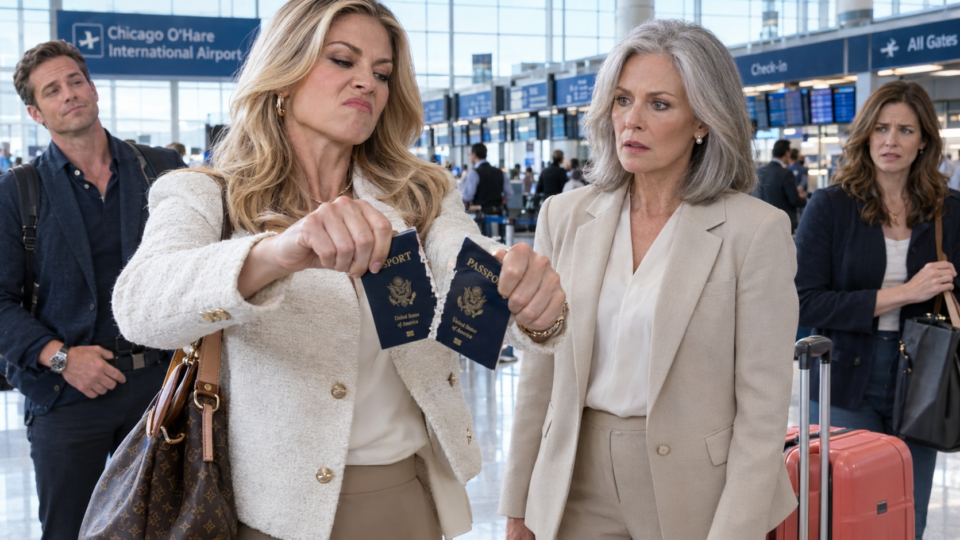
The sound of my passport being ripped in half was sharper than any announcement echoing through Chicago O’Hare.
I still remember it perfectly.
That dry, ugly sound.
Rip.
For one second, I didn’t understand what had happened.
One moment, my passport was in Vanessa’s hand because she had offered to “organize everyone’s documents.” The next, she was holding two blue pieces of what had been my passport.
Then she dropped them into the trash can beside the first-class check-in line.
Just like that.
My stepdaughter smiled at me.
“You’re not going to Hawaii, Maggie.”
I stared at her.
Around us, suitcases rolled across the polished floor. Children cried. An airline employee called for passengers to have their identification ready. Somewhere behind me, an espresso machine hissed.
But all I could hear was Vanessa’s voice.
“You’re staying home to watch my cats,” she continued. “Somebody has to.”
I looked at the trash can.
Then at her.
“What did you just do?”
Vanessa gave an impatient sigh, as though I were the one making a scene.
“Oh, come on. Don’t act dramatic.”
Dramatic.
My passport was lying in a trash can in two pieces, and I was being dramatic.
Vanessa flicked a strand of highlighted blond hair away from her face.
“Princess needs wet food twice a day. Duke gets anxious if his litter box isn’t cleaned properly. I texted you the schedule.”
I didn’t answer.
I looked past her.
My daughter Emily stood several feet away with her carry-on beside her.
My own daughter.
She was thirty-eight years old, married, successful enough to own a nice house in Naperville, and wearing the pearl earrings I had given her on her wedding day.
She had seen everything.
“Emily?”
Her eyes immediately dropped toward the floor.
That hurt.
More than Vanessa’s hand tearing the passport.
More than Derek’s quiet chuckle.
More than the humiliation of strangers pretending not to stare.
“Mom,” Emily said softly, “maybe it’s easier this way.”
Something inside me went very still.
Derek stepped forward.
Vanessa’s husband was forty-one, tall, permanently tanned, and possessed the peculiar confidence of a man who had failed at three businesses but still believed he was the smartest person in every room.
He gave my shoulder a casual pat.
“It’s probably better this way, Maggie.”
His Rolex flashed beneath the airport lights.
I knew that watch.
I knew exactly what it had cost because I had helped pay for it.
“You’d slow us down anyway,” he added.
Behind him, my grandchildren were talking excitedly.
Sophie was twelve.
Ben was nine.
Neither had fully understood what Vanessa had done.
Ben was telling Sophie he wanted to see a sea turtle.
Sophie was checking pictures of the resort on her phone.
The oceanfront villa.
The private pool.
The lanai facing the Pacific.
The villa I had reserved.
The villa I had paid for.
Five first-class tickets.
Airport transfers.
Snorkeling.
A sunset dinner.
A family luau.
Seven nights in Maui.
It was supposed to be my retirement present to myself.
Instead, apparently, I had paid thousands of dollars to become the family cat sitter.
Vanessa glanced at her phone.
“We really have to go.”
I looked at her.
“Did you plan this?”
She rolled her eyes.
“Maggie.”
“Did you know before we came here that you were going to do this?”
Emily shifted uncomfortably.
That was my answer.
Vanessa gave a little laugh.
“We knew you’d argue if we told you at home.”
“So you brought me all the way to the airport.”
“Well, we needed someone to drive with us anyway.”
Another little laugh from Derek.
I looked at Emily again.
“Did you know?”
She wouldn’t answer.
“Emily.”
Her face tightened.
“Mom, please. Not here.”
Not here.
As though the problem was the location.
As though there were some dignified place for your family to explain that they had deliberately brought you to an airport so they could publicly destroy your travel document and send you home to scoop cat litter while they enjoyed the vacation you paid for.
I looked at my daughter for several seconds.
Then I nodded.
“All right.”
Emily finally looked up.
She seemed relieved.
Vanessa smiled.
“There. See? I knew you’d understand.”
Understand.
That word almost made me laugh.
Instead, I adjusted the leather planner hanging from my shoulder.
I had carried planners like that for thirty years.
I had spent three decades as a senior corporate accountant for a Fortune 500 company.
Numbers had been my life.
Numbers did not flatter you.
They did not manipulate you.
They did not tell you that destroying your passport was “easier.”
Numbers simply told the truth.
And the truth was that for the previous seven years, after my husband Richard died, I had become the financial backbone of a family that had slowly learned to treat my generosity as an entitlement.
I had helped Vanessa and Derek buy their house.
I had covered Emily’s wedding expenses when costs went beyond her budget.
I had paid private-school tuition when Sophie needed extra support.
I had paid for car repairs.
Dental bills.
A broken furnace.
Summer camps.
Emergency flights.
Christmases.
Birthdays.
And Derek’s business ideas.
There had always been another business idea.
A mobile fitness company.
A specialty coffee subscription.
An online consulting platform.
Every one had been described as his “breakthrough.”
Every one had somehow required a check from me.
At first, I hadn’t minded helping.
Richard had believed family should take care of family.
So had I.
But somewhere along the way, helping had stopped being something I chose to do.
It had become something they expected.
I just hadn’t admitted it yet.
Until that moment.
Until I saw pieces of my passport sitting among coffee cups and discarded baggage tags.
Vanessa lifted her designer tote higher onto her shoulder.
Inside it were the boarding passes.
Boarding passes purchased with my money.
“Come on,” she said to the others. “We’re going to miss check-in.”
Derek looked at me.
“You know where the spare key is, right?”
I said nothing.
“Kitchen drawer,” Vanessa answered for me. “And Princess won’t eat the cheap brand. It has to be the salmon pâté.”
Then they walked away.
Just walked away.
Emily hesitated.
For perhaps two seconds, I thought she might come back.
She looked over her shoulder at me.
I saw shame in her face.
I saw conflict.
Maybe even regret.
Then Vanessa called her name.
Emily turned away.
And followed them.
I watched my family move toward the counter.
Vanessa was already laughing again.
Derek said something that made Sophie smile.
Ben dragged his little suitcase behind him.
They were discussing cocktails, snorkeling, and whether they should order room service on the first night.
They believed the situation was finished.
They believed I would retrieve my ruined passport from the trash, take a taxi home, feed Vanessa’s cats, and wait patiently for photographs from the vacation I had purchased.
For seven years, that probably would have been exactly what I did.
But they had forgotten something important about me.
Before I became “Mom.”
Before I became “Grandma Maggie.”
Before I became the woman everyone called whenever a credit card was declined or a furnace stopped working…
I had spent thirty years reading contracts.
I knew who owned what.
I knew whose signature mattered.
And I knew exactly whose name appeared on every reservation.
Mine.
I turned away from the trash can.
I did not retrieve the passport.
Not yet.
Instead, I wrapped my fingers around the handle of my coral suitcase.
Then I walked toward customer service.
Every click of those wheels against the airport floor sounded like a decision.
Click.
No more tuition.
Click.
No more emergency checks.
Click.
No more rescuing Derek.
Click.
No more pretending Emily’s silence didn’t hurt.
By the time I reached the counter, my hands had stopped shaking.
A young airline agent smiled at me.
Her name tag said MARIA.
“How can I help you, ma’am?”
I placed my leather planner on the counter.
Then I opened it.
Inside were neatly written confirmation numbers, reservation codes, payment references, and contact information.
Maria looked down at the pages.
Then at me.
“I need to cancel a family reservation.”
“Of course. Which reservation?”
I gave her the number.
She typed.
Her eyebrows lifted.
“All five first-class tickets?”
“Yes.”
She looked at me.
“The whole party?”
“The entire party.”
She hesitated.
“Are you certain?”
I turned slightly.
Across the terminal, Vanessa was posing for a selfie.
Derek stood beside her.
Emily was behind them.
My grandchildren were smiling.
For one dangerous second, I nearly changed my mind.
Not because of Vanessa.
Not because of Derek.
Because of Sophie and Ben.
They hadn’t torn my passport.
They hadn’t planned this.
But then I remembered something Richard used to say.
You can love people without financing their disrespect.
He had said it once about a cousin who constantly borrowed money.
At the time, I had laughed.
Standing in that airport, I finally understood.
I looked back at Maria.
“I’m certain.”
She nodded.
Her fingers moved across the keyboard.
One by one, the seats disappeared.
I called the villa company.
Canceled.
The private airport transfer.
Canceled.
The snorkeling package.
Canceled.
The luau.
Canceled.
The sunset dinner.
Canceled.
Some deposits were refundable.
A few weren’t.
I didn’t care.
The money I lost was tuition.
Not theirs.
Mine.
Maria was helping me finish the airline cancellation when I heard shouting from the first-class counter.
I didn’t need to turn around.
I recognized Vanessa’s voice immediately.
“What do you mean canceled?”
I closed my eyes.
Just for a second.
Then I heard Derek.
“That’s impossible. Scan it again.”
Maria looked at me.
I looked toward the counter.
Vanessa handed over another boarding pass.
The employee scanned it.
A red warning appeared.
Then another.
Then another.
Derek leaned over the counter.
Emily turned around.
Her eyes found mine.
And suddenly she understood.
I closed my planner.
Vanessa stared at me from across the terminal.
The color drained from her face.
Then she started walking.
Fast.
Derek followed.
Emily came behind them.
Vanessa reached me first.
“What did you do?”
I looked at her.
“I canceled my vacation.”
“Your vacation?”
“Yes.”
“You canceled our tickets!”
“They were my tickets.”
Her mouth fell open.
“You can’t do that.”
“I just did.”
Derek stepped forward.
“Okay, Maggie. Very funny. Reinstate them.”
“No.”
His expression changed.
“What?”
“No.”
Vanessa laughed once.
It was a short, disbelieving sound.
“Stop acting ridiculous.”
“I’m not acting.”
“You’re seriously ruining Hawaii because of a passport?”
I looked at her.
“No, Vanessa. You ruined Hawaii because of a passport.”
Her face hardened.
“It was a joke.”
“A joke?”
“Yes.”
“You destroyed a federal travel document.”
Her confidence flickered.
“Don’t make it sound criminal.”
“I didn’t call it anything. I described what you did.”
Emily whispered, “Mom…”
I turned toward her.
She stopped.
For the first time, I noticed Sophie and Ben standing several yards away.
Sophie looked confused.
Ben looked frightened.
I lowered my voice.
“We’re not doing this in front of the children.”
Vanessa folded her arms.
“You already ruined their vacation.”
“No. You decided their vacation was worth humiliating the person who paid for it.”
“They were excited!”
“So was I.”
That silenced her.
Only for a moment.
Then Derek stepped closer.
“Listen, we’re all upset.”
I almost admired the audacity.
“We?”
“Let’s just fix it.”
“You can buy new tickets.”
His expression tightened.
“That’s not the point.”
“It seems exactly like the point.”
“We can’t get five first-class seats this late.”
“Then fly economy.”
Vanessa stared at me.
“You canceled the villa too?”
“Yes.”
“The villa?”
“Yes.”
“The snorkeling?”
“Yes.”
“The luau?”
“Yes.”
She looked genuinely stunned.
Not ashamed.
Not sorry.
Stunned.
As though she had only just discovered actions could have consequences.
Then she said the sentence that changed everything.
“You owe us that trip.”
I stared at her.
“What?”
“You promised us Hawaii.”
Something in my chest finally broke open.
Not painfully.
Cleanly.
Like a lock.
“I owe you?”
Vanessa realized too late how those words sounded.
She opened her mouth.
I raised one hand.
“No.”
She stopped.
“I have spent seven years confusing generosity with obligation,” I said. “That ends today.”
Derek scoffed.
“Maggie, don’t be dramatic.”
I looked at his watch.
Then his shoes.
Then the expensive carry-on I had given him for Christmas.
“You’re wearing several thousand dollars’ worth of my drama.”
His face reddened.
Emily whispered my name again.
I turned to her.
“What?”
She looked close to tears.
“We should go somewhere private.”
“No.”
“Mom—”
“You had privacy before we came here. You could have called me. You could have told me. You could have said you didn’t want me on the trip I paid for.”
“I did want you there.”
“Then why did you let her tear up my passport?”
Emily looked down.
There it was again.
That floor.
That polished airport floor had received more honesty from my daughter than I had.
“I didn’t know she was going to actually rip it,” Emily whispered.
“But you knew I was supposed to stay behind.”
She said nothing.
I nodded.
“That’s what I thought.”
Sophie called from behind us.
“Grandma?”
I turned.
Her eyes were wet.
“Are we not going?”
My anger disappeared immediately.
I walked to her.
“No, sweetheart.”
“Why?”
I glanced at the adults.
Vanessa looked terrified of what I might say.
I refused to use a child as a weapon.
“Because the adults made some bad decisions, and the trip isn’t happening today.”
“Did I do something?”
My heart cracked.
“No.”
I knelt and hugged her.
“Absolutely not.”
Ben joined us.
“What about the turtles?”
“Sea turtles will still be there another day.”
He looked disappointed.
I kissed his forehead.
Then I stood.
Vanessa grabbed my arm.
“You cannot do this.”
I looked down at her hand.
She released me.
“You have twenty seconds to stop touching me,” I said quietly.
She stepped back.
I had never spoken to her like that.
Maybe that was why she finally looked uncertain.
I picked up my suitcase.
Emily stared at me.
“Where are you going?”
“Home.”
“To feed the cats?” Vanessa asked.
For the first time that morning, I smiled.
“No.”
Her face changed.
“What do you mean, no?”
“I mean you should probably find someone else.”
“Our flight was supposed to leave in two hours!”
“Not anymore.”
“Maggie!”
I walked away.
Then I stopped.
Turned.
And looked directly at Vanessa.
“Oh, and Vanessa?”
“What?”
“When you get home, you might want to check the kitchen drawer.”
She frowned.
“Why?”
“Because I won’t be using your spare key again.”
Then I left them standing beneath the glowing departure board.
I thought that would be the end of it.
I was wrong.
My phone began ringing before I even reached the parking garage.
CHAPTER 2 : THE PRICE OF BEING USEFUL
Vanessa called eleven times before I reached my car.
Derek called four.
Emily called twice.
I answered none of them.
I placed my coral suitcase in the trunk and sat behind the wheel without starting the engine.
My hands were shaking again.
Anger had carried me through the terminal.
Now that I was alone, grief took its place.
I stared through the windshield.
I had imagined this morning for months.
Richard had always wanted to take me to Hawaii.
We had talked about it for years.
After retirement, we’d say.
After the mortgage.
After the next promotion.
After Emily’s wedding.
After Vanessa got settled.
After.
There was always an after.
Then Richard had a heart attack at fifty-nine.
There had been no Hawaii.
For three years after his death, I barely traveled anywhere except to see family.
Eventually I realized I was waiting for a future that had already disappeared.
So I planned Maui.
Not as an extravagant gesture.
As permission.
Permission to live again.
And because I loved my family, I invited them into that dream.
That was the part that hurt.
They hadn’t merely taken advantage of my money.
They had taken something that meant something to me and decided I was the least necessary part of it.
I pressed my palms against the steering wheel.
Then my phone lit up.
EMILY
I almost ignored it.
Instead, I answered.
“Hello.”
“Mom.”
She was crying.
I closed my eyes.
“Where are you?”
“In my car.”
“We’re still inside.”
“I assumed so.”
“Vanessa is losing it.”
“That sounds like Vanessa’s problem.”
“Derek says maybe if you call the airline right now—”
“No.”
Silence.
Then Emily said, “Okay.”
That surprised me.
Not because she agreed.
Because she hadn’t argued.
I waited.
Finally she whispered, “I’m sorry.”
I looked through the windshield at airplanes moving beyond the parking structure.
“For which part?”
Another silence.
“All of it.”
“That’s broad.”
“I should have stopped her.”
“Yes.”
“I didn’t think she’d actually rip it.”
“You’ve said that.”
“I thought she’d hide it.”
I went still.
“What?”
Emily inhaled sharply.
Too late.
“Emily.”
She started crying harder.
“What did you mean?”
“Mom…”
“What did you mean when you said you thought she would hide it?”
“She said she was going to make sure you couldn’t board.”
I gripped the steering wheel.
“So you knew.”
“I knew she wanted you to stay behind.”
“Why?”
“She didn’t want you there.”
There are truths you already know before someone says them.
Hearing them still hurts.
“Why?”
“She said you’d make everything feel like a schedule.”
I almost laughed.
I had planned the schedule because Vanessa asked me to.
“And?”
Emily hesitated.
“She said she and Derek wanted the master suite.”
There it was.
The villa had four bedrooms.
The master suite had an oceanfront balcony and soaking tub.
When I booked it, I had mentioned how much I was looking forward to waking up and seeing the Pacific.
Apparently that had been another inconvenience.
“And she thought if I stayed home, she could have it.”
Emily said nothing.
I felt something inside me settle.
Not anger.
Clarity.
“Who suggested the cats?”
“Vanessa.”
“And you agreed?”
“I didn’t know how to tell you.”
“You could have tried the truth.”
“I know.”
“No, Emily. I don’t think you do.”
She began apologizing again.
I stopped her.
“I need some time.”
“Mom, please don’t shut me out.”
“I’m not shutting you out. I’m telling you I need time before I say something I can’t take back.”
She became quiet.
Then she said, “Vanessa says she’s coming to your house.”
My eyes opened.
“Why?”
“She wants to talk.”
“No.”
“I told her that.”
“Tell her again.”
“Okay.”
“And Emily?”
“Yes?”
“Get yourself home safely. Take care of Sophie and Ben.”
“I will.”
I ended the call.
Then I blocked Vanessa and Derek for the afternoon.
Not permanently.
Just long enough to think.
I drove home.
The house felt strange when I entered.
My luggage should have been in Maui that evening.
Instead, my coral suitcase stood in my hallway.
I carried it upstairs.
Then I made tea.
For twenty minutes, I sat at my kitchen table doing nothing.
Eventually, habit took over.
I opened my planner.
Then my laptop.
If emotions were messy, numbers were not.
I began reviewing seven years.
Not because I intended to demand repayment.
I wanted to understand.
There was the $18,000 I had contributed toward Vanessa and Derek’s down payment.
The $7,400 furnace replacement.
The $5,000 I had loaned Derek for the fitness business.
Another $8,500 for the coffee company.
The car repair.
School tuition.
Family vacations.
Christmas.
A medical deductible.
Credit-card debt they had called an emergency.
Emily’s wedding.
Her student-loan payment during maternity leave.
Summer camp for Sophie.
Dental work for Ben.
The total became uncomfortable long before I finished.
I stopped adding.
That was when I understood the real problem.
It wasn’t the money.
I had been fortunate.
Richard and I had saved carefully.
My career had paid well.
I owned my home outright.
I had retirement accounts.
I could afford generosity.
The problem was what my generosity had taught them.
Every crisis ended with Maggie.
Every shortage ended with Maggie.
Every uncomfortable consequence could be transferred to Maggie.
And because I loved them, I had allowed it.
My phone buzzed.
A voicemail notification.
Vanessa.
I listened.
“Maggie, this has gone far enough. The kids are devastated. We lost the trip, we had to pay for transportation back, and now you’re ignoring everyone. You need to call me so we can figure out how you’re going to make this right.”
I played it twice.
Not because I couldn’t believe it.
Because I could.
That frightened me more.
A second voicemail came from Derek.
“Maggie, we all made mistakes today. Vanessa shouldn’t have damaged the passport, but canceling everything was way out of proportion. We’re family. Families forgive each other. Call me.”
Families forgive each other.
Interesting how often people discover forgiveness immediately after consequences arrive.
I closed the laptop.
The doorbell rang.
I didn’t move.
It rang again.
Then pounding.
“Maggie!”
Vanessa.
Of course.
I walked to the front door but didn’t open it.
“What do you want?”
Her voice came through the wood.
“Open the door.”
“No.”
“We need to talk.”
“We’re talking.”
“This is ridiculous.”
I almost smiled.
“You’re developing a very limited vocabulary today.”
“Maggie, open the door.”
“No.”
There was silence.
Then Derek spoke.
He was there too.
“Can we please handle this like adults?”
I leaned against the door.
“Adults generally don’t tear up other adults’ passports.”
“That was wrong,” he said.
Vanessa immediately snapped, “Derek!”
At least one of them was learning.
I waited.
Derek continued.
“But canceling the whole trip hurt everybody.”
“I agree.”
“So fix it.”
“No.”
A pause.
“What exactly do you want?” Vanessa demanded.
That question stopped me.
Because until that moment, I hadn’t thought beyond the airport.
What did I want?
An apology?
Money?
Respect?
Punishment?
None of those words felt quite right.
Then I knew.
“I want you to leave.”
“What?”
“I want you to go home.”
“That’s it?”
“For tonight.”
“And tomorrow?”
“I don’t know.”
“Maggie—”
“I spent seven years solving your emergencies. This is the first one I’m going to let you solve yourself.”
Derek said something I couldn’t hear.
Vanessa lowered her voice.
“You’re going to regret this.”
Maybe she meant it as a threat.
It didn’t sound like one.
It sounded like panic.
I stepped away from the door.
“No, Vanessa,” I said. “I think I’ve been regretting the opposite for a very long time.”
They stayed outside another five minutes.
Then their car finally left.
I returned to the kitchen.
My tea was cold.
I poured it out.
As I did, my phone rang again.
This time it was Sophie.
I answered immediately.
“Hi, sweetheart.”
“Grandma?”
Her voice was small.
“Yes.”
“Mom says you hate us.”
I closed my eyes.
And that was the moment I realized canceling Hawaii had only been the first battle.
CHAPTER 3 : WHAT MY MONEY HAD BOUGHT
“I don’t hate you.”
I said it immediately.
Sophie sniffled.
“Mom said you canceled Hawaii because you were mad at everybody.”
“I was angry.”
“At me?”
“Never at you.”
“What about Ben?”
“No.”
“Dad?”
I hesitated.
Children notice hesitation.
So I chose honesty without cruelty.
“I’m upset with some choices the adults made.”
“Mom says you embarrassed her.”
I sat down.
“Sophie, sometimes two people can remember the same event differently.”
“Did Mom really rip your passport?”
“Yes.”
“Why?”
Because she was entitled.
Because she wanted the master bedroom.
Because she had reduced me to a wallet with a pulse.
None of those belonged in a twelve-year-old’s ears.
“She made a very bad decision.”
“Can’t you get another passport?”
“Yes.”
“Then can we go later?”
My throat tightened.
“I don’t know.”
“Oh.”
I could hear disappointment.
Then she whispered, “I wanted you to come.”
I covered my mouth.
That nearly undid me.
“I wanted to come too.”
“Mom said you wouldn’t like snorkeling.”
I laughed through the ache.
“Your grandfather and I used to scuba dive.”
“What?”
That surprised her.
“Yes.”
“You never told me.”
“You never asked.”
She laughed.
A tiny laugh.
For the first time that day, I felt something warm.
“Grandma?”
“Yes?”
“I’m sorry Mom ripped your passport.”
“Thank you.”
“I think it was mean.”
I swallowed.
“It was.”
“I have to go. Dad’s coming.”
“All right.”
“I love you.”
“I love you too.”
The call ended.
I sat alone at my kitchen table.
Then I cried.
Not loudly.
Not dramatically.
Just quietly.
For Richard.
For Hawaii.
For Emily.
For the years I had mistaken being needed for being loved.
The next morning, I started changing things.
Not out of revenge.
That distinction mattered to me.
I wasn’t going to destroy anyone.
I wasn’t going to demand gifts back.
I wasn’t going to humiliate them publicly.
I was simply going to stop paying for things that were not mine.
I removed my card from the family grocery-delivery account.
I canceled the automatic payment I had been making toward Sophie and Ben’s private-school tuition after the current term.
I stopped the monthly transfer to Derek’s business account.
I removed Vanessa as an authorized user on an emergency credit card.
Then I wrote everything down.
Old habits.
Documentation.
At ten thirty, Emily arrived.
Alone.
I let her inside.
She looked terrible.
Her hair was pulled into a loose ponytail, and there were dark circles beneath her eyes.
“I brought coffee.”
“I have coffee.”
“I know.”
She set the cups on the table anyway.
For a while, neither of us spoke.
Finally she said, “I left Vanessa’s house.”
I looked at her.
“You stayed there?”
“Last night. The kids were upset.”
I nodded.
“She’s furious.”
“I assumed.”
“She says you’re punishing everyone.”
“I’m setting boundaries.”
“She won’t see the difference.”
“That’s not my responsibility.”
Emily looked down.
That floor again.
Even in my kitchen, she found one.
I waited.
Eventually she said, “I’ve been a coward.”
I didn’t reassure her.
She needed to finish.
“I knew what Vanessa was planning.”
“How much?”
“She complained about you coming almost from the beginning.”
“Why didn’t you tell me?”
“Because I didn’t want the fight.”
“So you chose me.”
Her eyes lifted.
“What?”
“You didn’t avoid the fight. You chose who would absorb it.”
She stared at me.
I continued.
“You knew Vanessa would be difficult if you challenged her, so you let me be hurt instead.”
Tears filled her eyes.
“Yes.”
The honesty hurt.
But I respected it.
She wiped her face.
“I’m sorry.”
I said nothing.
“I know saying that isn’t enough.”
“No.”
“I don’t know how to fix it.”
“Good.”
She looked startled.
“You don’t need to fix it today. You need to understand it.”
She nodded.
Then she asked, “What are you going to do?”
“About what?”
“Everything.”
I turned my laptop toward her.
A spreadsheet filled the screen.
Emily recognized it immediately.
She knew her mother.
“What’s that?”
“Seven years.”
She scanned the categories.
Her face changed.
“Mom…”
“I’m not asking anyone to repay me.”
She looked relieved.
Too relieved.
“But I’m finished financing everyone.”
Her head snapped up.
“What does that mean?”
“It means exactly what I said.”
“What about the school?”
“I’ll pay through the current term because I made that commitment. After that, the parents can decide what they can afford.”
“Mom, Sophie loves that school.”
“Then her parents should prioritize it.”
Emily looked uncomfortable.
“What about Derek’s company?”
“No more transfers.”
“Vanessa’s going to explode.”
“She’s welcome to.”
“And emergencies?”
“A genuine emergency involving the children is something I’ll consider. Poor planning is not an emergency.”
Emily stared at the spreadsheet.
Then she said something unexpected.
“You should have done this years ago.”
I looked at her.
She gave a miserable little laugh.
“We all got used to it.”
“At least you admit it.”
“I think we stopped asking whether you wanted to help.”
“Yes.”
“We just assumed.”
“Yes.”
“I’m ashamed.”
I reached across the table and touched her hand.
“I don’t need you to be ashamed forever.”
She cried harder.
“I need you to be different.”
She nodded.
“I can do that.”
“We’ll see.”
That surprised her too.
I had always rushed to reassure my children.
That morning, I realized reassurance could become another kind of rescue.
Emily stayed for an hour.
Before leaving, she hugged me.
I hugged her back.
But forgiveness did not erase the airport.
Love did not erase consequences.
Both things could be true.
At noon, I received an email from Vanessa.
The subject line was:
HAWAII EXPENSES
I almost deleted it.
Instead, I opened it.
She had created a list.
Transportation home from O’Hare.
Airport meals.
A cancellation fee for a pet sitter she had apparently hired after I refused.
Nonrefundable vacation clothes.
A new swimsuit.
Two Hawaiian shirts for Derek.
She had totaled everything.
Then she wrote:
Since you unilaterally canceled the family trip, I expect reimbursement for the costs your decision created.
I stared at the email.
Then I laughed.
I laughed so hard I had to remove my glasses.
Richard would have loved that email.
He had always said Vanessa could turn entitlement into an accounting category.
I did not respond.
Twenty minutes later, she called from another number.
I answered before realizing who it was.
“Maggie.”
I nearly hung up.
Then I decided I was tired of avoiding conversations.
“Yes?”
“Did you see my email?”
“I did.”
“When are you sending the money?”
“I’m not.”
“What?”
“I’m not reimbursing you.”
“You canceled the trip.”
“Yes.”
“Then you’re responsible.”
“No.”
Her voice sharpened.
“You promised us Hawaii.”
“I invited you on a vacation I purchased. You destroyed the document I needed to participate in that vacation.”
“That has nothing to do with Derek’s clothes.”
“Correct. Which is why I’m especially confused about why you expect me to pay for them.”
She inhaled.
“You’ve changed.”
There it was.
The accusation people use when your boundaries become inconvenient.
“Yes,” I said.
That silenced her.
“You’re really going to do this?”
“Yes.”
“To your family?”
“Especially to my family.”
She laughed bitterly.
“Dad would be ashamed of you.”
The room went cold.
Richard.
She had finally reached for the weapon she thought would hurt most.
And it did.
But grief had taught me something.
The dead cannot defend themselves from being used in arguments.
So the living have to protect their memory.
“Do not use your father that way.”
“You know he believed in family.”
“I was married to him for thirty-two years. I know what he believed.”
“He would never have canceled that trip.”
“No,” I said. “He would have taken the passport out of your hand before you tore it.”
Silence.
“And Vanessa?”
“What?”
“Your father would have been horrified by what you did.”
Her breathing changed.
I knew I had hit something real.
For all her faults, Vanessa had adored Richard.
She had been fourteen when I married him.
I had never tried to replace her mother.
I had simply tried to love her.
For years, I thought I had succeeded.
Maybe I had.
Maybe love had simply become tangled with money.
“Maggie…”
“I need space.”
“How much?”
“I don’t know.”
“What am I supposed to tell the kids?”
“The truth.”
She scoffed.
“Your version?”
“No. The simple truth. You destroyed my passport to prevent me from taking a trip I paid for. I canceled the trip. The adults are working through the consequences.”
“You want them to hate me.”
“No.”
And I meant it.
“I want them to learn something better than what we taught you.”
She hung up.
That evening, I made an appointment to replace my passport.
Then I opened the Maui villa website.
The same villa was available six weeks later.
I stared at the photographs.
The ocean.
The balcony.
The palms bending in the wind.
For several minutes, my finger hovered over the booking button.
I closed the page.
I wasn’t ready.
Three days passed.
Then four.
Vanessa stopped calling.
Derek did not.
He left increasingly polite messages.
By the fifth day, I understood why.
His monthly business transfer had failed.
“Maggie, call me. There seems to be an issue with the account.”
There was no issue.
I had simply stopped solving his.
On Friday morning, Derek appeared at my door alone.
This time I opened it.
He looked nervous.
“Can I come in?”
“No.”
He blinked.
“I just need five minutes.”
“You can have them there.”
He glanced toward the neighboring houses.
“Seriously?”
“Four minutes and fifty seconds.”
He exhaled.
“Fine.”
Then he lowered his voice.
“I need the transfer.”
“No.”
“Maggie, payroll is next week.”
“Then I hope your business has enough revenue to cover payroll.”
His jaw tightened.
“You know we’re still growing.”
“You’ve been growing for three years.”
“We’re close.”
“You’ve been close for three years too.”
He rubbed his forehead.
“Vanessa doesn’t know how bad things are.”
That was new.
I said nothing.
“She thinks we have more runway.”
“How much do you need?”
Relief flashed across his face.
“Fifteen thousand.”
I almost laughed.
Then I realized he thought I was considering it.
“No.”
His face fell.
“Maggie.”
“No.”
“If the company folds—”
“Then it folds.”
“You’d let that happen?”
“It isn’t my company.”
“I have employees.”
“Then you should have been more honest about your finances.”
His expression hardened.
“You’re doing this because of the airport.”
“The airport helped me see it.”
“So this is revenge.”
“No.”
“What would you call it?”
“Retirement.”
He stared at me.
“I retired from my job last year. Apparently I forgot to retire from supporting your household.”
He looked at me for a long moment.
Then he said quietly, “You’re going to destroy this family.”
I shook my head.
“No, Derek. If removing my credit card destroys the family, then the family was built on the wrong thing.”
He walked away without saying goodbye.
I watched him get into his car.
For the first time, I wondered how much of their life was real.
The house.
The cars.
The clothes.
The dinners.
The vacations.
How much had they actually been able to afford?
That afternoon, Emily called.
“Mom?”
“Yes?”
“Vanessa and Derek are fighting.”
“I’m sorry to hear that.”
“It’s about money.”
I closed my eyes.
Of course it was.
“She didn’t know how much you were giving him.”
“That’s between them.”
“There’s something else.”
I waited.
Emily took a breath.
“Vanessa says they may have to sell the house.”
And suddenly, the airport didn’t feel like the beginning of their crisis.
It felt like the moment I had finally stopped hiding it from them.
CHAPTER 4 : THE FAMILY MEETING
The following Sunday, Vanessa asked for a family meeting.
Not demanded.
Asked.
That difference was small.
But I noticed it.
We met at Emily’s house because I didn’t want the conversation in mine.
Sophie and Ben were at a friend’s birthday party.
That was intentional.
Some conversations belong to adults.
When I arrived, Vanessa was already sitting at the dining table.
Derek sat beside her.
Emily was in the kitchen.
No one looked comfortable.
Good.
Comfort had protected this problem long enough.
I placed my planner on the table.
Vanessa stared at it.
“You brought the book.”
I almost smiled.
“Yes.”
Derek shifted in his chair.
Emily brought coffee.
Then she sat beside me.
Vanessa noticed.
Something flickered across her face.
“Are we choosing sides now?”
Emily shook her head.
“No.”
“It looks like it.”
“Vanessa, stop.”
I looked at my daughter.
That was the first time I had heard Emily speak firmly to her sister in years.
Vanessa heard it too.
She leaned back.
“Fine.”
I folded my hands.
“You asked for this meeting.”
Vanessa looked at Derek.
He looked at her.
Finally she said, “We’re in trouble.”
I waited.
“We might have to sell the house.”
“So Emily told me.”
Vanessa shot her a look.
Emily did not look away.
Another change.
Derek cleared his throat.
“My company is experiencing a temporary liquidity issue.”
I almost smiled at the corporate phrasing.
“How temporary?”
He didn’t answer.
Vanessa did.
“Permanent.”
He looked at her.
“What?”
“You heard me.”
“Vanessa—”
“No. I’m done pretending.”
She looked at me.
“I found the statements.”
I said nothing.
“He’s been losing money for almost two years.”
Derek’s face tightened.
“It’s a startup.”
“It’s not a startup anymore, Derek. It’s a hole.”
“Very supportive.”
“You lied to me.”
“I was protecting you.”
Vanessa laughed bitterly.
“From arithmetic?”
For one brief, strange second, she sounded exactly like me.
Then she turned back.
“I didn’t know how much you’d been giving him.”
“I wasn’t hiding it,” I said.
“He was.”
Derek looked at me.
“You knew Vanessa didn’t know?”
“No.”
He looked away.
I understood then.
Whenever Derek asked for help, he had framed it as something they had discussed together.
Apparently they hadn’t.
That didn’t excuse Vanessa.
But it explained some things.
Not the passport.
Nothing explained that.
Still, truth rarely arrives in clean packages.
Vanessa looked exhausted.
“I thought we were doing well.”
“You were living well,” I said.
“That isn’t always the same thing.”
She flinched.
I opened my planner.
Derek stared at it.
“I’m not here to audit you.”
His shoulders relaxed slightly.
“I’m here because we need to understand what changes now.”
Vanessa looked at me.
“What changes?”
“My money is no longer part of your household budget.”
Derek leaned forward.
“Maggie—”
“No.”
He stopped.
“I will finish the school tuition through the current term because I promised that. I will continue birthday and Christmas gifts for the children. If Sophie or Ben has a genuine medical emergency, you can call me.”
Vanessa’s eyes narrowed.
“That’s it?”
“Yes.”
“What about the mortgage?”
“No.”
“Derek’s company?”
“No.”
“Cars?”
“No.”
“Vacations?”
“No.”
She laughed without humor.
“So you’re cutting us off.”
“I’m stopping financial support between capable adults.”
“You make it sound so clinical.”
“I’m an accountant.”
Emily almost smiled.
Vanessa saw it.
“You think this is funny?”
“No,” Emily said. “I think Mom is right.”
Silence.
Vanessa stared at her.
“You’re unbelievable.”
“I should have said something years ago.”
“You took her money too.”
“Yes.”
Emily’s answer was immediate.
“I did. And I got used to it. That’s why I’m not pretending this is only about you.”
Vanessa looked at me.
“So she gets forgiven?”
“This isn’t a competition.”
“It always is with her.”
Emily stiffened.
And suddenly I saw something older than Hawaii.
Older than money.
Two sisters who had spent decades measuring themselves against each other.
One biological.
One step.
One afraid she didn’t belong.
One afraid she was being replaced.
Richard and I had worked hard to make us a family.
Maybe sometimes we had worked so hard at making everything equal that we never allowed them to say when something hurt.
Vanessa looked at me.
“You always loved her more.”
Emily whispered, “Vanessa…”
“No. She did.”
I didn’t answer quickly.
Because easy reassurance would have been dishonest.
“I loved you differently.”
Her eyes filled with tears.
“There.”
“That doesn’t mean less.”
“It felt like less.”
I sat back.
“Then I wish you had told me.”
“When? While you were paying for Emily’s wedding?”
“I also contributed to yours.”
“Not as much.”
“Your wedding cost less.”
“That’s exactly what I mean. Everything with you is numbers.”
“No.”
My voice became firmer.
“Numbers are what you use when feelings are being rewritten.”
She stared at me.
“I came to your school conferences. I sat beside you when you had your appendix removed. I helped you move into your first apartment. I watched Sophie for three weeks when you had pneumonia. I flew to Denver when Derek’s father died. I cooked Thanksgiving dinner every year because you said hosting stressed you out. None of those things appear on a spreadsheet.”
Vanessa’s eyes dropped.
“I loved you.”
Past tense slipped out accidentally.
She heard it.
So did I.
I corrected myself.
“I love you.”
Her face crumpled slightly.
“But love does not mean you can humiliate me.”
“I know.”
The words were so quiet I almost missed them.
“What?”
She looked at me.
“I know.”
Derek turned toward her.
Vanessa ignored him.
“I shouldn’t have ripped your passport.”
“No.”
“I shouldn’t have planned to leave you behind.”
“No.”
“I thought…”
She stopped.
“What?”
She wiped beneath one eye.
“I thought you’d complain, then forgive me.”
There it was.
The ugliest truth of the entire situation.
Not hatred.
Certainty.
She had been certain I would absorb it.
Because I always had.
“I probably would have,” I said.
She looked at me.
“Before.”
The room became silent.
Vanessa whispered, “I’m sorry.”
I studied her face.
For the first time since the airport, I believed she understood at least part of what she had done.
But an apology is not a time machine.
“Thank you.”
She waited.
When I said nothing else, confusion crossed her face.
“That’s it?”
“What were you expecting?”
“I don’t know.”
“Forgiveness?”
“Maybe.”
“I’m working on that.”
Her eyes hardened slightly.
“So I have to earn it?”
“No. Forgiveness isn’t a salary.”
“Then what?”
“I can forgive you and still not trust you.”
She looked wounded.
I let her.
Some wounds teach.
Derek shifted impatiently.
“So what are we supposed to do about the house?”
All three women turned toward him.
He looked startled.
I almost laughed.
Vanessa did not.
“You,” she said, “are going to find a job.”
His face changed.
“I have a job.”
“You have a company that loses money.”
“We’ve discussed this.”
“No. You talked and I believed you.”
He looked at me.
“Maggie, can you explain to her that shutting down now would waste everything we’ve invested?”
I stared at him.
“No.”
His mouth tightened.
“You understand sunk costs.”
“Exactly.”
Emily covered a smile with her coffee cup.
Derek looked from one face to another.
For perhaps the first time, he realized there would be no rescue.
The meeting lasted another hour.
Vanessa and Derek would list one of their cars.
They would meet with their mortgage lender.
Derek would suspend his business expansion and look for salaried work.
They would evaluate whether they could keep the house.
None of it involved my checkbook.
When we finished, Vanessa followed me outside.
“Maggie?”
I turned.
She stood on Emily’s porch.
Without makeup and expensive airport clothes, she looked younger.
Almost like the fourteen-year-old girl I had met when Richard first introduced us.
That girl had crossed her arms and told me, “You’re not my mother.”
I had answered, “I know. We can start with Maggie.”
It had taken two years before she hugged me voluntarily.
Twenty-five years later, we were standing on another threshold.
“I really am sorry,” she said.
“I know.”
“Are you going to Hawaii?”
The question surprised me.
“I don’t know.”
“You should.”
I studied her.
She looked down.
“I mean it.”
“Why?”
“Because Dad wanted to take you.”
My throat tightened.
She remembered.
“I found his old travel folder.”
“What travel folder?”
“In one of the boxes you gave me after he died.”
I stared at her.
“He had brochures.”
I couldn’t speak.
“He’d circled Maui.”
Of course he had.
Richard circled everything.
Restaurants.
Hotels.
Newspaper articles.
He believed pens existed to argue with paper.
Vanessa wiped her cheek.
“There was a note.”
“What did it say?”
She hesitated.
Then smiled sadly.
“Take Maggie before she decides everybody else needs the money more.”
I laughed.
Then I cried.
Vanessa cried too.
For a moment, neither of us moved.
Then she stepped forward.
I let her hug me.
I hugged her back.
It did not fix everything.
It was not supposed to.
But it was a beginning.
That evening, I went home.
I found the Maui villa online.
The same balcony.
The same ocean.
The same bedroom Vanessa had wanted.
Six weeks later.
Available.
I entered my payment information.
Then I stopped.
Five travelers.
That had been the original plan.
I changed the number.
One.
My finger hovered over the button.
For most of my life, I had been somebody’s wife, somebody’s mother, somebody’s stepmother, somebody’s grandmother, somebody’s emergency contact.
The idea of traveling alone frightened me.
Then I imagined Richard.
Take Maggie before she decides everybody else needs the money more.
I clicked CONFIRM.
And for the first time, Hawaii belonged only to me.
CHAPTER 5 : THE SEAT BESIDE ME
Six weeks later, I stood in Chicago O’Hare again.
Same terminal.
Same rolling suitcases.
Same departure boards.
Different woman.
My replacement passport was tucked inside a zippered compartment in my purse.
I checked it three times.
Then four.
Old habits.
My coral suitcase rolled behind me.
When I approached the first-class counter, I recognized Maria.
The agent who had canceled the original reservation.
She recognized me too.
Her eyes widened.
“Well,” she said, smiling. “You came back.”
“I did.”
“Going somewhere nice?”
“Maui.”
Her smile grew.
“Good for you.”
I handed her my passport.
She inspected it.
“Looks intact.”
I laughed.
“Let’s keep it that way.”
She printed my boarding pass.
“One passenger?”
“One.”
Saying it aloud felt strange.
Not sad.
Just new.
I went through security.
Bought coffee.
Sat near the gate.
My phone buzzed.
A message from Emily.
Have an amazing trip. Send pictures. I love you.
Then Sophie.
GRANDMA FIND A TURTLE FOR ME!!!
Ben sent six turtle emojis.
I smiled.
Then another message appeared.
Vanessa.
I stared at her name before opening it.
I hope you have the room with the balcony.
I read the sentence twice.
Then typed:
I do.
Three dots appeared.
Disappeared.
Returned.
Finally:
Good. You should have had it the first time.
That mattered more than I expected.
Vanessa and I were not magically repaired.
Real life does not work that way.
She and Derek sold one of their cars.
Derek took a salaried position with a logistics company while winding down most of his business.
They kept the house, though barely.
Vanessa started managing their finances herself.
The first time she told me they had made an entire month’s expenses without borrowing anything, I congratulated her.
I did not offer money.
Emily changed too.
She started saying no.
Not only to Vanessa.
To me.
That was how I knew the change was real.
Healthy boundaries work in both directions.
Once, I offered to pay for Sophie’s summer camp.
Emily said, “No, Mom. We’ve got it.”
A year earlier, that would have hurt my feelings.
Now it made me proud.
And the strangest change happened in me.
I discovered how much of my identity had been built around being useful.
When nobody needed a check, a ride, a rescue, or a solution, I had to ask a question I had avoided for years.
What did I want?
The answers were surprisingly ordinary.
I wanted to travel.
I wanted to take watercolor classes.
I wanted to replace the old chairs on my patio.
I wanted to read novels in the afternoon without feeling guilty.
I wanted Sunday dinners where nobody brought bills.
I wanted my grandchildren to visit because they wanted my stories, not because their parents needed childcare.
I wanted to miss Richard without treating my remaining years as a waiting room.
The gate agent announced boarding.
First class.
Group one.
I stood.
Then my phone rang.
Vanessa.
I considered ignoring it.
Instead, I answered.
“Hello?”
“Are you boarding?”
“Yes.”
“Okay.”
She sounded nervous.
“Is something wrong?”
“No.”
A pause.
Then she said, “I wanted to tell you something before you leave.”
“I’m listening.”
“I was awful.”
I closed my eyes.
“You already apologized.”
“I know. But I don’t think I said the right thing.”
I moved away from the boarding line.
“All right.”
She inhaled.
“I kept telling myself the passport was the problem.”
I waited.
“It wasn’t.”
“No.”
“The problem was that I thought your kindness belonged to me.”
My throat tightened.
She continued.
“I thought because you always helped, you always would. And because you always forgave me, I didn’t have to think about what forgiveness cost you.”
I said nothing.
“I’m sorry for ripping your passport. But I’m more sorry I thought you were the easiest person to sacrifice.”
People moved around me toward the gate.
I looked through the enormous windows at the airplane waiting outside.
“That’s what hurt,” I said.
“I know.”
“I would have given you almost anything if you had asked.”
“I know.”
“That was the problem.”
“I know that too.”
For a moment, we were both silent.
Then Vanessa laughed softly.
“Dad would be yelling at me.”
“He rarely yelled.”
“He’d make that disappointed face.”
I smiled.
“Yes.”
“Worse.”
“Much worse.”
She laughed.
Then her voice became quiet.
“I love you, Maggie.”
I swallowed.
“I love you too.”
“Go to Hawaii.”
“I’m trying.”
“And don’t bring us anything expensive.”
I laughed.
“That may be the most convincing evidence of personal growth I’ve heard.”
“Very funny.”
“I might bring the children something.”
“Fine.”
“Something small.”
“Good.”
“And Vanessa?”
“Yes?”
“Take care of yourself.”
“You too.”
I ended the call.
Then I boarded.
My seat was beside the window.
There was nobody beside me yet.
I placed my purse beneath the seat and touched the passport through the leather.
Whole.
Mine.
Safe.
As the plane taxied toward the runway, I thought about the first trip.
Five tickets.
Five people.
Thousands of dollars.
A villa.
Excursions.
Plans.
I had believed generosity guaranteed togetherness.
It didn’t.
Money can purchase seats beside you.
It cannot make the people sitting in them respect you.
The engines grew louder.
Chicago began sliding past the window.
Then we lifted.
For the first time since Richard died, I felt something I had almost forgotten.
Anticipation.
Not obligation.
Not responsibility.
Not usefulness.
Anticipation.
When I arrived in Maui, warm air wrapped around me the moment I stepped outside.
It smelled faintly of flowers and salt.
A driver held a sign with my name.
MARGARET COLLINS.
Not Mom.
Not Grandma.
Not Maggie, can you help?
Margaret Collins.
I smiled.
“That’s me.”
The villa was even more beautiful than the photographs.
The manager showed me through the kitchen, living room, patio, and finally the master suite.
He opened the balcony doors.
The Pacific stretched beyond the railing.
Blue beyond anything I had imagined.
For several seconds, I couldn’t move.
“Will this room work for you?” he asked.
I laughed.
“Yes.”
After he left, I placed my suitcase beside the bed.
Then I walked onto the balcony.
The sun was beginning to sink.
Gold spilled across the water.
I thought of Richard.
I wished he were there.
That grief would always be part of me.
But for once, wishing for him did not make the moment feel empty.
It made it precious.
I took out my phone.
Sophie had sent another message.
TURTLE YET???
I replied:
I’ve been here eleven minutes. Give your grandmother a chance.
Then I took a photograph of the ocean.
I sent it to the family group chat.
Emily responded with hearts.
Sophie demanded turtle pictures.
Ben wanted to know whether there were sharks.
Derek wrote:
Beautiful view. Enjoy it, Maggie.
Then Vanessa replied.
Dad would have loved that.
I looked at the ocean.
“Yes,” I whispered.
“He would.”
The next morning, I went snorkeling.
I was the oldest person in my group.
Derek would have been shocked.
Our guide helped us into the water near a reef.
At first, my breathing sounded too loud inside the mask.
Then I looked down.
The world changed.
Blue water.
Sunlight.
Coral.
Fish flashing silver and yellow.
And then, beneath me, a green sea turtle moved slowly through the water.
Beautiful.
Ancient.
Completely unconcerned with anyone’s schedule.
I laughed into my snorkel.
The guide pointed toward it.
I already had my underwater camera ready.
For Ben.
For Sophie.
For myself.
The turtle disappeared into deeper water.
I floated there for another minute.
Then I thought about the airport.
The trash can.
The torn passport.
Vanessa’s smile.
Emily looking at the floor.
Derek saying I would slow them down.
At the time, it had felt like one of the worst moments of my life.
Maybe it was.
But terrible moments can reveal things comfortable ones hide.
If Vanessa had simply asked me to watch her cats, I might have done it.
If she had complained enough, I might even have canceled Hawaii myself.
I might have handed over the master bedroom.
I might have paid for everyone and thanked them for allowing me to come.
That was the frightening part.
The passport forced me to see what gradual disrespect had made invisible.
When I returned to the boat, the guide helped me aboard.
“You did great,” he said.
“Not too slow?”
He looked confused.
“Slow?”
I smiled.
“Never mind.”
That evening, I attended the luau alone.
At first, I felt self-conscious.
Families surrounded me.
Couples held hands.
Children ran between tables.
Then an older woman sitting nearby introduced herself.
Her name was Carol.
She was seventy-one and traveling alone after a divorce.
We talked through dinner.
She had been to fourteen countries.
Alone.
“You get used to it,” she said.
“To being alone?”
She shook her head.
“To not waiting.”
That sentence stayed with me.
The following days were filled with small freedoms.
I ate breakfast whenever I wanted.
I read beside the pool.
I booked a sunset cruise.
I bought Sophie a turtle necklace and Ben a ridiculous shark T-shirt.
For Emily, I found a pair of handmade earrings.
For Vanessa, I bought nothing expensive.
Just a postcard.
On the front was a photograph of the ocean.
On the back, I wrote:
Family should be a place where love is given freely, not where kindness becomes a debt.
I stared at the sentence.
Then added:
We’re learning.
That felt more honest.
On my final night, I sat on the balcony with a glass of wine.
Richard’s old photograph rested beside me.
I had carried it in my planner.
“You were right,” I told him.
The ocean answered.
“You usually were.”
That was not entirely true.
Richard would have argued.
I smiled.
“I finally came.”
The sun touched the horizon.
I thought of all the money I had spent over the years.
Some of it I regretted.
Most of it I didn’t.
Helping my family had never been the mistake.
Believing help had to continue regardless of how I was treated—that had been the mistake.
Generosity without boundaries does not always create gratitude.
Sometimes it creates expectation.
And expectation, fed long enough, can become entitlement.
I had learned that in the ugliest possible way.
But I had learned something else too.
Boundaries did not destroy my family.
They revealed it.
Emily remained.
The grandchildren remained.
Even Vanessa remained.
Different.
Uncomfortable.
Imperfect.
But trying.
Derek had stopped asking me for money.
For the first time, our conversations were about ordinary things.
Weather.
Work.
Ben’s soccer games.
The Bears losing.
I discovered I liked him better when I wasn’t financing him.
Maybe he liked himself better too.
Six months after Hawaii, Vanessa invited me to dinner.
I almost said no.
Then I went.
The meal was homemade.
Nothing fancy.
No expensive restaurant.
No expectation that I would pay.
After dinner, Sophie showed me a school project.
Ben made me watch a video about sharks.
Derek talked about his new job.
Then Vanessa brought out coffee.
“We have something to tell you.”
I raised an eyebrow.
“No business proposal, I hope.”
Derek laughed.
“No.”
Vanessa sat across from me.
“We made a budget.”
I stared at her.
“A real one?”
She nodded proudly.
“Emergency fund too.”
I looked at Derek.
“Whose idea?”
“Vanessa’s.”
“Smart woman.”
Vanessa smiled.
“We paid off one credit card.”
“That’s wonderful.”
“And we’re not asking you for anything.”
“Even more wonderful.”
Everyone laughed.
Then Vanessa became serious.
“There is one thing.”
I waited.
She reached into a drawer.
For half a second, old instincts returned.
A bill?
A request?
Instead, she placed a small box in front of me.
I opened it.
Inside was a passport holder.
Dark blue leather.
Simple.
Embossed in small gold letters:
MARGARET — GO WHERE YOU WANT
I stared at it.
Vanessa looked nervous.
“I know it doesn’t fix anything.”
“No.”
“I know.”
I touched the leather.
“It’s beautiful.”
Her eyes filled.
“I’m sorry.”
This time, I reached across the table.
I took her hand.
“I forgive you.”
She cried.
So did I.
Forgiveness did not mean I restored the old financial arrangements.
I never did.
That mattered.
Because if forgiveness requires returning to the conditions that allowed someone to hurt you, it is not forgiveness.
It is surrender.
We built something different instead.
Slower.
Less expensive.
More honest.
A year after the airport incident, Sophie asked me to tell the story at dinner.
“The passport story?”
Vanessa groaned.
“No.”
Ben laughed.
“Yes!”
Derek covered his face.
Emily, who had joined us that evening, nearly spit out her drink.
Sophie looked at me.
“Grandma, were you really going to let them go without you?”
I thought about it.
“No.”
Vanessa pointed at me.
“She canceled everything in about six minutes.”
“Seven,” I corrected.
Emily laughed.
“Of course she knows the exact time.”
“I’m an accountant.”
Ben stared at Vanessa.
“Mom, why did you rip Grandma’s passport?”
The table became quieter.
Vanessa looked at me.
I let her answer.
She took a breath.
“Because I was selfish.”
Ben considered this.
“That was dumb.”
Derek choked on his water.
Vanessa nodded.
“Yes. It was.”
Sophie looked at me.
“And Grandma canceled everything?”
“Yes.”
“Was that mean?”
Another silence.
Everyone looked at me.
I thought carefully.
“I was angry.”
“That’s not an answer.”
Twelve-year-olds are dangerous that way.
I smiled.
“Sometimes consequences feel mean when we don’t like them.”
Sophie considered that.
Then nodded.
“Did you really go by yourself later?”
“Yes.”
“Were you scared?”
“A little.”
“Was it fun?”
“Very.”
“Did you see turtles?”
“You have photographic evidence.”
She smiled.
Then she asked, “Would you go alone again?”
I looked around the table.
At Emily.
At Vanessa.
At Derek.
At my grandchildren.
At the family that had nearly broken itself because we had confused money with love and silence with peace.
“Yes,” I said.
“I would.”
Vanessa smiled.
“Good.”
Later that night, I drove home alone.
My house was quiet when I entered.
Once, quiet had frightened me.
Now it felt peaceful.
I placed my purse on the counter.
Inside it was my passport.
I carried it more often than necessary.
Maybe because I liked knowing I could leave.
Not leave my family.
Leave expectation.
Leave obligation.
Leave any place where love demanded I disappear.
I went upstairs.
On my bedroom wall was a framed photograph from Maui.
The sunset from the villa balcony.
Beside it was another photograph.
A sea turtle beneath blue water.
And beneath those pictures sat the blue passport holder Vanessa had given me.
GO WHERE YOU WANT.
Sometimes I still thought about that first morning at O’Hare.
I remembered Vanessa ripping the passport.
Derek laughing.
Emily staring at the floor.
And me standing there with my coral suitcase, humiliated in front of strangers.
If I could speak to that woman now, I would tell her something.
I would tell her not to cry.
Not because what happened wasn’t cruel.
It was.
Not because family betrayal doesn’t hurt.
It does.
I would tell her not to cry because the sound she had just heard was not only a passport being torn apart.
It was something else breaking too.
An old agreement.
One I had never consciously made.
The agreement that I would always pay.
Always forgive immediately.
Always make things easier.
Always absorb the discomfort so everyone else could remain comfortable.
Always stay home if someone needed me there.
That agreement had been destroyed in the same instant as my passport.
And unlike the passport, I never replaced it.
I replaced something else instead.
My sense of myself.
A woman who could say no.
A mother who could love without rescuing.
A stepmother who could forgive without surrendering.
A grandmother whose grandchildren knew her as a person, not simply the woman who paid.
A widow who finally took the trip she and her husband had postponed for too many years.
A sixty-four-year-old woman sitting in first class with a new passport, a coral suitcase, and an empty seat beside her that no longer felt empty.
Vanessa had thought tearing my passport would keep me home.
For a few hours, it did.
But in the end, she gave me something neither of us expected.
A reason to stop waiting for permission.
A reason to look at everything I had been paying for and ask what it was actually costing me.
A reason to discover that being loved and being useful were not the same thing.
And a reason to finally understand what Richard had tried to tell me years before.
You can love people without financing their disrespect.
I still loved my family.
I probably always would.
But now, when we traveled together, everyone paid what they could.
When someone had a problem, I listened before reaching for my checkbook.
When someone asked me for something, I allowed myself to say no without providing a three-page explanation.
And when I wanted something for myself, I no longer waited to see whether someone else needed the money first.
The following spring, I booked Italy.
One ticket.
My ticket.
When Sophie found out, she gasped.
“You’re going alone again?”
“Yes.”
“Grandma!”
“What?”
“You’re becoming one of those traveling grandmas.”
I smiled.
“I certainly hope so.”
Vanessa was standing behind her.
Our eyes met.
For one tiny moment, I think we both remembered the airport.
The trash can.
The pieces of blue paper.
Then she smiled.
“Keep your passport away from me.”
I laughed.
“Oh, believe me.”
She laughed too.
And this time, the laughter didn’t hurt.
I zipped my passport safely inside my purse.
Whole.
Valid.
Mine.
Just like the life I had finally remembered belonged to me.