CHAPTER 1: THE CHRISTMAS SHE THOUGHT SHE OWNED
The moment my daughter-in-law announced she had invited twenty-five people to my house for Christmas without asking me, she smiled as if the house already belonged to her.
“My whole family will be there,” Whitney said brightly. “It’s only twenty-five people.”
Only.
I stood on the other side of my kitchen island with both hands wrapped around a mug of coffee that had already gone cold.
Outside, the December sky over Kentucky had turned the color of dirty wool. It wasn’t even four o’clock, but darkness had begun settling over the fields behind my house. Bare branches scratched at the windows whenever the wind came down from the creek.
Inside, Whitney looked like she had dressed for a Christmas catalog.
Red dress.
Black heels.
Diamond earrings.
Expensive perfume.
Not one grocery bag in sight.
She was studying my kitchen while she spoke—not looking at me, exactly, but at my counters, my double oven, the breakfast nook, the doorway into the dining room.
Like a woman inspecting a venue she had already booked.
“I figured we could put the children in the den,” she continued. “The adults can use the dining room and kitchen. We’ll need your folding tables from the basement.”
“We?”
She either didn’t hear the word or chose not to.
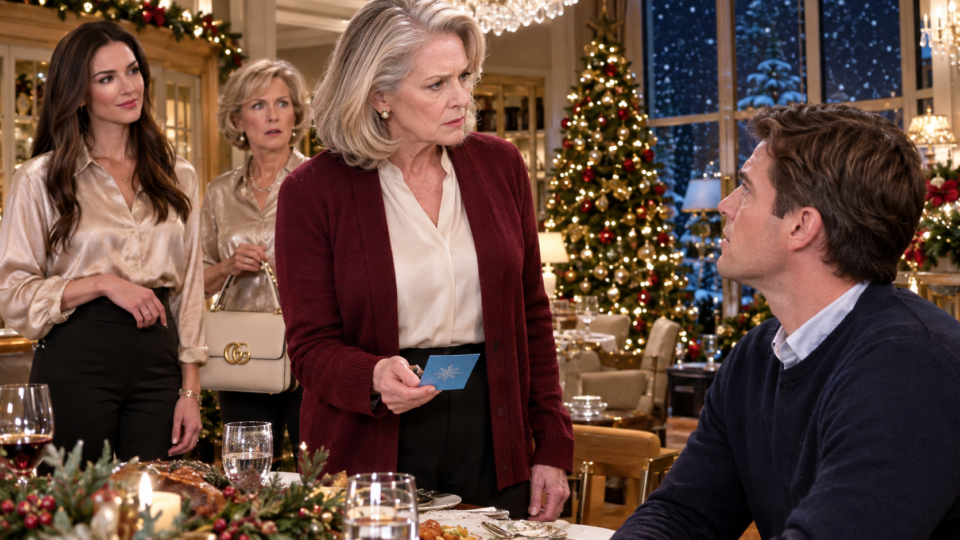
“And my mother thinks the tree would look better by the front windows this year. That way people can take pictures when they come in.”
I looked toward my Christmas tree.
I had decorated it myself six days earlier.
Every ornament on it had a memory.
A wooden horse Trevor painted in second grade.
A glass angel my husband, Frank, bought me our first Christmas in the house.
A crooked little snowman Trevor made from cotton balls when he was seven.
My mother’s silver bell.
Apparently, those memories were now interfering with Whitney’s photographs.
She opened my refrigerator.
Actually opened it.
“What have you bought so far?”
That was when something inside me went completely still.
It wasn’t anger.
Anger would have been familiar.
I had been angry with Whitney before.
I had been angry when she volunteered me to host Easter brunch for eighteen people.
Angry when she invited her cousins to use my backyard for the Fourth of July and told me about it two days beforehand.
Angry when she announced at Thanksgiving that I was making two turkeys because her brother “didn’t really like ham.”
I had swallowed every bit of it.
This was different.
This was the moment when anger had finally burned itself clean.
“Nothing,” I said.
Whitney turned around.
“Nothing?”
“For Christmas.”
Her smile weakened.
“But Christmas is next week.”
“I’m aware.”
“Well, you usually start shopping by now.”
Usually.
That word had ruled my life for years.
Carolyn usually makes the turkey.
Carolyn usually has extra sheets.
Carolyn usually makes that pecan pie.
Carolyn usually doesn’t mind.
Carolyn usually pays.
Carolyn usually cleans up.
Carolyn usually smiles.
Women my age were raised to believe that love meant labor.
You remembered birthdays nobody else remembered.
You knew which child hated onions and which uncle couldn’t eat nuts.
You bought groceries.
You washed sheets.
You cleaned bathrooms before guests arrived and cleaned them again after guests left.
You carried folding chairs upstairs.
You put casseroles in the oven while everyone else opened wine.
You stood over a sink with swollen feet while laughter floated in from another room.
Then, at the end of the evening, somebody hugged you and said, “What a beautiful Christmas.”
Nobody asked who had made it beautiful.
For forty years, that person had been me.
Christmas happened in the same brick house outside Louisville.
Same scratched roasting pan.
Same porcelain dishes carried carefully down from the top cabinet.
Same sore knees at midnight.
When Frank was alive, he helped.
He carved the turkey, washed whatever I dirtied, and at eleven at night, when everyone had finally gone home, he would pour us each half a glass of wine.
“To another successful invasion,” he used to say.
I would laugh.
Then he died.
And somehow, after that, the invasion stopped being funny.
Whitney shut my refrigerator.
“Okay,” she said slowly. “Well, I can send you the menu.”
“No need.”
“Carolyn.”
“Whitney.”
Something in my voice finally made her look at me.
Really look.
I set my coffee on the counter.
“Wonderful,” I said. “Have all twenty-five people.”
Her smile returned.
“See? I knew—”
“But I won’t be here.”
Silence.
The refrigerator motor hummed behind her.
“What?”
“I’ll be away for Christmas.”
The smile disappeared completely.
“You’re joking.”
“No.”
“But we’re having Christmas here.”
“You’re having Christmas here.”
Her eyebrows drew together.
“I don’t understand.”
“You invited them. So you can buy the groceries, cook the food, set the tables, wash the sheets, clean the bathrooms, entertain the children, wash the dishes, take out the trash and put the house back together afterward.”
She stared at me as though I had begun speaking another language.
“Carolyn, I don’t cook for twenty-five people.”
“Neither did I the first time.”
“But you like doing this.”
There it was.
I almost laughed.
Instead, I asked, “Who told you that?”
“You always do it.”
“That wasn’t my question.”
Her face tightened.
For five years, Whitney had treated my house like a private country club with no membership fee and a built-in cook.
The strange part was that she could be delightful while doing it.
In public, Whitney was warmth and charm.
She kissed cheeks.
She remembered names.
She complimented dresses.
She posted photographs online with captions about gratitude and family.
People loved her.
And if you saw her only in those moments, you would have thought I was lucky to have her.
But without an audience, Whitney’s sweetness could disappear in a second.
The first time I noticed it was after an Easter dinner three years earlier.
Her relatives had left.
Trevor was outside loading their car.
I was scraping dried potatoes from a casserole dish when Whitney came into the kitchen.
I said, “Next year, I think somebody else should host.”
She didn’t even look up from her phone.
“But everyone likes it here.”
“It’s getting difficult for me.”
She sighed.
“Carolyn, you’re sixty-five, not ninety.”
Then Trevor walked back in.
Her face changed instantly.
She kissed my cheek.
“Thank you for everything. It was perfect.”
Trevor saw the kiss.
He didn’t hear what came before it.
That became the pattern.
And Trevor?
My only son had perfected the art of seeing just enough to feel guilty and not enough to act.
“Mom, you know how Whitney can be,” he would whisper.
Yes.
I knew exactly how Whitney could be.
What Trevor never understood was that eventually, “That’s just how she is” becomes another way of saying, “So you’ll have to be the one who keeps surrendering.”
The front door opened.
“Whit?”
Trevor’s voice carried down the hallway.
A moment later, he entered the kitchen wearing his navy office coat, his tie loosened at the collar.
He stopped when he saw our faces.
“What happened?”
Whitney folded her arms.
“Your mother says she’s leaving for Christmas.”
Trevor looked at me.
“Leaving?”
“I’m taking a trip.”
“When?”
“December twenty-third.”
“Where?”
“Does it matter?”
“Yes, Mom, actually, it does.”
“Why?”
“Because everyone already made plans.”
“I’m sure they did.”
His mouth tightened.
“It’s Christmas.”
“Yes.”
“It’s family tradition.”
That sentence hurt more than I expected.
Not because it was cruel.
Because Trevor believed it.
He believed tradition was something that simply existed.
Like weather.
Like gravity.
Not something his mother created through forty years of work.
I looked at him.
“Tell me something, Trevor. What part of the tradition belongs to you?”
He blinked.
“What?”
“The turkey?”
“Mom—”
“The shopping? Cleaning? Decorating? Guest rooms? Desserts? Dishes?”
“That’s not fair.”
“Which part?”
Whitney stepped between us.
“Nobody is forcing you to do anything.”
I looked at her.
“You invited twenty-five people to my home.”
“They’re family.”
“They’re your family.”
“They’re Trevor’s family too.”
“Then Trevor can cook.”
My son closed his eyes briefly.
“Can everybody calm down?”
That almost made me smile.
When a woman finally stops doing what everyone expects, somebody always asks her to calm down.
I crossed the kitchen into the hallway.
Beside the coat closet stood my suitcase.
I had brought it downstairs that morning.
Trevor saw it.
His expression changed.
“You’re serious.”
“Very.”
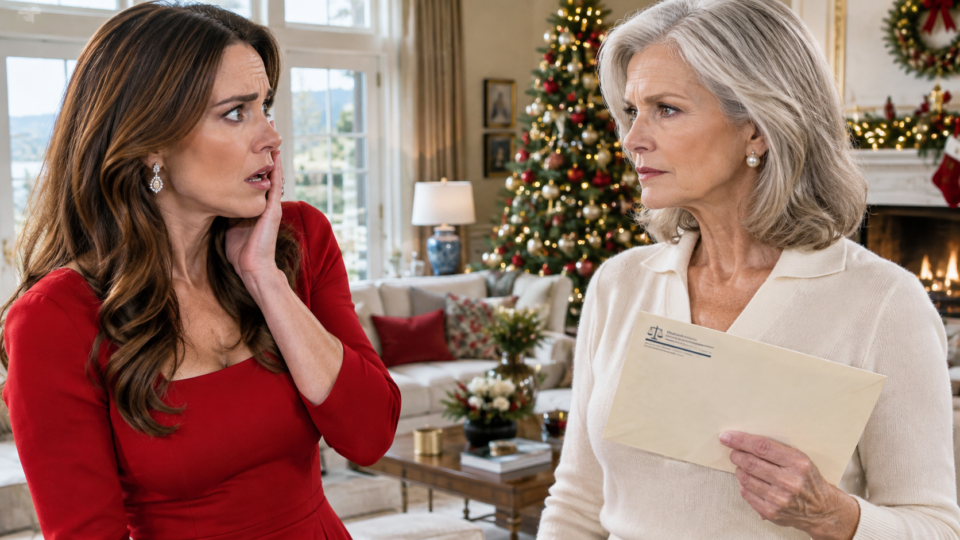
On the hallway table lay a cream-colored envelope.
I picked it up.
Whitney noticed the letterhead before Trevor did.
**Harrison, Pike & Weller — Attorneys at Law.**
Her face changed.
Not dramatically.
Whitney was too controlled for that.
But I saw her shoulders stiffen.
Three days earlier, I had sat in the office of Elaine Harrison, an estate attorney with silver hair and a habit of looking over her glasses when she asked important questions.
I had changed documents that had remained almost untouched for thirty years.
For three decades, I had intended to leave everything to Trevor.
My savings.
My investments.
My home.
And the land behind the creek that my parents had left to me.
Trevor knew that.
I had never hidden it.
But Trevor had treated it as something for the future.
Whitney had started treating it as something already purchased.
Twice, I had heard her say:
“When this place belongs to us…”
The first time, she was talking about remodeling the kitchen.
The second time, she was standing on my back patio with her mother.
“When this place belongs to us, I’m getting rid of those old trees. They block the view.”
Those trees had been planted by my father.
Something had shifted inside me that day.
Not enough to act.
Not yet.
But enough to begin paying attention.
Now Whitney stared at the envelope in my hand.
“Carolyn,” she said quietly. “What did you sign?”
I looked at her.
Then at my son.
I had set up a trust.
I had changed the beneficiaries.
And I had included one particular provision concerning the house that would make Whitney’s Christmas plans considerably more expensive than she understood.
I opened my mouth.
Then Trevor’s gaze moved past me.
Toward the mantel.
There was another cream-colored envelope sitting beside Frank’s old brass clock.
This one did not come from my attorney.
And it wasn’t addressed to Trevor.
Whitney’s name was written across the front.
I saw her notice it.
All the color drained from her face.
Trevor frowned.
“Whitney?”
She said nothing.
He walked toward the mantel.
She moved before he did.
“Don’t.”
One word.
Too sharp.
Too frightened.
Trevor stopped.
I looked from Whitney to the envelope.
That envelope had arrived by certified mail that morning.
I had signed for it because Whitney had used my address.
Again.
I had not opened it.
I didn’t need to.
The return address had already told me enough.
It came from the mortgage company handling the loan application Whitney had been talking about for weeks.
The loan she claimed would finance renovations on “their future property.”
My property.
Trevor looked at his wife.
“What is that?”
Whitney swallowed.
“Nothing.”
I had spent sixty-eight years learning that whenever someone looks terrified and calls something nothing, it is almost always the exact thing you should pay attention to.
I held out my hand.
“Maybe,” I said, “Christmas can wait five minutes.”
And for the first time that afternoon, Whitney stopped acting like she owned my house.
She started acting like she was afraid of losing something.
CHAPTER 2: WHEN THIS PLACE BELONGS TO US
Trevor reached for the envelope.
Whitney grabbed it first.
“Why is my mail coming here?” she demanded.
It was an impressive attempt.
Turn fear into anger.
Turn the question around.
Make somebody else defend themselves.
I had watched her do it before.
“You used my address,” I said.
“I must have made a mistake.”
“For a mortgage company?”
Trevor looked at her.
“Mortgage?”
“It’s not what you think.”
He gave a humorless laugh.
“I haven’t told you what I think.”
Whitney held the envelope against her chest.
“It was preliminary.”
“What was?”
She glanced at me.
That glance told me something important.
Whatever she had done, she had expected to explain it to Trevor eventually.
She had never expected to explain it in front of me.
“Can we talk at home?”
Trevor shook his head.
“No.”
“Trevor.”
“Why did a mortgage company send something to my mother’s address?”
Whitney’s jaw tightened.
“I was looking at financing options.”
“For what?”
Silence.
I knew.
Not every detail.
But enough.
For months, Whitney had talked about renovating my house.
At first, I thought it was simply another one of her fantasies.
The kitchen was “dated.”
The upstairs bathrooms were “embarrassing.”
The dining room wall should come down.
The den needed French doors.
The back acreage could support another structure.
She even once mentioned converting the old barn into an event space.
I had laughed.
She had not.
One afternoon in October, I came into the kitchen and found her photographing the room.
“What are you doing?” I asked.
“Just getting ideas.”
“For my kitchen?”
“For someday.”
That word again.
Someday.
A polite word for after you’re dead.
I began noticing other things after that.
A measuring tape left on the kitchen counter.
A contractor’s business card beside the sink.
Whitney asking casually how many acres were attached to the property.
Whitney wanting to know whether the mortgage had been paid off.
Whitney asking Trevor whether there were “tax complications” when property passed from a parent to a child.
Each question, by itself, could be explained.
Together, they formed a sentence.
She was planning a life in my house.
A life that required me to no longer be living in it.
Trevor stared at his wife.
“Financing what?”
Whitney exhaled.
“The renovations.”
He went still.
“What renovations?”
“For here.”
He looked at me.
Then back at her.
“Here?”
“I told you I was getting estimates.”
“You said you were getting ideas.”
“That’s what estimates are.”
“No, Whitney.”
Her voice sharpened.
“Fine. I talked to a lender. That’s all.”
“Using Mom’s address?”
“Because this is the property.”
“This is Mom’s property.”
“I know that.”
“Do you?”
The question hung between them.
I watched my son’s face.
For years, I had wished he would defend me.
Now that he finally was, I found I didn’t enjoy it as much as I thought I would.
Because I could see what it cost him.
Marriage teaches people to build a shared version of reality.
Trevor’s was cracking in my hallway.
Whitney turned toward me.
“You’re making this sound sinister.”
“I haven’t said anything.”
“That’s worse.”
“Why?”
“Because you’re standing there judging me.”
I thought of Easter.
Thanksgiving.
The Fourth of July.
The Christmas lists.
The meals.
The bills.
The phrase *when this place belongs to us.*
“I’m listening,” I said.
Trevor held out his hand.
“Open the letter.”
Whitney stared at him.
“Seriously?”
“Yes.”
“It’s addressed to me.”
“And it concerns my mother’s house.”
For a few seconds, nobody moved.
Then Whitney tore open the envelope.
She read.
Her eyes moved faster the farther down the page she got.
Trevor held out his hand again.
She gave it to him.
I watched his face while he read.
“What does it say?” I asked.
He looked up at Whitney.
“You applied for a home-equity loan.”
“Not exactly.”
“It says application.”
“It wasn’t finalized.”
“On Mom’s house?”
“No. Against the property once it transferred.”
My skin went cold.
There are sentences that reveal more than the speaker intends.
That was one of them.
Trevor lowered the page.
“Once it transferred?”
Whitney looked trapped now.
“Eventually.”
“Eventually when?”
She didn’t answer.
He asked again.
“When, Whitney?”
“When the house became yours.”
“My mother is standing right there.”
“I know she’s standing there!”
The words cracked through the hallway.
For once, Whitney’s mask slipped completely.
Her cheeks flushed.
Her eyes shone with anger.
Then she saw my face.
And she understood.
This wasn’t about Christmas anymore.
Maybe it never had been.
She softened her voice.
“Carolyn, nobody wants anything to happen to you.”
What a strange sentence to say when nobody had accused you of wanting anything to happen.
“I’m relieved,” I said.
She flinched.
Trevor dropped the letter onto the table.
“You planned a loan based on property I don’t own.”
“I was planning ahead.”
“With my inheritance.”
“That’s not fair.”
“Isn’t it?”
Whitney turned on me.
“You told him he would inherit this house.”
“I did.”
“So I wasn’t inventing anything.”
“No.”
Her expression changed.
She thought she had found solid ground.
“You see?”
“But I changed my mind.”
The room became silent.
Trevor stared at me.
Whitney stared harder.
“What does that mean?” Trevor asked.
I lifted the envelope from my attorney.
“It means this house is no longer part of an inheritance you can count on.”
Whitney’s lips parted.
Trevor looked hurt.
That was the first moment my resolve wavered.
He was still my son.
I remembered him at six years old, asleep on Frank’s chest.
At twelve, crying when his dog died.
At seventeen, trying to pretend he wasn’t nervous before his first date.
At twenty-nine, standing beside Whitney at their wedding, looking happier than I had ever seen him.
A mother can know her adult child has failed her and still remember every version of him that came before.
“Mom,” he said. “What did you do?”
“I protected my home.”
“From me?”
I shook my head.
“From entitlement.”
Whitney laughed once.
A small, bitter sound.
“There it is.”
“What?”
“You never liked me.”
“That isn’t true.”
“You’ve been waiting for an excuse.”
“Whitney—” Trevor began.
“No. She has. She’s always thought I was some gold digger.”
“I never used that word.”
“You didn’t have to.”
She pointed toward my attorney’s envelope.
“Look at what you’ve done.”
I felt something harden inside me.
“What I’ve done?”
“Yes.”
“You applied for financing against a future interest in property you do not own.”
“It was planning.”
“You invited twenty-five people to my house without asking.”
“It’s Christmas.”
“You told your mother you would remove my father’s trees after I was gone.”
Her face changed.
She hadn’t known I heard that.
Trevor turned.
“You said what?”
Whitney shook her head.
“That is completely out of context.”
“No,” I said. “It was actually remarkably clear.”
She looked at me with naked anger now.
“What do you want, Carolyn?”
The question surprised me.
Not because I didn’t know.
Because nobody had asked me that in years.
What did I want?
Not what Christmas needed.
Not what Trevor wanted.
Not what Whitney expected.
Me.
“I want,” I said slowly, “to stop being treated like the caretaker of everybody else’s future.”
Nobody answered.
I opened the attorney’s envelope.
“The house has been transferred into a trust.”
Whitney’s eyes narrowed.
“What kind of trust?”
“One you don’t control.”
“Who does?”
“I do while I’m alive.”
“And after?”
I looked directly at Trevor.
“The house will not pass outright to you.”
He swallowed.
I continued.
“You are still a beneficiary of part of my estate.”
His expression shifted.
Whitney’s did too.
“But not the house,” I said.
“Then who gets it?” Whitney asked.
“That depends.”
“On what?”
“On what happens to it.”
I had spent weeks discussing that question with Elaine.
I didn’t want to punish Trevor.
I wanted to protect the thing my parents had built and Frank and I had spent decades maintaining.
So the trust contained instructions.
After my death, Trevor would receive a defined portion of my financial assets.
The land behind the creek would remain protected.
And the house itself would not become anyone’s personal windfall.
Trevor could occupy it under specific conditions if he chose, but he could not borrow against it, sell it for a quick profit, or transfer control to someone else.
If he declined those conditions, the trust would sell the property and distribute the proceeds among the beneficiaries I had named, including charitable gifts important to Frank and me.
Whitney could not build her plans on it.
That was the point.
Trevor rubbed a hand across his mouth.
“You did all this without telling me.”
“Yes.”
“Why?”
“Because if I had told you first, would you have asked what I wanted?”
He looked away.
That was answer enough.
Whitney stepped toward me.
“You can change it back.”
I almost admired the certainty.
“I could.”
“Good.”
“I won’t.”
Her eyes flashed.
“Carolyn, think about what you’re doing.”
“I have.”
“To your son.”
That landed exactly where she intended.
But I was ready for it.
“I am leaving my son an inheritance. I am simply no longer leaving him my obedience.”
Trevor whispered, “Mom.”
“I love you. But love and ownership are not the same thing.”
Whitney folded the mortgage letter.
Very carefully.
“You’re going to regret this.”
Trevor looked at her sharply.
“What is that supposed to mean?”
She grabbed her coat.
“It means she’s blowing up this family over a Christmas dinner.”
“No,” I said.
Whitney stopped at the door.
“I’m refusing to cook a Christmas dinner. If that blows up the family, then perhaps dinner was holding up more than it should have.”
She left.
The door slammed.
Trevor remained.
For a while, neither of us spoke.
Finally he looked toward my suitcase.
“Are you really leaving?”
“Yes.”
“Where are you going?”
I told him.
A small inn in Asheville.
Frank and I had once planned to spend Christmas there.
We never did.
There was always family.
Always a meal.
Always another reason to wait until next year.
Trevor nodded.
Then he asked the question that told me he still didn’t understand.
“So what are we supposed to do about Christmas?”
I looked at my son.
And for the first time in his forty-one years, I let the problem remain his.
“I suppose,” I said, “you’ll have to figure it out.”
CHAPTER 3: THE PRICE OF “TRADITION”
For the next three days, my phone behaved like a fire alarm.
Whitney called twice.
I didn’t answer.
Her mother called.
I didn’t answer that either.
Then came the messages.
*Whitney says there’s been a misunderstanding.*
*Everyone has already arranged travel.*
*The children are looking forward to it.*
*Couldn’t you just do Christmas this year and discuss everything afterward?*
That last one came from Whitney’s aunt.
I stared at it for a long time.
Do Christmas this year.
Meaning cook.
Clean.
Pay.
Smile.
Then afterward, once everyone had eaten my food and slept in my beds and left my house dirty, perhaps I would be permitted to discuss whether I had wanted any of it.
I put the phone facedown.
On Saturday morning, Trevor came over alone.
He knocked.
That mattered.
My son had a key.
He had always used it.
That morning, he knocked.
I opened the door.
“Coffee?” I asked.
“Please.”
We sat at the kitchen table.
For once, there was no Whitney between us.
No Christmas list.
No emergency.
Just a mother and her son.
He looked tired.
“We had a fight.”
“I’m sorry.”
“Are you?”
“Yes.”
He studied me.
“I thought you hated her.”
“I don’t.”
“Could’ve fooled me.”
“I hate some of the ways she treats me. That isn’t the same thing.”
He nodded slowly.
Then he said, “She says the loan application was just research.”
“Do you believe her?”
“I believe she didn’t think she was stealing anything.”
That was a careful answer.
“She thought the house would be mine eventually,” he continued. “And I think in her head, that made planning for it okay.”
“Does it make it okay in your head?”
He stared into his coffee.
“No.”
I let the silence sit.
Trevor had always been gentle.
As a boy, that gentleness made him kind.
As a man, it sometimes made him cowardly.
He hated conflict so much that he would allow the stronger person in a room to decide what everybody else had to tolerate.
I had blamed Whitney for taking advantage of that.
I was beginning to understand that I had done it too.
Every time Trevor said, “Mom, you know how she is,” and I said, “Fine,” I taught him that he did not have to choose.
I would absorb the cost.
That was my part in this.
Not the cause.
But the pattern.
“I should have said something earlier,” I told him.
He looked up.
“You did.”
“No. I complained. Then I kept doing everything.”
“That’s because you love us.”
“Yes.”
“And you like having everyone here.”
“I liked parts of it.”
That surprised him.
I smiled sadly.
“I loved seeing you. I loved the children running around. I loved using your grandmother’s dishes. I loved the moment after dinner when everybody was full and the house was noisy and, for ten minutes, I could look around and think, Frank would have loved this.”
My throat tightened.
“But loving the result didn’t mean I loved being taken for granted.”
Trevor’s eyes dropped.
“I did that.”
“Yes.”
“I’m sorry.”
Two words.
No excuses.
I had waited years to hear them.
They did not fix everything.
But they opened a door.
He leaned back.
“Whitney says you’re trying to control us with the inheritance.”
I almost smiled.
“If I wanted to control you with money, I would promise you more, not less.”
He considered that.
“What exactly does the trust say?”
So I explained it.
Not every legal phrase.
The meaning.
The house was protected.
The acreage could not simply be carved up according to somebody’s development fantasy.
Trevor would receive money, but not the blank check he and Whitney had assumed.
If he ever lived in the house after I was gone, there were restrictions.
No loans against it.
No immediate sale.
No transfer to a spouse.
No treating the property as a guaranteed source of capital.
He listened.
When I finished, he asked, “Was that clause because of Whitney?”
“Partly.”
He winced.
“The rest was because of me.”
“You?”
“I spent too much of my life believing the best thing I could leave you was everything I owned.”
“What changed?”
“I realized the best thing I could leave you might be the knowledge that you were never entitled to it.”
He looked at me for a long time.
“That sounds harsh.”
“It felt harsh to write.”
I reached across the table.
“I am not trying to leave you nothing, Trevor. I’m trying to stop my death from being part of somebody else’s financial plan.”
His face crumpled for half a second.
Then he looked away.
“I never thought of it like that.”
“I know.”
That was the tragedy of it.
He hadn’t.
Whitney had.
But he had allowed her to.
After he left, I began packing.
I packed sweaters.
Comfortable shoes.
A book I had been pretending I would read for six months.
Frank’s old scarf.
On December twenty-third, I loaded the suitcase into my car.
Before leaving, I walked through the house.
The tree lights glowed in the front room.
The refrigerator was almost empty.
The kitchen counters were clean.
No turkey thawing.
No pies cooling.
No grocery receipts tucked beneath the fruit bowl.
It felt wrong.
Then it felt wonderful.
I left a key for Trevor.
Not Whitney.
Trevor.
With it was a note.
**You may use the house for Christmas. Please leave it as you found it. Everything else is your responsibility. Love, Mom.**
I drove away at ten that morning.
The farther I got from Louisville, the easier I breathed.
I expected guilt to chase me.
It did.
At the first gas station.
At lunch.
When I saw a minivan full of children wearing Santa hats.
When a Christmas song Frank loved came on the radio.
But guilt is not always proof that you are doing something wrong.
Sometimes it is simply the pain of breaking an old habit.
By evening, I reached Asheville.
The inn had a stone fireplace, pine garlands and an enormous tree decorated with dried oranges and gold ribbon.
A young woman at the desk smiled.
“Christmas getaway?”
I looked at Frank’s scarf looped around my neck.
“Something like that.”
My room overlooked the mountains.
I ordered dinner.
For myself.
One plate.
One glass.
One fork.
When I finished, I put the plate outside the door.
Somebody else washed it.
I nearly cried.
Christmas Eve morning, Trevor called.
I answered.
“Everything okay?”
A pause.
“Define okay.”
I smiled.
“What happened?”
“Whitney’s mother is here.”
“Already?”
“She wanted to help.”
“That sounds promising.”
“She brought six centerpieces.”
“Less promising.”
“And Whitney ordered groceries.”
“Good.”
“For fifteen people.”
I laughed before I could stop myself.
“Twenty-five are coming.”
“I know.”
“Does she?”
“She does now.”
He sounded exhausted.
“Mom, how do you calculate how much food people need?”
The question was so sincere that I almost rescued him.
Almost.
“Experience.”
“Helpful.”
“You have the internet.”
“I know.”
“Then use it.”
He sighed.
“I deserved that.”
“Yes.”
At three, he called again.
“Where’s the roasting pan?”
“Lower cabinet beside the dishwasher.”
“It’s not there.”
“Then Whitney moved it.”
“She says she didn’t.”
I pictured the scratched old pan.
Then remembered.
“I put it in the basement after Thanksgiving. Bottom shelf near the freezer.”
“Got it.”
An hour later:
“How long does a twenty-pound turkey take?”
“Trevor.”
“Right. Internet.”
At six:
“Do you own a second gravy boat?”
“No.”
“Whitney says you do.”
“Whitney is welcome to search.”
By eight, I stopped answering.
I sat downstairs near the inn fireplace with a glass of wine.
An older couple played cards at a table near me.
Someone’s little girl slept curled in an armchair.
Snow began falling beyond the windows.
And for the first time in decades, Christmas Eve did not feel like an exam I was afraid to fail.
My phone buzzed.
A photograph from Trevor.
My kitchen.
Boxes everywhere.
A turkey sitting in the sink.
Whitney’s six centerpieces taking up half the dining room.
Three children already running through the background.
Underneath, he had written:
**I understand now.**
I looked at those words until they blurred.
Then another message arrived.
This one was from Whitney.
**We need to talk when you get back. There are things Trevor doesn’t understand.**
A minute later, another.
**You’ve put him in a terrible position.**
Then:
**This trust affects both of us. You had no right to make a decision this big without discussing it with your family.**
I read that sentence twice.
No right.
To decide what happened to my own property.
Without discussing it with people who had already decided what should happen to it.
I did not respond.
At nine-thirty, Trevor called again.
His voice was different.
Quiet.
“Mom?”
“What is it?”
“I found something.”
My stomach tightened.
“What?”
“A folder.”
“Where?”
“In the desk in the den.”
I knew the desk.
Frank’s desk.
Whitney had been using it that week to organize Christmas.
“What kind of folder?”
Trevor took a breath.
“Contractor estimates.”
I closed my eyes.
He continued.
“Kitchen. Bathrooms. Back patio. Barn conversion.”
I said nothing.
“And there’s a sketch.”
“For what?”
“The property.”
The fire popped in front of me.
“What kind of sketch?”
“Lot divisions.”
There it was.
Not a new betrayal.
Just the full shape of the old one.
The acreage.
My father’s trees.
The creek.
The land Whitney had asked about.
All those casual questions.
All those photographs.
All those plans for someday.
Trevor’s voice broke.
“She had all this planned, Mom.”
“I know.”
“No. I mean really planned.”
I could hear him turning pages.
“There are notes about what things could be worth.”
I stared into the fire.
“Trevor.”
“What?”
“Ask her.”
“Ask her what?”
“Ask her why she was planning to divide property she did not own.”
He went silent.
Then, from somewhere away from the phone, I heard Whitney’s voice.
“Who are you talking to?”
Trevor didn’t answer.
Her voice came closer.
“Trevor?”
Then the line went dead.
I sat with my phone in my hand.
Five minutes passed.
Ten.
Twenty.
At eleven-fifteen, a message arrived.
Not from Trevor.
From Whitney.
**You have no idea what you’ve done.**
I looked at it.
Then I turned my phone off.
Because for once, I did know.
I had stopped making it easy.
And apparently, easy had been the foundation of everything.
CHAPTER 4 : TWENTY-FIVE GUESTS AND NO SERVANT
Christmas morning, I woke at seven.
For forty years, waking at seven on Christmas morning would have meant I was already behind.
That year, I lay in bed.
I listened to the silence.
Then I laughed.
I took a long shower.
I put on a cream sweater.
I went downstairs and ate eggs somebody else cooked.
At ten, I called Trevor.
No answer.
At eleven-thirty, he called me.
“Merry Christmas, Mom.”
“Merry Christmas.”
Behind him, I heard chaos.
Children yelling.
A dog barking.
A woman asking where the ice was.
Something metallic crashed.
I covered my mouth.
“Don’t laugh,” he said.
“I’m not.”
“You are.”
“A little.”
“The turkey is still raw.”
“What time did you put it in?”
“Nine.”
“When are you eating?”
“One.”
“Trevor.”
“I know.”
Someone shouted his name.
He said, “Hang on.”
I heard muffled conversation.
Then Whitney’s voice.
“No, the rolls go in the other oven!”
Trevor came back.
“I have to go.”
“How many people came?”
“Twenty-seven.”
I laughed.
“Why twenty-seven?”
“Two cousins brought dates.”
“Of course they did.”
He hesitated.
“Mom?”
“Yes?”
“I’m sorry.”
“You already said that.”
“I’m saying it again.”
This time I heard something behind the words.
Understanding.
Not complete.
But growing.
“Go save your turkey,” I said.
“It may be beyond saving.”
“Then order pizza.”
He groaned.
I smiled after we hung up.
At two, Whitney called.
I let it ring.
At two-ten, she called again.
At two-thirty, Trevor sent me a picture.
Pizza boxes.
Eleven of them.
Across my dining table.
My mother’s porcelain dishes were nowhere in sight.
Under the photograph:
**New tradition.**
I laughed so hard a woman in the lobby looked at me.
Christmas dinner at the inn was served at five.
I sat with six strangers at a long table.
A widower from Tennessee.
Two sisters from Ohio.
A retired teacher.
A couple celebrating their thirty-fifth anniversary.
Nobody expected me to serve them.
Nobody asked me where the gravy was.
Nobody told me the rolls were cold.
We talked.
We ate.
We laughed.
At dessert, the retired teacher asked why I was traveling alone.
“My family is having Christmas at my house.”
She blinked.
“Without you?”
“Yes.”
“That sounds complicated.”
“It was.”
“And now?”
I thought about it.
“Now it’s educational.”
She laughed.
I did too.
But back in my room that night, the laughter faded.
I looked at Frank’s scarf draped over the chair.
“I should’ve done this sooner,” I whispered.
And in the silence, I could almost hear him.
*You always did stay too long at the party, Care.*
I cried then.
Not because Christmas had been ruined.
Because it hadn’t.
That was the revelation.
Christmas survived without my turkey.
Without my dishes.
Without my labor.
The world did not collapse.
Twenty-seven people ate pizza and presumably lived.
Which meant all those years I had been told that everything depended on me were not quite true.
They had depended on me because I kept agreeing to be depended upon.
There is freedom in learning you are not indispensable.
Painful freedom.
But freedom.
I drove home on December twenty-seventh.
When I pulled into my driveway, I knew immediately something had changed.
Trevor’s car was there.
Whitney’s wasn’t.
Inside, the house was clean.
Not my version of clean.
But respectable.
Trash removed.
Floors vacuumed.
Counters wiped.
The tree still standing.
Trevor was in the kitchen.
He looked terrible.
“Coffee?” I asked.
He laughed weakly.
“You’re asking me?”
“My house.”
“Right.”
I made two cups.
We sat.
For a moment, neither of us mentioned Whitney.
Then I asked, “Where is she?”
“At her mother’s.”
I nodded.
“We had a fight Christmas Eve.”
“I assumed.”
“Then another Christmas night.”
He rubbed his face.
“I asked about the property plans.”
“And?”
“She said she was trying to build a future.”
“With land that wasn’t hers.”
“I said that.”
“What did she say?”
“That married people plan around future assets all the time.”
I didn’t answer.
“She said she thought I agreed.”
“Did you?”
Trevor’s eyes filled with shame.
“Not exactly.”
“What does that mean?”
“It means… when she talked about remodeling this place someday, I didn’t stop her.”
I waited.
“When she talked about the land, I didn’t stop her.”
I felt the old anger rising.
He continued before I could speak.
“I liked imagining it.”
That honesty stopped me.
He looked around the kitchen.
“I grew up here. Dad was here. You were here. I guess part of me liked thinking it would always be mine.”
“It can be part of your memories without being your possession.”
“I know that now.”
He swallowed.
“But I let her think more than that. I let myself think more than that.”
I sat back.
There it was.
The part I needed from him.
Not a villain.
Not a victim.
Responsibility.
“What happens now?” I asked.
“I don’t know.”
“With Whitney.”
“I don’t know.”
He looked toward the den.
“I love her.”
“I know.”
“She isn’t evil, Mom.”
“I never said she was.”
“She grew up differently. Her family talks about money constantly. Houses, investments, what things are worth. Her parents lost their house when she was a teenager. She says she promised herself she’d never be insecure like that again.”
For the first time, some of Whitney’s behavior made emotional sense.
It did not excuse it.
But motives and excuses are not the same thing.
Fear can explain greed.
It does not turn greed into permission.
“She wants security,” I said.
“Yes.”
“So do I.”
Trevor nodded.
“That’s what I told her.”
I looked at him.
He gave me a tired smile.
“You would’ve been proud.”
“I am.”
He looked down.
“She didn’t like hearing it.”
“I imagine not.”
Trevor reached into his coat pocket.
“There’s something else.”
He placed a folded paper on the table.
The mortgage-company letter.
“I called them.”
My eyes narrowed.
“You did?”
“Yes.”
“The application was never valid against your property. It couldn’t be. Whitney had no ownership interest.”
Relief moved through me, though I had expected as much.
“She hadn’t forged your signature or anything like that.”
I let out a breath.
That mattered.
I had been angry with Whitney.
I did not want to turn her into something worse than she was.
“So what did she do?”
“She made inquiries based on a possible future transfer. She submitted estimates and projections. They told her she’d need proof of ownership before anything could move forward.”
“Which she didn’t have.”
“Right.”
“And the letter?”
“A denial. Or more accurately, a refusal to proceed.”
I nodded.
So that was why Whitney had known exactly what the envelope was.
Embarrassment.
Exposure.
A plan collapsing.
Not a secret crime.
Just entitlement made visible on paper.
Trevor pushed the letter toward me.
“I wanted you to know.”
“Thank you.”
He stood.
At the doorway, he stopped.
“Mom?”
“Yes?”
“Don’t change the trust back because of me.”
I stared at him.
He continued.
“I was angry at first. But don’t.”
“Why?”
He looked around the house.
“Because I think you were right about something.”
“What?”
“I need to know that my life is mine to build.”
Then he left.
I sat alone in my kitchen.
And for the first time since signing those papers, I wondered whether the trust had protected more than my house.
Maybe it had protected my son from becoming a man who spent his life waiting for his mother to die.
CHAPTER 5: WHAT THE HOUSE WAS REALLY WORTH
Whitney came to see me on New Year’s Eve.
She knocked.
That mattered too.
When I opened the door, she wasn’t wearing a red dress.
No heels.
No diamonds.
Jeans, boots, gray coat.
She looked tired.
“Can I come in?”
I stepped aside.
We went to the kitchen.
For years, that room had been the battlefield she didn’t know I was fighting in.
That day, neither of us pretended.
“I’m not here to apologize for everything,” she said.
I almost smiled.
“That sounds like you.”
Her mouth twitched.
“I am sorry about Christmas.”
I waited.
“I shouldn’t have invited everyone without asking.”
“No.”
“And I shouldn’t have assumed you would cook.”
“No.”
“And the loan…”
She looked away.
“I should have talked to you.”
“You shouldn’t have planned financing around my property at all.”
She nodded reluctantly.
“Yes.”
That word seemed physically painful for her.
I poured coffee.
She accepted a cup.
After a moment, she said, “Do you know what my mother said when I told her about the trust?”
“No.”
“She said you hated me.”
“Do you believe her?”
Whitney stared into her coffee.
“I did.”
“And now?”
“I think you don’t trust me.”
“That’s different.”
She looked up.
“Do you?”
“No.”
The answer hurt her.
I could see it.
But I was finished making lies prettier so other people could swallow them.
“You were making plans for my house,” I said. “You discussed changing my property. You assumed my son’s inheritance would become your financial foundation. You invited people here without asking me. Trust doesn’t survive on good intentions alone.”
Her eyes became wet.
“I wasn’t waiting for you to die.”
“I know.”
She blinked.
That surprised her.
“I don’t think you wanted me dead, Whitney.”
“Then why—”
“Because wanting someone alive and respecting their life are different things.”
She went still.
“You respected my existence,” I continued. “You did not respect my authority over it.”
For a long time, she said nothing.
Then she whispered, “That’s fair.”
I had expected anger.
I wasn’t prepared for agreement.
She wiped beneath one eye.
“My parents lost everything when I was sixteen.”
“Trevor told me.”
Her jaw tightened.
“Of course he did.”
“He was trying to explain.”
“I hate people knowing.”
“Why?”
“Because it makes me sound pathetic.”
“No. It makes you sound sixteen.”
She looked at me.
“My father made bad investments. Then he hid it from my mother. One day there was a notice on the door. A month later we were living with my aunt.”
She stared toward the window.
“I remember my mother crying because she didn’t know where we would live.”
I listened.
“I promised myself I would never be that helpless.”
“And somewhere along the way, security became ownership.”
She gave a bitter little laugh.
“Maybe.”
“And ownership became ownership of things that weren’t yours.”
She nodded.
“Yes.”
There was no triumph in hearing it.
Only sadness.
Because this was what family conflicts usually looked like underneath all the shouting.
Not monsters.
Wounds.
Fear.
Weakness.
People passing their pain from one person to another and calling it necessity.
Whitney looked at me.
“When you changed the trust, I panicked.”
“I noticed.”
“I thought you were taking Trevor’s future away.”
“No.”
“I know that now.”
She wrapped both hands around her cup.
“But I also thought you were taking away mine.”
“That was the problem.”
She closed her eyes.
“Yes.”
We sat in silence.
Then I said, “I’m not changing it back.”
“I know.”
“The house stays protected.”
“I know.”
“The land too.”
She nodded.
“And Christmas?”
That made her look up.
“What about it?”
“I’m not hosting twenty-five people again.”
Despite everything, she laughed.
A real laugh.
“Neither am I.”
“Twenty-seven.”
She covered her face.
“Oh God.”
“How was the turkey?”
“We don’t discuss the turkey.”
“I heard there was pizza.”
“Eleven pizzas.”
“I saw.”
“Your son sent pictures?”
“He did.”
“Traitor.”
“Apparently.”
Her smile faded slowly.
“I understand something now.”
“What?”
“I thought you did all of it because you wanted control.”
That stunned me.
“Control?”
“You picked the menu. You set the table. You decided when everyone ate. It always seemed like… your thing.”
I sat back.
There it was.
The same event viewed from opposite sides.
What felt to me like obligation had looked to her like authority.
“What would have happened,” I asked, “if five years ago you had said, ‘Carolyn, I’ll buy the groceries this year’?”
She looked embarrassed.
“I don’t know.”
“I do.”
“What?”
“I would have kissed you.”
She laughed.
So did I.
Then my eyes filled.
Hers did too.
“I don’t want to hate you,” I said.
“I don’t want you to.”
“But I also won’t go back.”
“I know.”
That was as close to peace as we reached that day.
Not forgiveness.
Not yet.
Something more useful.
Honesty.
The months after that were not magically easy.
Whitney and Trevor stayed together.
But Trevor stopped disappearing whenever conflict appeared.
When Whitney volunteered him for something, he learned to say no.
When she tried to make plans involving me, he asked me first.
Whitney herself changed more slowly.
At Easter, she called.
“Would you like to come to our place?”
Not host.
Come.
I almost asked her to repeat it.
“What should I bring?”
“Nothing.”
I laughed.
“Now you’re frightening me.”
She laughed too.
I brought flowers anyway.
At Thanksgiving, Trevor cooked the turkey.
It was dry.
Nobody died.
Whitney made mashed potatoes.
Her mother brought pies.
I sat at their table.
After dinner, I stood automatically and began gathering plates.
Whitney took them from my hands.
“No.”
I stared at her.
“You cooked for forty years,” she said. “Sit down.”
So I did.
It was harder than you would think.
Being useful can become an addiction when usefulness has been your identity.
I kept wanting to stand.
To wipe something.
To carry something.
Then Trevor handed me a glass of wine.
“Stay.”
I stayed.
That Christmas, we did something completely different.
No twenty-five people.
No twenty-seven.
Trevor and Whitney came to my house Christmas morning.
They knocked.
I opened the door.
Whitney carried two grocery bags.
Trevor carried a roasting pan.
A new one.
“What’s that?” I asked.
“Insurance,” he said.
“Against what?”
“Your old pan disappearing into the basement.”
Whitney laughed.
She kissed my cheek.
“Before you ask, we’re cooking.”
“Both of you?”
“Yes.”
“Should I alert the fire department?”
Trevor rolled his eyes.
“Mom.”
I stepped aside.
The house filled with smells slowly.
Butter.
Rosemary.
Coffee.
Something slightly burned.
For once, none of those smells depended entirely on me.
I sat near the tree while they argued cheerfully in the kitchen.
At one point, Whitney came into the living room.
She stood beside me looking at the ornaments.
Her eyes stopped on Frank’s glass angel.
“That was Trevor’s dad’s, wasn’t it?”
“He gave it to me.”
“It’s beautiful.”
“Yes.”
She touched nothing.
That mattered.
Then she looked out the window toward the trees beyond the creek.
“I’m glad you kept them.”
I followed her gaze.
My father’s trees stood black against the pale winter sky.
“So am I.”
She sat beside me.
“Carolyn?”
“Yes?”
“I used to think this house was valuable because of what it was worth.”
I waited.
She smiled faintly.
“I was wrong.”
I looked around the room.
The worn floorboards.
The mantel Frank built.
The scratches near the doorway where Trevor’s bicycle once hit the wall.
The tree.
The photographs.
The house had value.
Of course it did.
Any realtor could give me a number.
But worth was different.
Worth was my mother teaching me how to roll pie dough at the kitchen counter.
Worth was Frank asleep in his chair.
Worth was Trevor running downstairs on Christmas morning.
Worth was forty years of dinners and arguments and birthdays and grief.
Worth was also knowing when to stop sacrificing yourself just because sacrifice had become familiar.
The trust remained unchanged.
I never regretted it.
Not because I wanted to punish my son.
Not because I wanted to defeat Whitney.
Because the paperwork had done something I should have done years earlier.
It drew a boundary nobody could pretend not to see.
My house was mine while I was alive.
My money was mine.
My time was mine.
My labor was mine.
And love, if it was really love, would have to learn how to exist without owning any of them.
Later that Christmas afternoon, Trevor ruined the gravy.
Whitney burned the first tray of rolls.
I watched both disasters from my chair.
“Mom,” Trevor called. “Help.”
I smiled.
There was a time when that single word would have brought me running.
Instead, I took another sip of wine.
“You have the internet.”
Whitney burst out laughing.
“Your mother has been waiting an entire year to say that.”
“She’s enjoying this.”
“I am,” I called back.
Eventually I went into the kitchen.
Not because they expected me to.
Because I wanted to.
That difference was everything.
I showed Trevor how to rescue the gravy.
Whitney opened the second package of rolls.
We bumped elbows.
We laughed.
Nobody was keeping score.
When dinner was ready, Trevor carried the turkey.
Whitney carried the vegetables.
I carried nothing but my wine.
We sat down.
Trevor raised his glass.
“To Mom.”
I shook my head.
“No.”
He looked confused.
I lifted mine.
“To everybody who cooked.”
Whitney smiled.
“To everybody who cleans.”
Trevor groaned.
“Fine. I’ll clean.”
We laughed.
Outside, darkness settled over the fields.
Inside, the tree lights reflected in the windows.
I thought about the Christmas before.
Whitney standing in my kitchen in her red dress, announcing twenty-five guests as though my home were already hers.
I thought about the attorney’s envelope.
The mortgage letter.
The contractor estimates.
The arguments.
The pizza.
The fear that setting one boundary might destroy my family.
It hadn’t.
It had exposed the parts of the family that needed to change.
There is a difference.
For most of my life, I believed keeping a family together meant absorbing whatever threatened to pull it apart.
Swallow the insult.
Pay the bill.
Cook the meal.
Avoid the argument.
Forgive before anyone apologizes.
Keep smiling.
But sometimes, the thing holding a family together is also keeping it sick.
Sometimes you have to put down the roasting pan.
Sometimes you have to leave the room.
Sometimes you have to let grown people solve the problem they created.
And sometimes the most loving word a mother can say is no.
Whitney never got the house she had planned around.
Trevor never received the unrestricted inheritance he had quietly assumed would be his.
And I never became the endlessly accommodating mother and mother-in-law they had once expected me to remain.
But we gained something none of us had planned for.
Trevor learned that an inheritance was a gift, not a promise.
Whitney learned that security could not be built by claiming someone else’s future.
And I learned that being needed was not the same as being loved.
After dinner, I went into the living room while Trevor and Whitney cleaned the kitchen.
I heard plates clinking.
Water running.
Whitney telling Trevor he was loading the dishwasher wrong.
Trevor telling her there were at least three valid ways to load a dishwasher.
I smiled.
Frank’s photograph sat on the mantel beside the clock.
I picked it up.
“Well,” I whispered, “another successful invasion.”
For a moment, I could almost hear his laugh.
Then Trevor called from the kitchen.
“Mom?”
“Yes?”
“Where do the porcelain dishes go?”
I looked toward the top cabinet.
For forty years, I had been the one who put them away.
Not that night.
“Top shelf,” I called. “You’ll figure it out.”
I sat back in my chair.
My knees didn’t hurt.
My hands weren’t raw from dishwater.
There were no strangers’ coats across my bed.
No unpaid grocery bill waiting on the counter.
No woman standing in my kitchen planning what she would do when the house finally became hers.
Just my son.
My daughter-in-law.
The sound of them cleaning up after the meal they had cooked.
And me.
Still alive.
Still here.
Still the owner of my own home, my own time, and whatever Christmases I had left.
I looked at the tree and smiled.
For forty years, I thought my job was to make Christmas happen for everyone else.
It took me until I was sixty-eight to understand something much simpler.
Christmas did not need me to exhaust myself in order to be beautiful.
Neither did my family.
And neither did love.
That was the inheritance I finally decided was worth leaving behind.