CHAPTER 1 : THE EMPTY TABLE
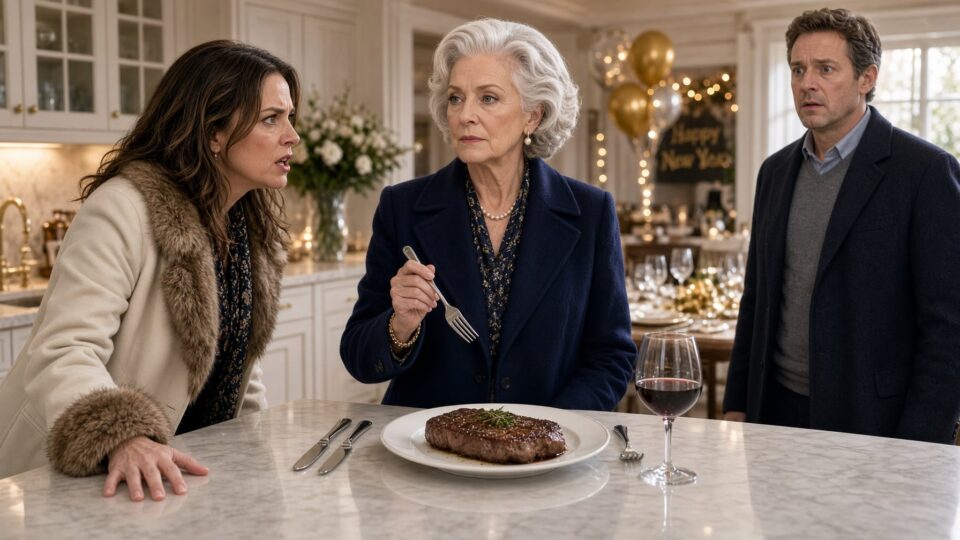
“Where the hell were you, you damn old woman? My family is starving, and the table still isn’t set!”
Harper’s voice cut across my kitchen on New Year’s Eve, sharp enough to make the fourteen people gathered in my dining room turn their heads.
I sat at the kitchen island with a knife in my right hand and a ribeye steak on the plate in front of me.
I had already eaten half of it.
The meat was tender, seasoned with rosemary and black pepper, and cooked exactly the way I liked it. There was no gravy on the counter, no mountain of mashed potatoes waiting in a serving dish, no rolls warming in the oven, and no prime rib resting beneath a sheet of foil.
The oven was cold.
The kitchen was spotless.
And the only person I had cooked for was myself.
Two sealed envelopes lay inside the drawer beside my left hand.
One contained a legal document.
The other contained a letter I had written three days earlier and still wasn’t certain I had the courage to deliver.
Harper stood opposite me, both hands pressed against my kitchen counter. She wore a burgundy dress that probably cost more than the groceries she had expected me to purchase, and her blond hair was arranged in loose curls around her face.
Her cheeks were flushed.
Not from embarrassment.
From fury.
“You cooked for yourself?” she asked.
I placed my knife beside my plate.
“Yes.”
Her mouth opened slightly, as though she had expected a different answer. Perhaps she thought I would deny it. Perhaps she expected me to leap out of my chair, apologize for some imaginary mistake, and begin pulling ingredients from the refrigerator.
“You knew everyone was coming.”
“I knew you invited everyone.”
A strange silence spread through the room.
Fourteen people suddenly found the ceiling, the hardwood floor, and their phones fascinating.
Harper’s mother, Denise, stood near the dining room entrance with her arms folded tightly over her chest. Her husband, Robert, stared at the centerpiece on the table. Harper’s sister, Mallory, pretended to read a message.
My son Liam stood a few feet behind his wife.
He looked pale.
Not surprised.
Not confused.
Pale.
Because Liam knew.
He knew I had warned them.
He knew I had told Harper, twice in person and once in writing, that I would not be responsible for another family gathering she arranged without my permission.
He knew I had told him that if anyone arrived expecting dinner, they would have to bring their own.
And he knew this wasn’t an accident.
“Mom,” he said quietly.
I looked at him.
He had always been my boy, even at thirty-five. There were still moments when I saw the child who used to crawl into our bed during thunderstorms, clutching his blanket and asking whether the house would protect him.
I had spent years protecting him.
From scraped knees, broken friendships, failed exams, bad decisions, and the consequences of choices he didn’t want to face.
But I was beginning to understand that a mother could protect her child for so long that the child eventually forgot she was a person who needed protecting too.
“Don’t,” I said.
Liam closed his mouth.
Harper turned toward him.
“Don’t what?”
“Nothing,” he replied.
She looked back at me. “This is unbelievable. We have fourteen people here. Your own son is standing in your kitchen, and you couldn’t even prepare the meal you promised?”
“I didn’t promise.”
“You said you would think about it.”
“That was before you told everyone I was making prime rib.”
Her face tightened.
“I told them because I assumed you would do the decent thing.”
I glanced at the dining room table.
The table had belonged to David.
My husband had bought it twenty-six years earlier, after we had finally paid off the mortgage and decided we could afford something that wasn’t assembled from a flat-packed box. It was dark walnut, heavy, and marked by years of family dinners.
There was a small burn mark near one corner from when Liam was eleven and knocked over a candle.
David had refused to replace the table.
“It’s a family mark,” he had said, smiling as he rubbed the damaged wood with a cloth. “Someday he’ll tell his own children how he did it.”
We never got that far.
David died almost three years ago.
And now Harper had decorated the table with gold napkin rings and white candles, as if the house had already become hers.
“Harper,” I said, “you brought fourteen people to my house without asking me. You told them I would cook. That’s your mistake, not mine.”
She laughed once.
It was a short, humorless sound.
“You’re seriously going to do this in front of everyone?”
“I’m not doing anything to you.”
“You’re humiliating me.”
I looked at her.
“No. I’m refusing to rescue you.”
That was when her expression changed.
For a second, I saw something underneath the anger. Not hurt. Not disappointment.
Fear.
Harper had built the entire evening around the assumption that I would comply. Her parents would arrive, her relatives would sit at my table, and I would spend six or seven hours working in the kitchen while she enjoyed the praise.
She had not considered the possibility that I might say no.
She had mistaken my silence for obedience.
And now, in front of everyone, I had taken that obedience away.
“You’re being spiteful,” she said.
I picked up my fork.
“Then you’ll have to survive the evening with that burden.”
I cut another piece of steak.
Nobody spoke.
I could feel Liam watching me.
I didn’t look at him.
Because if I did, I was afraid I would see the same pleading expression he had worn for months.
Please, Mom. Don’t make this a big deal.
But this was a big deal.
It had been a big deal for a long time.
And I was finally tired of pretending it wasn’t.
Four months earlier, when Liam and Harper first moved into my home, I had believed I was opening the door to a new chapter in my life.
I had not understood that I was handing someone else the opportunity to rewrite the entire story.
David had been gone for nearly three years.
The first year after his death, I barely noticed how quiet the house had become. I was too busy handling paperwork, sorting through his clothes, answering sympathy messages, and learning how to make decisions without asking him what he thought.
The second year was worse.
By then, people had stopped calling as often. Friends returned to their own routines. The neighbors were kind, but kindness was not the same as companionship.
I began eating dinner at the kitchen island because sitting alone at the dining room table felt ridiculous.
Sometimes I would put on the television just to hear another voice.
Sometimes I would leave the hallway light on because David had always hated coming home to a dark house.
His leather chair remained in the den. I never sat in it.
The chair still smelled faintly of his aftershave, or perhaps I only imagined it did.
Then Liam called one Sunday afternoon.
“Mom, can we come over?”
“Of course.”
“Harper and I need to talk to you about something.”
The tone of his voice made me sit up.
“Is everything all right?”
“Yeah. Nothing terrible. We just need somewhere to stay for a little while.”
I asked what had happened.
He explained that their apartment lease was ending, that Harper had found the rent increase unreasonable, and that they were trying to save money while deciding where to live next.
“How long is a little while?” I asked.
“Until the end of January,” he said. “Maybe a little earlier if we find something.”
It was September.
Four months.
I remember standing at the kitchen window, looking at the backyard where David and I had planted a maple tree when Liam graduated from high school.
Four months seemed manageable.
The house had three bedrooms, two and a half bathrooms, and more space than I needed. Liam had grown up there. It was natural to let him return.
I told him yes.
I even told him not to worry about contributing to the household expenses while they got settled.
“It’s your home too,” I said.
I meant it as a reassurance.
I did not mean it as a transfer of ownership.
When they arrived a week later, Harper hugged me tightly.
“You have no idea how much this means to us,” she said. “We’ll be out of your hair before you know it.”
I believed her.
I showed them the guest room, helped carry their boxes, and made dinner that first evening. Harper brought a bottle of wine and insisted on doing the dishes.
She thanked me three times.
The next morning, I found my coffee machine sitting on the floor beside the pantry.
I stared at it.
“Harper?” I called.
She appeared in the doorway wearing a silk robe.
“Oh, I moved that.”
“Why?”
“It made the counter look crowded.”
I looked at the empty space where I had kept it for seven years.
“Could you put it back?”
She smiled.
“Of course. I just thought it would look nicer over here.”
She pointed to a narrow shelf beside the refrigerator.
I didn’t argue.
That was the first time.
A week later, my blue kitchen towels disappeared.
When I asked where they were, Harper said she had put them in the laundry because they looked dated.
“They were David’s favorite color,” I said.
“Oh.” She paused. “I’m sorry. I didn’t know.”
I believed her apology.
Or at least I wanted to.
She bought new towels in a soft cream color and arranged them neatly on the oven handle. They were attractive. They matched her idea of the kitchen.
I placed my old towels in the linen closet.
That was the second time.
Then came David’s chair.
I found it pushed against the wall in the spare room, surrounded by a stack of boxes.
My breath caught.
“What is this?” I asked.
Harper was standing in the hallway, scrolling through her phone.
“It’s just temporary. We needed to make the den more open.”
“Why did you move his chair?”
“It doesn’t really go with the room.”
I looked at her.
“It’s not a decoration.”
She lifted her eyes from the phone.
“I know it was your husband’s, but it’s just a chair.”
I remember the way those words landed.
Not loudly.
Not dramatically.
They simply entered me and stayed there.
It’s just a chair.
To Harper, it was an object that occupied space.
To me, it was the chair David had sat in every evening after work. The chair where he had fallen asleep during baseball games. The chair where Liam had once sat on his father’s lap, both of them laughing so hard that I had to take a picture.
It was a piece of a life that no longer existed.
I wanted to explain that.
Instead, I said, “Please put it back.”
Harper sighed.
“Fine.”
Liam came home an hour later.
I told him what happened.
He rubbed his forehead.
“Mom, she’s trying to make the house feel comfortable.”
“It’s already comfortable.”
“That’s not what I mean.”
“She moved your father’s chair.”
“It’s a chair.”
I looked at him.
He stopped speaking.
Then he said the words I would come to hear more often than I wanted to remember.
“Please, Mom. Don’t make this a big deal.”
I went to bed early that night.
I lay in the dark and thought about how many times a person could be asked to surrender something small before the small things became a life.
By October, Harper had stopped asking before making changes.
The coffee machine was permanently on the shelf.
The cream towels had replaced my blue ones.
David’s chair returned to the den, but only after I moved it myself.
She rearranged the kitchen cabinets because she said the previous system was inefficient. She discarded two old baking trays, claiming they were scratched beyond use.
One of them had been a gift from my mother.
When I asked where it was, Harper said she had thrown it away.
“Why didn’t you ask me?”
“I didn’t realize it was sentimental.”
“Then you should have asked.”
She looked at me for a long moment.
“I’ll buy you another one.”
I didn’t need another one.
That was the point.
But I didn’t explain it.
I was tired of having to justify every object I had chosen to keep.
I began spending more time upstairs.
Sometimes I ate in my bedroom, even though I had always considered that a habit of people who were ill or unhappy.
I was becoming both.
One evening, Liam found me sitting on the edge of the bed with a box of David’s old photographs.
He stood in the doorway.
“Mom?”
I wiped my eyes quickly.
“What?”
“Harper said you were upset.”
“I’m fine.”
He walked in and sat beside me.
For a moment, he was just my son again.
The man who had held my hand at his father’s funeral. The boy who had slept against my shoulder when he had a fever. The person I had raised, fed, taught, and loved without ever calculating what I would receive in return.
“Are you unhappy with us being here?” he asked.
I looked at him.
The honest answer was complicated.
I was happy he was close.
I was unhappy that being close to him seemed to require me to disappear.
“I want you to be happy,” I said.
“We are.”
“Good.”
“But Harper feels like you don’t want her here.”
I lowered my gaze.
“That’s not true.”
“She thinks you resent us.”
I almost laughed.
“Does she?”
“Mom.”
I closed the photo box.
“Liam, I don’t resent you. But this is still my house, and I need you both to remember that.”
He nodded.
“I know.”
“Then help me.”
“I will.”
I wanted to believe him.
I wanted to believe that my son understood what I was saying, that he saw the imbalance, that he would eventually stand beside me when the next boundary was crossed.
He kissed my cheek.
“Love you, Mom.”
“Love you too.”
After he left, I sat alone for a long time.
I did not know that the next time he said those words, they would hurt more than they had ever comforted me.
CHAPTER 2 : THE HOUSE THEY HAD ALREADY CLAIMED
The first time Harper invited her family to dinner without asking me, I was in the grocery store.
I had just placed a carton of eggs into my cart when my phone rang.
“Mom,” Liam said.
“Hi, sweetheart.”
“Are you home?”
“No. I’m at the store. Why?”
There was a pause.
“Harper’s parents are coming over tonight.”
I glanced at the cart.
“How many people?”
“Just her parents and her sister.”
“That’s three people.”
“Yeah.”
“Do they know they’re coming to my house?”
He exhaled.
“Mom, please.”
I closed my eyes.
“Liam, what does that mean?”
“They’re already on their way.”
I stood in the middle of the aisle, surrounded by shelves of canned vegetables and holiday decorations.
“Are you telling me or asking me?”
“I’m telling you.”
“Then why did you call?”
“Because I thought you should know.”
I could hear a television playing in the background.
“Did Harper ask me?”
“She’s been busy.”
“Everyone’s busy, Liam.”
“Mom, it’s just dinner.”
I looked down at my shopping cart.
There were ingredients for a simple meal for one person: chicken, vegetables, and a small loaf of bread. I had planned to eat early and read in the den.
“Fine,” I said. “I’ll make enough for five.”
“Thanks, Mom.”
The relief in his voice made something inside me soften.
That was my weakness.
Not that I loved him.
That I could hear the relief in his voice and mistake it for gratitude.
I bought more food.
I prepared roasted chicken, potatoes, green beans, and a pie I had made from scratch.
Harper’s parents arrived at six-thirty.
Denise hugged me and said, “You always make everyone feel so welcome.”
I smiled.
Harper kissed my cheek.
“Thank you for doing this.”
I wanted to ask whether she had noticed that I had not agreed to it.
Instead, I said, “You’re welcome.”
Her sister Mallory arrived twenty minutes later with a bottle of wine and a story about her job.
By the time dinner was served, the dining room was full of conversation.
I sat at the table and watched them eat.
Robert complimented the chicken.
Denise asked for the recipe.
Harper told everyone that I had always been an excellent cook.
I should have enjoyed the praise.
But I noticed that Harper never once mentioned that I had been informed only after the invitations had been accepted.
The next morning, I found a message on my phone.
Harper: My aunt might come by this weekend. Hope that’s okay!
I stared at the screen.
Then I replied.
Me: Please ask me before inviting anyone to the house.
The response came almost immediately.
Harper: Of course! Sorry, I assumed it was fine.
I placed the phone on the counter.
For the next few days, I thought perhaps the message had worked.
Then Saturday arrived.
At eleven in the morning, I heard the front door open.
A woman I had never met walked into the hallway carrying a handbag.
Behind her came Harper’s aunt, her cousin, and two children.
Harper followed them.
“Oh, good,” she said when she saw me. “You’re up.”
I stood beside the staircase.
“Who are they?”
She smiled.
“My aunt Linda, her daughter, and the kids. They wanted to see the house.”
I looked at the strangers.
Then at Harper.
“You invited them here?”
“They were in the neighborhood.”
I felt a slow pressure building behind my eyes.
“Did you ask me?”
Harper rolled her eyes.
“Not every visit needs to be a formal event.”
“It’s not about formality. It’s about permission.”
Linda stepped forward.
“Oh, I’m sorry. We didn’t mean to intrude.”
I immediately felt guilty.
That was what Harper relied on.
She created a situation where objecting made me appear rude, and then allowed everyone else to watch while I swallowed my discomfort.
I smiled at Linda.
“It’s all right. Please come in.”
Harper’s expression softened with satisfaction.
I saw it.
I had begun to notice things I once ignored.
The way she waited until other people were present before challenging me.
The way she used my son’s discomfort to make me back down.
The way she apologized only when an apology was useful.
I made coffee for everyone.
I found cookies in the pantry.
I showed Linda the backyard.
The children ran through the hallway while Harper talked about how beautiful the house was.
“Our kitchen gets so much natural light,” she said.
Our kitchen.
I stood by the window and looked at the garden.
David had planted the rose bushes along the fence. He had spent an entire summer building the small stone path leading to the shed.
Now Harper was telling her relatives how she wanted to put a firepit near the back fence.
“We could have people over all summer,” she said.
Linda smiled.
“That would be lovely.”
I said nothing.
But that evening, after everyone left, I opened the notebook I kept in my desk.
It was an ordinary spiral notebook with a blue cover.
I wrote one sentence.
No more unannounced guests.
Then I added the date.
I didn’t know yet why I felt the need to record it.
Perhaps I had started to understand that when someone repeatedly denied crossing a boundary, it helped to have a record of where the boundary had been.
The Thanksgiving incident happened two weeks later.
Harper announced it on a Wednesday evening while we were eating dinner.
“I’ve been thinking,” she said.
I put down my fork.
That sentence had become a warning.
“About what?”
“Thanksgiving.”
Liam glanced at her.
Harper smiled.
“We should host it here.”
I looked at her.
“Who is we?”
She laughed.
“Mom, don’t start.”
I waited.
She began listing the guests.
Her parents. Her sister. Her aunt. Two cousins. Their spouses. A few friends.
Thirteen people.
I counted twice because I wasn’t sure I had heard correctly.
“Thirteen?”
“Yes.”
“And what exactly are you planning to cook?”
Harper looked surprised.
“Why would I plan to cook?”
I stared at her.
“Because you’re hosting.”
“It’s your kitchen.”
I felt a strange stillness settle over the table.
Liam reached for his glass of water.
“Mom, we can work it out.”
Harper pulled a folded piece of paper from her purse.
“I already made a menu.”
She slid it across the table.
I looked down.
Turkey.
Stuffing.
Mashed potatoes.
Green beans.
Cranberry sauce.
Gravy.
Dinner rolls.
Pumpkin pie.
Apple pie.
A cheese board.
Several appetizers.
Beside each item, she had written a name.
Almost every dish had my name beside it.
Harper had written table and drinks next to hers.
I looked up.
“You want me to cook all of this?”
“It’s not that much.”
“Harper, there are thirteen people.”
“Fourteen, actually. My uncle might come.”
I set the paper down.
“Then you’ll need to find someone else to cook.”
Her expression hardened.
“But the groceries are already purchased.”
I looked at Liam.
He looked away.
That was when I understood that they had planned everything before asking me.
The menu was not a suggestion.
It was an assignment.
And I was the person who had been assigned to carry it out.
I pushed the paper toward her.
“I won’t be doing this.”
Harper leaned back.
“Seriously?”
“Yes.”
She shook her head.
“You’ve become so difficult.”
I felt the familiar urge to defend myself.
To explain that I was tired. That I had spent years preparing meals for my family. That I was still grieving a husband whose absence had changed the shape of every holiday.
But I stopped.
I didn’t need a speech to justify a boundary.
“I’ll cook for myself,” I said. “You can arrange whatever you want for everyone else.”
Harper stared at me.
Then she stood and left the room.
Liam waited until she was gone.
“Mom.”
I looked at him.
“Don’t ask me to change my mind.”
He rubbed his face.
“She just wants Thanksgiving to be nice.”
“I want that too.”
“Then why are you making it so hard?”
I felt something break quietly inside me.
“Because I don’t want to spend the entire day cooking while everyone else enjoys the holiday.”
He looked down at the table.
“I’ll help.”
“Will you?”
“Yes.”
I wanted to ask why he hadn’t helped before.
Instead, I said, “Then tell Harper that she needs to plan the meal with me, not for me.”
He nodded.
But the next morning, I found a grocery delivery at the front door.
The receipt listed my name.
And the entire menu was still there.
Thanksgiving morning, I woke at five-thirty.
I lay in bed and listened to the house.
The heater hummed.
A car passed outside.
Somewhere downstairs, a door opened.
I knew what I should do.
I should stay in bed.
I should tell Harper that she had made the arrangements, and she could deal with them.
I should refuse to be pulled into another day of work disguised as family.
Instead, I got up.
I went downstairs.
The kitchen was filled with groceries.
The turkey sat in its packaging on the counter. Vegetables crowded the refrigerator. Bags of potatoes lined the floor.
I stood there for several minutes.
Then I washed my hands.
I began cooking.
Not because Harper was right.
Not because I owed her anything.
Because I could already imagine the guests arriving hungry, and I could not bring myself to let them suffer for a decision they had not made.
That was the truth I hated most about myself.
I was not weak because I couldn’t say no.
I was weak because I could say no and still choose to save everyone.
By eight, the turkey was in the oven.
By nine, the stuffing was prepared.
By ten, I had chopped enough vegetables to fill three serving dishes.
Harper came downstairs wearing a cream sweater and jeans.
She looked into the kitchen.
“Oh, you’re already doing all that?”
I didn’t turn around.
“Good morning to you too.”
She walked over to the counter.
“The table needs to look more festive.”
I looked at her.
“Then decorate it.”
She smiled.
“Of course.”
For the next two hours, she arranged candles and napkins. She moved the dining chairs into place. She took pictures of the table from several angles.
I kept cooking.
Liam came into the kitchen around noon.
“Need any help?”
I handed him a bowl of potatoes.
“Peel these.”
He nodded.
For a moment, we worked side by side.
I wanted to say something.
I wanted to ask him whether he understood what was happening, whether he realized how much of my life had begun to revolve around Harper’s expectations.
But he looked tired.
And I was tired too.
So I said nothing.
The guests arrived at two.
Harper greeted them at the door.
“Welcome to our home!”
The words struck me so suddenly that I nearly dropped the serving spoon in my hand.
Our home.
I looked at Liam.
He was carrying a tray of drinks.
He heard her.
He looked at me.
For one second, his expression showed discomfort.
Then he looked away.
I served dinner.
I refilled glasses.
I carried dishes to the table.
I listened while Harper’s relatives complimented the food.
When Robert told me the turkey was excellent, I thanked him.
When Denise asked whether I had made the stuffing myself, I said yes.
When Harper’s aunt said, “You must be so happy to have the children here,” I smiled.
The dinner lasted two hours.
By the time the guests left, my feet hurt.
My shoulders ached.
There were dishes stacked beside the sink.
Harper stood in the dining room, looking at the photographs she had taken.
“Everyone loved it,” she said.
I looked at her.
“I’m glad.”
She turned toward me.
“You should smile in the pictures next time.”
I didn’t answer.
She walked upstairs.
Liam stayed behind.
“Mom,” he said.
I was rinsing a serving dish.
“What?”
“Thank you.”
I turned off the faucet.
He came closer and kissed my cheek.
“You saved us.”
The words were meant to be affectionate.
But I felt something inside me go still.
I had saved them.
Again.
And I knew, with a certainty that frightened me, that they would expect me to do it again.
That night, after the kitchen was clean, I went upstairs.
I changed into my pajamas and sat on the edge of my bed.
My phone buzzed.
I opened Facebook.
Harper had posted photographs from Thanksgiving.
There were pictures of the table.
Pictures of the food.
Pictures of her parents laughing.
A picture of Liam holding a wineglass.
And a photograph of Harper standing in front of the dining room, smiling as if she had designed the entire celebration.
The caption read:
Our first Thanksgiving as Mr. & Mrs. Powell in our beautiful home. So grateful for family and everything we’re building together.
I read it once.
Then again.
My fingers grew cold.
Our beautiful home.
I looked around my bedroom.
The quilt David had bought me on our twentieth anniversary lay folded at the foot of the bed. His old watch sat on the nightstand. A photograph of the two of us stood beside the lamp.
I had spent thirty years building this home.
I had paid the mortgage.
I had repaired the roof.
I had painted the walls.
I had stood beside David when he was sick and held his hand while he struggled to breathe.
And now Harper had placed three words beneath a photograph and claimed the result of all those years.
I opened the comments.
Denise had written:
So proud of you two! Can’t wait to see what the future holds.
Harper replied:
We have so many plans.
I set the phone down.
I did not confront her.
Not that night.
Instead, I opened my blue notebook.
I wrote the caption exactly as it appeared.
Then I wrote:
November 27. Thanksgiving. Harper described my house as theirs.
I closed the notebook.
The next morning, I called my attorney.
CHAPTER 3 : THE DRAWER WITH TWO ENVELOPES
My attorney’s name was Margaret Ellis.
She had handled the paperwork when David and I refinanced the house years earlier. She had helped me settle his estate after his death, and she was one of the few people who spoke to me without assuming I needed to be comforted.
When I called, her assistant said she could see me the following afternoon.
I drove downtown wearing the navy suit I had worn to David’s memorial service.
I had not worn it since the funeral.
The jacket still fit, although the sleeves felt looser than I remembered.
I carried a folder containing my deed, my will, bank statements, and a list of the things I needed to ask.
Margaret greeted me with a hug.
“You look serious,” she said.
“I am.”
She closed the office door.
“Tell me.”
I sat across from her desk.
“My son and his wife are living with me.”
“I remember.”
“They were supposed to stay until the end of January.”
“And now?”
“Now my daughter-in-law is talking about my house as if it’s already hers.”
Margaret was quiet.
I told her about the Thanksgiving post. The unannounced guests. The renovations. The chair. The conversations I had overheard.
I told her about the night on the staircase.
That was the part I had tried hardest not to think about.
It had happened in early December.
I had woken thirsty and started downstairs for a glass of water. The den light was on, and I heard Harper and Liam talking.
I stopped on the staircase when I heard my name.
“Your mother needs to be realistic,” Harper had said.
Liam replied, “About what?”
“The house.”
I had held the railing.
Harper continued.
“She’s sixty-eight, Liam. She has this enormous place, and we’re throwing money away waiting.”
“Waiting for what?”
“You know what.”
There was a pause.
Then Harper said, “It’s going to be yours eventually anyway.”
I felt my stomach tighten.
Liam spoke quietly.
“The house belongs to Mom.”
“I know.”
“Then stop talking about it like it’s already ours.”
Harper laughed.
“Who else is she going to leave it to?”
The silence that followed was long enough for me to hear the refrigerator motor switch on in the kitchen.
I waited.
I waited for Liam to tell her that the question was cruel.
That I was his mother.
That my death was not a financial plan.
Instead, he said:
“I know.”
I had returned upstairs without getting the water.
I told Margaret everything.
When I finished, she leaned back in her chair.
“Have you updated your will recently?”
“After David died.”
“Does Liam inherit the house?”
“Yes.”
“Does Harper?”
“Not directly.”
Margaret nodded.
“Does your will contain any conditions?”
“No. Liam is my only child.”
She folded her hands on the desk.
“Then you need to decide what you want before you make any changes.”
I looked at her.
“What do you mean?”
“I mean that your estate is yours to arrange. But don’t make a decision simply because you’re angry.”
I almost smiled.
“I’m not angry about the house.”
Margaret raised an eyebrow.
I sighed.
“Fine. I’m angry about the house.”
“That’s understandable. But anger and clarity are not always the same thing.”
I looked down at my hands.
“I don’t want to punish Liam.”
“Then what do you want?”
I thought about the Thanksgiving table.
About David’s chair.
About the way Harper had spoken of the house.
“I want to know that my home will remain mine for as long as I live.”
Margaret nodded.
“That is something we can protect.”
She explained my options.
I could update my will. I could establish a trust. I could make sure that no one assumed the house would pass automatically without my wishes being documented. I could also clarify the living arrangements and establish a written agreement with Liam and Harper.
I listened carefully.
For the first time in months, I felt as if I were sitting in a room where my choices mattered.
Before I left, Margaret said, “You don’t have to decide everything today.”
“I know.”
“But you should stop relying on verbal promises.”
I looked at her.
“That’s what I’ve been doing.”
“Yes.”
I placed my hands on the folder.
“Then let’s put it in writing.”
The following week, I began keeping records.
I wrote down the dates when Harper invited guests.
I kept copies of the messages where I had told her not to.
I wrote down what had happened with the renovations.
I recorded the conversations I remembered accurately, without embellishing them.
I did not do this because I wanted to build a case against my family.
I did it because I was tired of being told that I had misunderstood what I had seen.
The records gave me something solid to hold on to.
They helped me separate what had happened from what I wished had happened.
And what had happened was becoming harder to ignore.
Harper had begun speaking about January as if it were a distant inconvenience.
“We’ll have to start looking at furniture soon,” she said one evening.
I was sitting at the kitchen island, sorting mail.
“Furniture for what?”
“The living room.”
I looked up.
“Why?”
“Because once we get settled, I want to replace the sofa.”
I stared at her.
“Are you planning to move out in January?”
She blinked.
“Of course. But we’re not sure yet.”
“You said you would be out by the end of January.”
“We’ll see.”
I placed the mail on the counter.
“Harper, that was the agreement.”
She crossed her arms.
“I know what the agreement was.”
“Then why are you talking about replacing furniture?”
“Because we need to think ahead.”
I looked toward the doorway.
Liam stood there.
“Did you hear that?” I asked him.
He nodded.
“Mom, we’re looking.”
“Looking isn’t the same as moving.”
“We’re trying.”
I felt a familiar ache.
“I need certainty, Liam.”
He looked at Harper.
Then back at me.
“We’ll figure it out.”
I had heard those words before.
They were always offered when someone wanted to delay a difficult conversation.
I nodded slowly.
“All right.”
That night, I called Margaret again.
By mid-December, the house no longer felt like a place where I lived.
It felt like a place where I waited.
Waited for the next guest.
Waited for the next request.
Waited for Harper to decide whether my furniture was acceptable.
Waited for Liam to find the courage to tell his wife that I was not an obstacle in their future.
The worst part was that I still loved him.
Love did not disappear because someone disappointed you.
It became heavier.
I remembered the day he was born.
David had been so nervous that he had dropped his car keys twice while trying to leave the house.
I remembered holding Liam for the first time.
His tiny fingers curled around mine, and I had felt something so enormous that I could barely breathe.
I had promised myself I would always protect him.
I had not understood that one day I might have to protect myself from the consequences of protecting him too much.
One afternoon, I was in the laundry room when I heard Harper speaking on the phone.
She was in the hallway.
“I don’t know how much longer we can keep doing this,” she said.
I froze.
“Because she makes everything difficult.”
A pause.
Then:
“Liam knows. He just doesn’t want to deal with it.”
I stopped folding the towel in my hands.
“It’s not like we’re asking for something unreasonable.”
Another pause.
“Eventually, the house will be ours. We just need to get through the next few years.”
My hand tightened around the towel.
I waited for Liam’s voice.
He was standing beside her.
I could hear him say something too softly to understand.
Harper answered, “I’m not saying she has to die tomorrow.”
The towel slipped from my hand.
I stood perfectly still.
Then she laughed, as if she had made a harmless joke.
“I’m saying we need to be practical.”
I left the laundry room without making a sound.
I went upstairs.
I closed my bedroom door.
And for the first time since Harper had moved in, I cried without trying to stop myself.
Not because I believed she wanted me dead.
She had not said that.
But because she had reduced my life to a waiting period.
A few years.
A financial obstacle.
A future that mattered more to her than the woman currently standing in her way.
I sat on the bed until the crying passed.
Then I opened my desk drawer.
I took out two envelopes.
The first contained a draft of the revised legal documents Margaret had prepared.
The second contained a letter to Liam.
I had written it after the conversation on the staircase.
I had written:
My son, I need you to understand that I am still here. I am not a house, an inheritance, or a future financial arrangement. I am your mother. I love you, but I will not allow love to become the reason I surrender my dignity.
I had not sent it.
I wasn’t sure I could.
I placed both envelopes in the drawer.
Then I locked it.
The week before Christmas, Harper began discussing New Year’s Eve.
“We should have everyone over,” she announced during breakfast.
I looked up from my coffee.
“Everyone?”
“My family. Liam’s friends. Some of our neighbors.”
“How many people?”
She thought for a moment.
“Fourteen, maybe.”
I put down my mug.
“No.”
She stared at me.
“What?”
“No.”
“You haven’t even heard the plans.”
“I’ve heard enough.”
Harper’s cheeks colored.
“You don’t get to dictate everything.”
I looked at her.
“I own the house.”
Liam set down his fork.
“Mom.”
I turned to him.
“No, Liam. I’m not doing this again.”
Harper pushed back her chair.
“You’re being completely unreasonable.”
“Then host the party somewhere else.”
She stood.
“You know what? Fine. We’ll do it here, and you can do whatever you want.”
I looked at her.
“That’s exactly what I intend to do.”
She left the kitchen.
Liam remained seated.
He looked exhausted.
I almost felt sorry for him.
Then I remembered the staircase.
The words he had spoken.
I know.
“Mom,” he said.
I waited.
“I’ll talk to her.”
“Please do.”
He nodded.
But he didn’t talk to her.
Or if he did, it changed nothing.
Three days later, Harper sent invitations.
She sent them from her phone.
The message included the address of my home, the arrival time, and a note that dinner would be served at seven.
At the bottom, she had written:
Come hungry! My mother-in-law is making her famous prime rib.
I stared at the message.
Then I opened the conversation with Liam.
I typed:
I told Harper I would not be cooking for New Year’s Eve. Please make sure everyone knows that.
He replied after twenty minutes.
I’ll handle it.
I wrote back:
I need you to be clear.
His response was short.
I know, Mom.
I set my phone down.
This time, I did not feel reassured.
I felt tired.
CHAPTER 4: THE LAST DINNER I WOULD NOT COOK
On New Year’s Eve, I woke before sunrise.
The house was quiet.
For a few seconds, I forgot that Harper and Liam were downstairs. I imagined the old mornings when David would make coffee and open the curtains, and the light would spread across the kitchen floor.
I got dressed slowly.
I put on a soft gray sweater and black trousers.
Then I went downstairs.
Harper was already in the kitchen.
She stood at the island with her phone in one hand and a cup of coffee in the other.
“Good morning,” she said without looking up.
“Morning.”
She scrolled.
“Your refrigerator is practically empty.”
“It’s not.”
“There isn’t enough food for everyone.”
“Because I haven’t bought food for everyone.”
She looked up.
I could see the argument forming in her expression.
“Mom, we’ve discussed this.”
“No, we haven’t.”
She put down her phone.
“Liam said you would make the prime rib.”
“Liam was mistaken.”
“Then why didn’t you tell me?”
“I did.”
“When?”
“Several times.”
She shook her head.
“You can’t just change your mind at the last minute.”
“I told you before you sent the invitations.”
“People are coming.”
“Then they can eat somewhere else.”
Harper laughed.
“You really think you’re going to embarrass me like this?”
I looked at her.
“I think you should stop making promises on my behalf.”
She stared at me.
Then she picked up her phone.
“Fine.”
I watched her walk out of the kitchen.
I had expected relief.
Instead, I felt a hollow ache.
Because I knew what would happen next.
She would tell the guests that I was being difficult.
She would tell Liam that I had ruined the evening.
She would make me the villain in a story she had written herself.
And Liam would probably ask me to fix it.
I went to the refrigerator.
I took out a ribeye steak.
I seasoned it with salt, pepper, garlic, and rosemary.
I heated a skillet.
The sizzle filled the kitchen.
For the first time in months, I cooked without thinking about how many people would eat the food.
I cooked for myself.
I set the steak on a plate.
I poured a glass of water.
Then I sat at the kitchen island.
The oven remained cold.
The counters remained spotless.
Two sealed envelopes waited in the drawer beside me.
I ate slowly.
I wanted to remember what it felt like to sit in my own kitchen without being responsible for someone else’s satisfaction.
At six-thirty, the first guests arrived.
I heard laughter from the hallway.
Doors opened.
Coats were hung.
Harper’s voice rose above the others.
“Come in! Everyone’s here!”
I finished my steak.
I wiped my mouth with a napkin.
Then I heard her shouting.
“Where the hell were you, you damn old woman?”
And the evening began.
I let her finish.
I let her accuse me.
I let her tell the room that I had ruined her plans.
Then I said:
“I’m not making dinner.”
Harper stared at me.
“What are we supposed to eat?”
“I don’t know.”
She looked toward Liam.
“Tell her.”
He stood behind his wife, his face pale.
“Mom, we need to talk.”
“Not in front of everyone.”
Harper gave a bitter laugh.
“Oh, now she cares about appearances.”
I looked at her.
“You invited them. You can explain the situation.”
Her parents shifted uncomfortably.
Robert cleared his throat.
“Maybe we should order something.”
Harper turned toward him.
“Dad, this is not your problem.”
“It becomes everyone’s problem when there are fourteen hungry people.”
I saw the first crack in her certainty.
She had expected the room to support her.
Instead, the room was beginning to recognize that she had created the problem.
Mallory stepped forward.
“Harper, we can just get takeout.”
Harper glared at her.
“That’s not the point.”
“No,” I said. “It isn’t.”
Everyone looked at me.
I stood.
“I want to explain something.”
Harper crossed her arms.
“Go ahead.”
I looked at the guests.
“I’m sorry that you were invited here under false expectations. I did not agree to prepare this meal. I told Harper that before the invitations were sent.”
Harper opened her mouth.
I continued.
“I have cooked for this family many times. I have welcomed guests. I have made meals, cleaned up, and tried to make everyone comfortable. But I am not a catering service, and this is not a house that belongs to anyone except me.”
The room was silent.
Liam looked down.
Harper’s mother stared at the floor.
I turned toward Harper.
“You have invited people into my home without asking. You have moved my belongings. You have spoken about renovating my kitchen. You have described my house as yours.”
Harper’s face hardened.
“Are you really going to air all of this in front of my family?”
“You brought them here.”
“You’re being cruel.”
“No,” I said quietly. “I’m being honest.”
She looked toward Liam.
“Are you going to let her talk to me like this?”
Liam swallowed.
“Harper—”
“Say something!”
He looked at me.
I could see the battle in his face.
The same battle I had watched for months.
The desire to avoid conflict.
The fear of disappointing his wife.
The knowledge that he was standing in a room where his mother had finally refused to make herself smaller.
I waited.
“Mom,” he said.
I closed my eyes briefly.
“Not this time.”
He stopped.
The words seemed to surprise him.
Not this time.
I had said them softly, but they carried more weight than I expected.
Harper stepped toward me.
“You’ve always been like this. You make everyone feel guilty for needing you.”
I looked at her.
“And you make everyone feel guilty when I say no.”
Her mouth tightened.
“You think you’re so superior.”
“No. I think I’m tired.”
That silenced her.
For a moment, I saw the woman who had moved into my house, thanked me for helping her, and promised that she would be gone by January.
I wondered where that woman had gone.
Or whether I had simply wanted to believe she existed.
Robert cleared his throat.
“I think we should leave.”
Harper turned toward him.
“Dad!”
“It’s New Year’s Eve,” he said. “We can find somewhere to eat.”
Denise looked at me.
“I’m sorry,” she said.
I nodded.
“Thank you.”
One by one, the guests began collecting their coats.
The house filled with awkward movement.
People avoided my eyes.
Mallory hugged me before leaving.
“I’m sorry,” she whispered.
I thanked her.
Harper stood near the door, furious and humiliated.
Liam remained behind.
When the last guest left, he closed the door.
The house became quiet again.
He turned toward me.
“Mom.”
I looked at him.
“Are you going to ask me to apologize?”
He shook his head.
“No.”
“Then what are you going to say?”
He stared at the floor.
“I should have stopped this.”
I waited.
He looked up.
“I should have said something months ago.”
My throat tightened.
“Yes.”
He swallowed.
“I’m sorry.”
I wanted to believe him.
I wanted to walk toward him, touch his face, and tell him that everything was all right.
But everything was not all right.
I had spent months waiting for him to say those words.
And now that he had, they could not undo what had already happened.
“Liam,” I said, “I love you.”
He nodded.
“But I can’t keep living like this.”
“I know.”
“No. I don’t think you do.”
He flinched.
I took a breath.
“I need you and Harper to move out. I need a firm date. And I need it in writing.”
He stared at me.
“Mom, we were already planning to—”
“Then it shouldn’t be difficult.”
He looked toward the staircase.
Harper stood at the top.
She had heard everything.
“We’re not moving out tomorrow,” she said.
I turned toward her.
“I didn’t ask you to.”
“You can’t just throw us out.”
“I can ask you to leave my house.”
“Liam is your son.”
“Yes.”
“And I’m his wife.”
“Yes.”
“So this is our home too.”
I looked at her.
“No. You live here. That is not the same thing.”
She descended the stairs slowly.
“You’re going to regret this.”
I felt the old fear rise in me.
Not fear of her.
Fear of losing my son.
Fear of becoming the mother who chose property over family.
Fear of being alone again.
Then I remembered the conversation on the staircase.
The way Harper had discussed my death as if it were a financial timeline.
The way Liam had answered, I know.
I looked at him.
“I have already regretted a lot of things,” I said. “But setting boundaries is not going to be one of them.”
Harper shook her head.
“You’re unbelievable.”
She turned and walked upstairs.
Liam stood in the hallway.
“Mom, can we talk tomorrow?”
I looked at him.
“Tomorrow.”
He nodded.
Then he followed his wife upstairs.
I remained in the kitchen alone.
At midnight, fireworks began outside.
I stood by the window and watched the sky brighten over the neighborhood.
I thought of David.
I thought of the first New Year’s Eve we had spent in this house.
We had been married for eight years. Liam was three. We had stayed up late, drinking champagne from mismatched glasses, while our son slept upstairs.
David had kissed my forehead.
“Another year,” he had said.
I had smiled.
“Another year.”
I pressed my hand against the window.
For the first time in a long time, I did not wish for the past to return.
I wished for the future to belong to me again.
The next morning, I sat at the kitchen island with a cup of coffee.
Liam came downstairs at eight.
He looked as if he hadn’t slept.
“Mom.”
“Sit.”
He pulled out a chair.
I placed a folder on the table.
He looked at it.
“What is that?”
“The agreement for you and Harper to move out.”
He stared at the papers.
“Mom, do we have to do this formally?”
“Yes.”
He lowered his eyes.
I opened the folder.
“The original agreement was that you would stay until the end of January. I want that date confirmed. I want the house returned in the condition it was in when you moved in. And I want no further changes to the property without my written permission.”
He read the document.
Then he looked up.
“You already had this prepared?”
“Yes.”
“When?”
“Before New Year’s Eve.”
His face changed.
“You knew you were going to do this?”
“I knew I needed to protect myself.”
He leaned back.
“Mom, I never meant for you to feel like we were taking advantage of you.”
I looked at him.
“But you were.”
He closed his eyes.
I waited.
After a moment, he said, “I should have handled things differently.”
“Yes.”
“Harper’s been under a lot of pressure.”
“I know.”
“She wants us to have our own place.”
“Then why are you still here?”
He looked at me.
I saw the answer before he spoke.
Because the house was convenient.
Because living with me allowed them to save money.
Because the future they imagined depended on my continued generosity.
And because Liam had never forced himself to confront what that meant.
“I don’t know,” he said.
I nodded.
“That is what worries me.”
He folded his hands.
“Are you changing your will?”
I did not answer immediately.
The question had come sooner than I expected.
I looked at my son.
“Why do you ask?”
He swallowed.
“I just want to know.”
“Do you?”
He stared at the table.
I felt the ache in my chest again.
“Liam, the fact that you are asking me about my will before you’ve even asked whether I’m all right tells me something.”
His face went pale.
“That’s not fair.”
“Maybe not. But it’s what I feel.”
He pushed back his chair.
“Mom, I love you.”
I looked at him.
“Then show me.”
He stood still for a long time.
Then he nodded.
“I will.”
He left the kitchen.
I sat alone.
I had wanted him to understand.
I had wanted him to choose me.
But I was beginning to see that I could not force someone to value what I had spent my life giving them.
I could only decide what I would continue to give.
CHAPTER 5 : WHAT BELONGED TO ME
The move-out agreement was signed on January 4.
Liam read every page.
Harper refused to sit in the room while he signed it.
She stayed upstairs, and I heard her moving furniture as if she were trying to prove that the house still belonged to her.
When Liam finished, he placed the pen on the table.
“Is this enough?”
“Yes.”
He looked at me.
“Mom, I know this isn’t what you wanted.”
I smiled faintly.
“I wanted you to be happy.”
“I am happy.”
“Then you have nothing to fear from leaving.”
He looked down.
I wanted to tell him that he could still come home.
That the door would always be open to him.
But I was no longer sure what I meant by home.
I had always thought it meant a place where someone was welcome.
Now I understood that it also meant a place where someone could feel safe.
And I needed to feel safe in mine.
The next few weeks were uncomfortable.
Harper complained about the agreement.
She complained about the January deadline.
She complained about the fact that I had asked her to stop inviting people over.
She complained about the fact that I had moved David’s chair back to the exact place where he had always kept it.
She complained that the house felt cold.
I did not respond to every complaint.
I began taking walks in the morning.
I joined a small book club at the library.
I called my friend Evelyn, who had been asking me for months to come over for lunch.
I started cooking smaller meals again.
Sometimes I made enough for two, because old habits were hard to break.
Then I remembered that I was the only person eating.
And I learned to make just enough for myself.
Liam began looking for an apartment.
He showed me photographs of places online.
Some were too expensive.
Some were too small.
Some were far from his work.
I helped him compare prices.
I answered his questions.
I did not offer to let him stay longer.
That was the hardest part.
Every time he looked tired, I wanted to tell him he could stay.
Every time Harper complained about the cost of moving, I wanted to offer money.
But I stopped myself.
Not because I wanted them to suffer.
Because I wanted them to build a life that did not depend on my surrender.
One evening, Liam came home from work and found me in the den.
I was sitting in David’s chair.
He stopped in the doorway.
“I haven’t seen you sit there in years.”
I looked up.
“I thought I’d try it.”
He smiled faintly.
“Does it still smell like Dad?”
I laughed softly.
“A little.”
He came in and sat on the sofa.
For a while, neither of us spoke.
Then he said, “I remember when Dad died.”
I looked at him.
“So do I.”
“I was so angry.”
“About what?”
“Everything. That he was gone. That you were alone. That I couldn’t fix it.”
I lowered my eyes.
“You were young.”
“I was thirty-two.”
“You were still my son.”
He nodded.
“I think I wanted to believe that if I could make you happy, I wouldn’t have to feel guilty.”
I looked at him.
“Guilty about what?”
He stared at his hands.
“About leaving.”
I said nothing.
He continued.
“After I married Harper, I felt like I was supposed to build my own life. But every time I came here, it felt like I was still a child. And then she started talking about the house, and I just… I didn’t know how to stop it.”
I took a breath.
“You knew it was wrong.”
He nodded.
“Yes.”
“Then why didn’t you?”
He looked up.
“Because I was afraid.”
The answer hurt.
Not because it was unexpected.
Because it was honest.
I had spent months thinking my son was choosing Harper over me.
Perhaps he had been choosing the path that required the least courage.
But the effect had been the same.
I reached for his hand.
“Liam, I can’t be responsible for your fear.”
“I know.”
“You have to learn how to stand beside the people you love, even when it’s uncomfortable.”
He squeezed my fingers.
“I know.”
I looked at him.
“Do you?”
He nodded.
“I do now.”
I wanted to believe him.
This time, I let myself hope.
Not because he had promised.
Because he had finally begun to understand what his choices had cost.
Harper’s attitude changed when she realized I was not going to reverse the agreement.
At first, she became colder.
Then she became careful.
She stopped moving my belongings.
She stopped inviting people without asking.
She even returned my blue towels to the kitchen.
I found them folded neatly in a drawer.
I did not know whether the gesture was sincere or strategic.
I did not ask.
I had learned that not every improvement needed to be rewarded with trust.
Trust was something that had to be rebuilt.
And I was no longer willing to rebuild it alone.
One Saturday afternoon, I was in the kitchen when Harper came downstairs.
“Can we talk?” she asked.
I turned off the faucet.
“About what?”
She hesitated.
“The house.”
I waited.
She pulled out a chair and sat.
I remained standing.
“I know you think I was trying to take it from you.”
I looked at her.
“Were you?”
She frowned.
“I never said that.”
“You talked about renovating it.”
“We were discussing possibilities.”
“You described it as yours.”
She looked down.
“I shouldn’t have said that.”
“No.”
She folded her hands.
“I was excited about our future.”
“I understand.”
“Do you?”
I looked at her.
“Yes. I understand wanting a home. Wanting stability. Wanting something that belongs to you.”
Her expression softened slightly.
“Then why are you treating us like we’re strangers?”
I felt a quiet sadness.
“Because you treated me like I was in the way.”
She looked up.
I continued.
“You came into my home and began changing things without asking. You invited people and expected me to feed them. You talked about my future as if it were a resource you were waiting to receive.”
Her eyes filled with tears.
I was not sure whether they were genuine.
But I let her speak.
“I never meant to hurt you.”
“I believe that you may not have meant to hurt me. But you did.”
She wiped her cheek.
“Liam loves you.”
“I know.”
“He’s been so upset.”
“I know.”
“Can we just move forward?”
I looked at her.
“Moving forward doesn’t mean pretending nothing happened.”
She nodded slowly.
“What do you want from me?”
I thought about it.
“Respect.”
She looked away.
“Anything else?”
“Honesty.”
She nodded.
“And space.”
Her face tightened.
“I understand.”
I hoped she did.
But I knew that understanding was not the same as changing.
Only time would show me which one she was capable of.
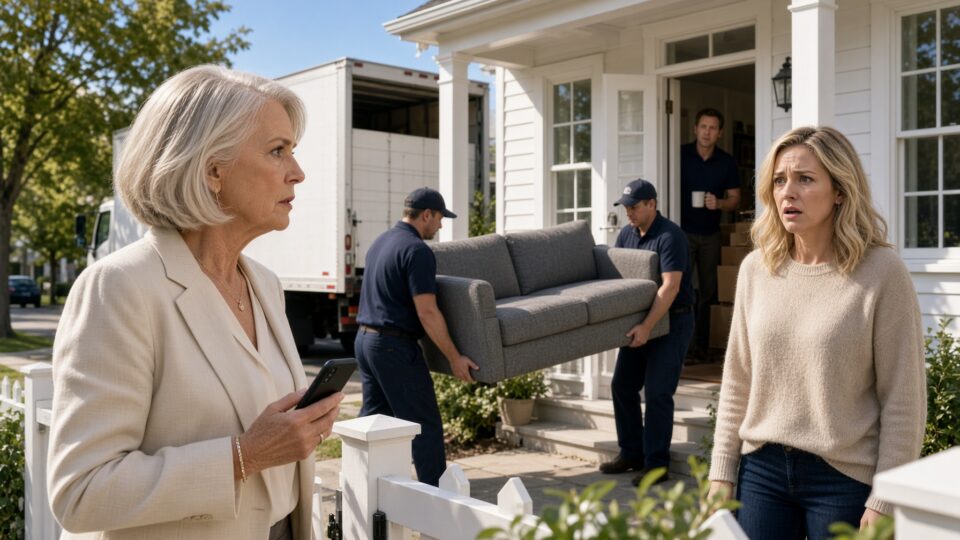
On January 28, Liam and Harper moved into their apartment.
The truck arrived at eight in the morning.
I stood on the porch while the movers carried boxes through the front door.
Harper had more belongings than I realized.
Boxes of dishes.
Decorations.
Clothing.
Furniture she had purchased during the months she lived with me.
She looked around the house one last time.
“I can’t believe we’re leaving.”
I did not answer.
She turned toward me.
“Are you happy?”
I looked at her.
“I’m relieved.”
She blinked.
The honesty seemed to surprise her.
Then she looked away.
Liam came out carrying the last box.
He set it inside the truck.
Then he came toward me.
I held out my arms.
He hugged me tightly.
For a moment, I felt the old ache.
My son.
My boy.
The child who had once fallen asleep against my shoulder.
The man who had hurt me without fully understanding what he was doing.
I held him.
“I love you,” he whispered.
“I love you too.”
He pulled back.
“Can I come for dinner next week?”
I smiled.
“Of course.”
“Just me.”
I laughed softly.
“Just you.”
He kissed my forehead.
Then he walked toward the truck.
I watched until the vehicle disappeared at the end of the street.
The house became quiet.
Not empty.
Quiet.
There was a difference.
I went inside.
The kitchen was mine again.
The cream towels were gone.
My blue towels hung beside the oven.
The coffee machine sat in its old place.
David’s chair stood in the den.
I touched its worn leather armrest.
For the first time in months, I felt the house settle around me.
I had not lost my son.
I had lost the illusion that loving him meant allowing him to make every decision for me.
And that was not the same thing.
A week later, I met Margaret at her office.
The revised documents were ready.
I sat across from her desk while she explained the changes.
I had decided to establish a trust that would allow me to remain in the house for the rest of my life. I would retain control over the property and my finances. The documents made my wishes clear and prevented anyone from assuming that living in my home gave them a claim to it.
I had also updated my will.
Liam would still receive an inheritance.
But the house would not simply become available for him to claim while I was alive.
My wishes would be documented.
My home would remain mine.
Margaret placed the final papers in front of me.
“Have you spoken to Liam?”
“Yes.”
“And does he know you’ve changed your plans?”
“He knows I’m taking steps to protect myself.”
Margaret nodded.
“Good.”
I signed the documents.
My hand trembled slightly.
Not from fear.
From the weight of the decision.
When I finished, I looked at the papers.
For years, I had believed that being a good mother meant leaving everything I owned to my child.
Now I understood that I could love my son and still decide what happened to my property.
I could help him without sacrificing my security.
I could leave him something without giving him the right to expect it.
I could be his mother without becoming his financial plan.
Margaret placed the documents in a folder.
“That’s done.”
I nodded.
I felt lighter.
Not happy.
Not triumphant.
Just lighter.
That evening, Liam came to dinner.
He arrived alone, carrying a small paper bag.
“What did you bring?” I asked.
“Dessert.”
I looked inside.
A slice of chocolate cake from the bakery near his apartment.
I smiled.
“Your father used to love that place.”
“I remember.”
We sat at the dining room table.
I made roast chicken, vegetables, and rice.
A simple meal.
No elaborate menu.
No guests.
No one expecting me to perform.
We ate slowly.
Liam told me about his new apartment.
The heating system was noisy.
The kitchen was small.
The upstairs neighbor played music late at night.
I listened.
I asked questions.
For the first time in months, our conversation was not about Harper’s demands or the house.
It was about his life.
And mine.
After dinner, he helped me clear the dishes.
We stood at the sink together.
“Mom,” he said.
“Yes?”
“I wanted to ask you something.”
I waited.
“Are you changing your will?”
I turned off the faucet.
He looked embarrassed.
“I know you don’t have to tell me.”
“No.”
“I just…”
I waited.
He took a breath.
“I want to understand.”
I dried my hands.
“I’m changing some of my estate planning.”
He nodded.
“Okay.”
“I want to be clear that this isn’t about punishing you.”
“I know.”
“I need to protect my home and my future.”
“I know.”
“And I need you to understand that I will decide what happens to my property.”
He looked at me.
“I understand.”
I studied his face.
“Do you?”
He nodded.
“Yes.”
I believed him more than I had before.
Not completely.
But enough to continue the conversation.
“I love you,” I said.
“I love you too.”
“Then don’t ever make me feel as though I have to choose between loving you and protecting myself.”
His eyes reddened.
“I won’t.”
I reached across the counter and touched his hand.
We stood there quietly.
It was not a perfect reconciliation.
There was no dramatic apology that erased the past.
There was no promise that every future disagreement would be easy.
But there was honesty.
And honesty was a place to begin.
Three months later, I hosted a small dinner.
Not fourteen people.
Not a gathering organized by someone else.
Just six friends from the neighborhood and my sister, Evelyn.
I cooked roast beef, potatoes, and a lemon cake.
Everyone helped.
Evelyn brought the salad.
Margaret brought wine.
My neighbor Susan brought bread.
We sat around David’s table and talked until the candles burned low.
At one point, Evelyn looked at me.
“You seem different.”
I smiled.
“How?”
“More present.”
I looked around the room.
At the table.
At the chairs.
At the people who had come because they wanted to spend time with me.
“I think I am.”
After dinner, I stood in the kitchen washing a plate.
I heard the front door open.
Liam had arrived to pick up a book he had left behind.
He stepped into the kitchen.
“Hey, Mom.”
“Hi.”
He looked around.
“Looks like you had a good evening.”
“We did.”
“Need help?”
I handed him a towel.
He smiled.
We worked side by side.
Then he looked at me.
“I’m proud of you.”
I laughed softly.
“You’re proud of me?”
“Yeah.”
“For what?”
“For standing up for yourself.”
I looked down at the plate in my hands.
I had wanted to hear those words for months.
But now that I heard them, they did not feel like permission.
They felt like recognition.
And I didn’t need his permission anymore.
EPILOGUE: THE WOMAN WHO SAT AT HER OWN TABLE
It has been nearly a year since New Year’s Eve.
Harper and Liam are still married.
They have their own apartment.
They are learning how to manage their expenses, their disagreements, and their future without relying on my house to solve every problem.
Harper and I speak occasionally.
We are civil.
Sometimes she comes for dinner.
When she does, she asks first.
She doesn’t move my belongings.
She doesn’t invite people without permission.
She doesn’t call my house hers.
I don’t know whether she has truly changed or whether she has simply learned where my boundaries are.
Perhaps time will tell.
Liam visits often.
He helps me with small repairs and calls on Sunday mornings.
Sometimes we discuss the past.
Sometimes we don’t.
There are days when I still feel hurt.
There are days when I remember the staircase and the words I heard in the dark.
There are days when I remember the Thanksgiving photograph and the caption beneath it.
Our beautiful home.
The memory no longer makes me feel powerless.
It reminds me of the moment I realized that silence had become a form of surrender.
I am sixty-nine now.
The house is still mine.
The maple tree in the backyard has grown taller.
David’s chair remains in the den.
My blue towels hang in the kitchen.
The coffee machine sits exactly where I want it.
And when I cook, I decide who sits at my table.
Sometimes it’s Liam.
Sometimes it’s a friend.
Sometimes it’s nobody.
On those evenings, I make a small dinner for myself and eat at the kitchen island.
I don’t feel guilty.
I don’t feel lonely in the way I once did.
I have learned that solitude and abandonment are not the same thing.
I have learned that a house can be full of people and still feel empty.
And I have learned that love does not require a woman to disappear inside the needs of everyone around her.
Last week, I opened the drawer beside the kitchen island.
The two envelopes were still there.
The first contained the legal documents that protected my home.
The second contained the letter I had written to Liam.
I read it again.
The words had not changed.
But I had.
I folded the letter and placed it back in the envelope.
Then I took out a fresh sheet of paper.
I wrote:
Dear Liam,
I love you. I always will.
But I want you to remember that your mother is not simply the person who feeds you, forgives you, opens her door, or leaves something behind.
I am a woman with a life of my own.
And I am still here.
I stopped writing.
Then I smiled.
I did not need to send the letter.
Not yet.
Perhaps one day I would.
Or perhaps the most important part of it had already been spoken.
I closed the drawer.
I went to the refrigerator.
I took out a ribeye steak.
I seasoned it with salt, pepper, and rosemary.
Then I turned on the stove.
The kitchen filled with the familiar sound of meat meeting heat.
Outside, the evening light fell across the backyard.
Inside, my home was quiet.
My home.
Not because I had defeated anyone.
Not because I had taken something from my son.
But because I had finally understood that I was allowed to keep what was mine.
I carried my dinner to the island.
I sat down.
And for once, I did not wait for anyone to tell me whether I deserved to eat.
I simply picked up my fork.
And I ate.