CHAPTER 1: THE CHAIR THAT WASN’T MINE
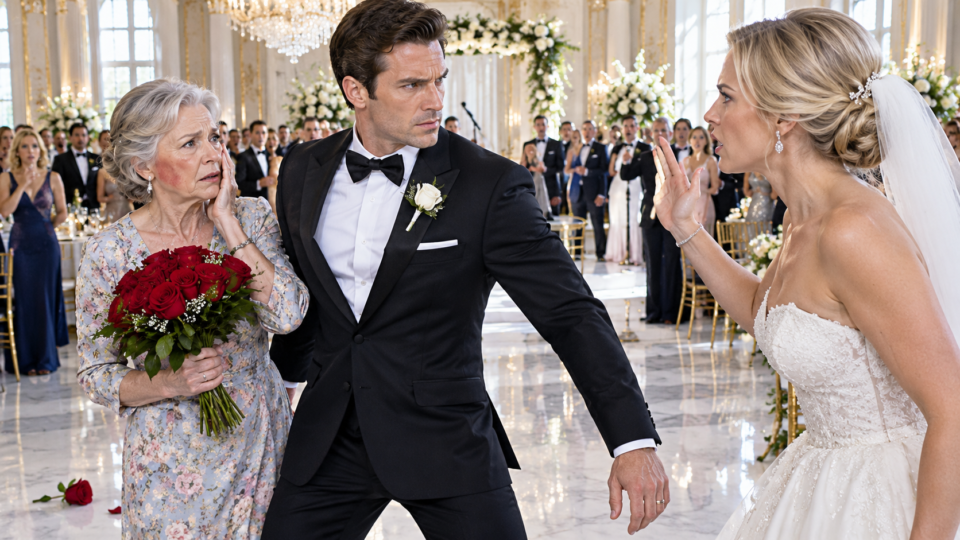
Claire pulled the only empty chair away from me and said, “There isn’t a seat for you, Helen. You can eat in the kitchen with the staff.”
My son was sitting three feet away.
He heard every word.
He saw exactly what she did.
And he said nothing.
That was the moment I understood that the cruelest thing a person can do to you is not always an insult.
Sometimes it is silence.
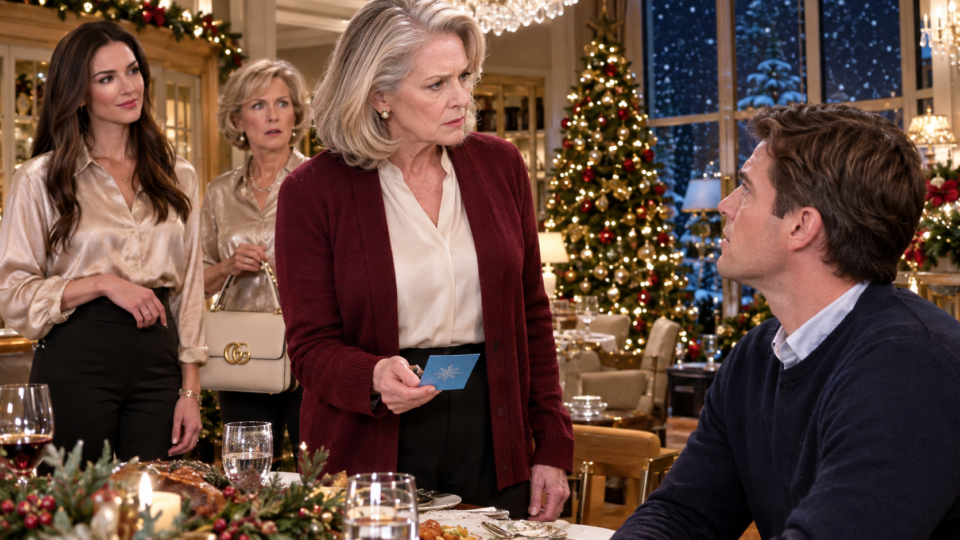
The restaurant looked as though someone had built it for a Christmas movie.
Evergreen branches were wrapped around the dark wooden beams. Candles flickered between crystal glasses. A massive Christmas tree stood beside the stone fireplace, covered in gold ornaments that reflected the warm light across the room. Outside, snow drifted softly against the tall windows.
Inside, nearly two dozen people were laughing, drinking wine, and congratulating Claire on the beautiful dinner she had arranged.
Except it wasn’t Claire’s dinner.
Not really.
The reservation had been made with my credit card.
The private dining room had been paid for by me.
Every bottle of wine on the table was on my account.
The flowers, the appetizers, the desserts, the little gold place cards Claire had spent weeks designing—all of it was being charged to me.
I had done it willingly.
At least, I had thought I had.
I had wanted my son to have a beautiful Christmas.
I had wanted to believe that after everything we had been through, my family had finally reached a place where we could sit together without old wounds showing through.
I was seventy years old.
Old enough to know that appearances could be deceiving.
Young enough, apparently, to keep deceiving myself.
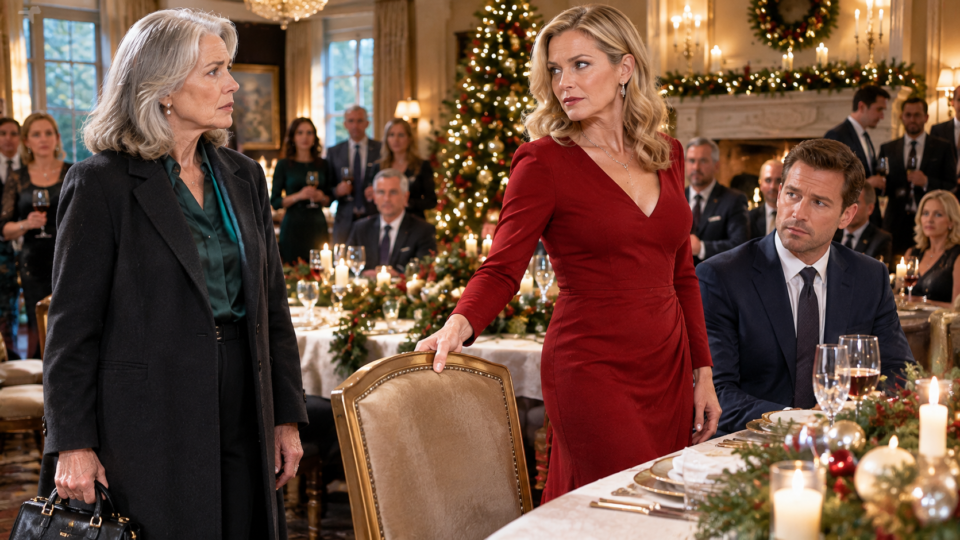
I had just taken off my coat when Claire stepped in front of me.
She was wearing an expensive red dress that shimmered whenever she moved beneath the restaurant lights. Her dark hair was swept over one shoulder, and a diamond bracelet caught the candlelight on her wrist.
She smiled.
Not an angry smile.
That would have been easier.
It was the smile of someone who believed she had every right to say what she was about to say.
She put one hand on the back of the empty chair beside the table.
“There isn’t a seat for you, Helen.”
I looked at the chair.
Then at her.
“I’m sorry?”
Claire tilted her head.
“You can eat in the kitchen with the staff.”
For a moment, I genuinely thought I had misunderstood her.
There are moments in life when the mind protects itself by refusing to accept what the ears have heard.
I looked around the table.
My son Ethan was seated near the center.
His wife Claire was standing beside me.
His uncle Daniel was there. Two of Ethan’s cousins. Claire’s sister and her husband. A few of their friends. Business acquaintances. People I had met many times before.
There were twenty-two people at the table.
Twenty-two.
And one empty chair.
Mine.
A woman near the end of the table slowly lowered her wineglass.
Someone else suddenly became fascinated by the folded napkin in front of him.
Nobody laughed.
Nobody told Claire to stop.
Claire gave a tiny shrug.
“The reservation is full. We had to make some choices.”
I stared at her.
“The reservation is full?”
“Yes.”
“And the empty chair?”
She looked at it.
Then back at me.
“Oh, that?”
Her voice became almost playful.
“That one is being used.”
I felt something cold settle inside my chest.
I looked at Ethan.
“Ethan?”
He raised his eyes.
For half a second, our eyes met.
I saw embarrassment.
I saw discomfort.
I thought, desperately, that I also saw shame.
Maybe I imagined it.
His gaze dropped to his napkin.
He adjusted the corner.
Then he said nothing.
I waited.
There was a time when Ethan would have crossed an entire room if someone had made me uncomfortable.
There was a time when he was a little boy who believed his mother was the strongest person in the world.
I remembered him at eight years old, standing in front of me after another difficult day at work, holding a crayon drawing in both hands.
“Mom,” he had said, “I made you something.”
It was a picture of our family.
There were only two people in it.
Him and me.
Above our heads, he had drawn a yellow sun so large it covered half the paper.
“That’s us,” he’d said proudly.
“What about Daddy?”
He had looked down.
Daddy had already been gone for years.
Michael died when Ethan was young.
After that, there had only been the two of us.
I had worked.
I had cooked.
I had cleaned.
I had learned how to repair things I had no business repairing because there was nobody else to do them.
I had learned how to smile when the electricity bill arrived.
I had learned how to stretch a grocery budget until it seemed impossible.
And when Ethan wanted something, I learned how to find a way.
One Christmas, when he was ten, he wanted a red bicycle.
We couldn’t afford a new one.
I found a used one through a classified advertisement.
The paint was scratched. One tire was nearly flat. The chain was rusted.
I bought it anyway.
For three nights after Ethan went to bed, I worked on that bicycle in the tiny space behind our apartment.
I cleaned it.
Polished it.
Repaired the chain.
Changed the tire.
By Christmas morning, it looked almost new.
I tied a red bow around the handlebars.
When Ethan came downstairs and saw it, he screamed.
“Mom!”
He ran to me so fast that he nearly knocked me over.
“Santa remembered!”
I laughed.
“Yes,” I said. “Santa remembered.”
He hugged me.
He hugged me so tightly that I closed my eyes.
That was my son.
The boy who once believed I could make Christmas happen with nothing but a tired pair of hands.
Now he was sitting three feet away while his wife told me to eat with the staff.
“Ethan?” I said again.
This time, he looked up.
“Mom…”
I waited.
He swallowed.
“I…”
Claire glanced at him.
It was subtle.
So subtle that someone else might not have noticed.
But I did.
Her eyes moved toward him.
His shoulders tightened.
Then he looked away.
That was when I knew.
He wasn’t trapped.
He was choosing.
Maybe he hated the situation.
Maybe he was uncomfortable.
Maybe some part of him wanted to stop it.
But he was choosing silence.
And silence was still a choice.
Claire sighed.
“I don’t know what you expected, Helen. We have a full table.”
I looked around.
Twenty-two people.
One empty chair.
My chair.
The chair she had physically moved away from me.
Something inside me broke.
Not loudly.
There was no dramatic crack.
No tears.
No shouting.
Just a quiet ending.
An ending to something I had spent years trying to preserve.
I had believed Ethan’s silence was temporary.
I had believed he would eventually understand.
I had believed that if I kept helping, kept giving, kept showing up, he would remember where he came from.
But standing there beneath the golden Christmas lights, I finally understood something I should have understood years earlier.
Love cannot make another person grateful.
Sacrifice cannot force loyalty.
And money cannot buy a place at a table where people have decided you don’t belong.
I looked at Claire.
Then at the empty chair.
Then at my son.
“It’s all right,” I said.
Claire blinked.
She had expected something else.
I could see it.
She expected me to cry.
Or argue.
Or demand an explanation.
Maybe she wanted to tell everyone later that I had caused a scene.
Instead, I smiled.
I walked toward the Christmas tree.
My handbag was resting beneath one of the windows.
I picked it up.
Then I slipped my coat over my shoulders.
Behind me, Ethan finally moved.
“Mom.”
I stopped.
For one foolish second, hope returned.
I didn’t turn around.
I waited for the words.
Wait.
I’m sorry.
Claire, give my mother the chair.
Any of them would have been enough.
Instead, Ethan asked, “Are you leaving?”
I closed my eyes.
Then I turned.
“Yes.”
His mouth opened.
Nothing came out.
Claire folded her arms.
“Well,” she said softly, “Merry Christmas.”
I looked at her.
“Merry Christmas, Claire.”
Then I looked at Ethan.
“Merry Christmas, son.”
He said nothing.
I walked out.
The cold air hit my face the moment I stepped through the doors.
Snow drifted beneath the streetlights.
For a few seconds, I stood beneath the restaurant awning and simply breathed.
The cold felt good.
It gave me something real to feel.
Behind the glass doors, I could still see the warm glow of the dining room.
I could see people moving.
I could see Claire sitting down.
I could see Ethan remaining in his chair.
My chair was gone.
Not occupied.
Gone.
I started walking.
I didn’t know where I was going.
I only knew I couldn’t go back inside.
And somewhere between the restaurant and my car, I asked myself a question I had avoided for years.
What do I want the rest of my life to look like?
Not Ethan’s life.
Not Claire’s life.
Mine.
The question frightened me.
Then, strangely, it made me feel free.
CHAPTER 2 : WHAT THEY THOUGHT I OWED THEM
I sat in my car for nearly ten minutes before starting the engine.
The heater blew warm air across my hands.
My phone rested on the passenger seat.
There were dozens of messages waiting.
Christmas greetings.
Business messages.
Friends checking on holiday plans.
I ignored all of them.
I was thinking about money.
Not because of the dinner.
Because of everything that had happened before it.
For years, I had convinced myself that helping Ethan was simply what a mother did.
When he and Claire bought their house, I helped with the down payment.
When the mortgage became difficult during a rough period, I covered several payments.
When Ethan needed a car, I guaranteed the lease.
When unexpected family expenses appeared, I quietly handled them.
I never announced it.
I never reminded him.
I never asked him to thank me.
That was my mistake.
Not helping.
Expecting nothing.
There is a difference between generosity and becoming someone’s invisible safety net.
At first, Ethan had been grateful.
“Mom, I don’t know what I’d do without you.”
I had always answered the same way.
“You’ll never have to find out.”
I meant it lovingly.
But over time, the sentence changed meaning.
He stopped asking whether I could help.
He began assuming I would.
Claire was even more comfortable with that assumption.
If there was a family dinner, I paid.
If there was a vacation, I contributed.
If there was an expensive celebration, I was somehow involved in the finances.
And because I never complained, nobody noticed.
Or perhaps they noticed and decided it was convenient not to notice.
I drove home slowly through the snow.
My apartment was quiet when I entered.
No Christmas music.
No voices.
Just the soft hum of the heating system and the little artificial tree I had decorated two weeks earlier.
I turned on the lights.
For a moment, the room looked beautiful.
Then it looked lonely.
I took off my coat and sat down.
The clock on the wall read 8:41.
I stared at it.
Then my eyes moved toward the old photograph on the bookshelf.
Michael and me.
We were younger.
Much younger.
He was smiling.
I was laughing.
Neither of us knew what the future would take from us.
Michael had always believed I could build something.
Even before Carter Freight became a real company, he used to tell me I was too stubborn to fail.
After he died, stubbornness became survival.
I started Carter Freight with one truck.
One.
It was old and temperamental, and I spent more time worrying about repairs than customers.
But I learned.
I learned logistics.
Contracts.
Fuel costs.
Routes.
Insurance.
Payroll.
I learned how to negotiate.
I learned how to recognize an opportunity.
I learned how to walk into rooms full of men who assumed a woman in her thirties couldn’t understand their business and make them regret underestimating me.
Over decades, the company grew.
One truck became five.
Five became twenty.
Then fifty.
Eventually, people began using the phrase “industry leader.”
I never liked that phrase.
It sounded too polished.
To me, it was still the same company Michael and I had dreamed about.
Only now, it was worth a fortune.
Months earlier, an acquisition offer had arrived.
One hundred sixty-five million dollars.
I had placed the documents in a drawer.
I told myself I needed time.
The truth was more complicated.
Selling Carter Freight felt like giving away a part of my life.
It felt like closing a door.
And I wasn’t ready to close it.
But sitting alone on Christmas Eve, I realized something.
The door wasn’t the company.
The company had never been the thing keeping me stuck.
Fear was.
Fear of change.
Fear of what Ethan would think.
Fear that if I stopped being the person everyone depended on, I would discover nobody actually needed me.
I picked up my phone.
There was one number I had called countless times in my life.
My attorney.
I pressed it.
He answered on the fourth ring.
“Helen? Merry Christmas.”
“Merry Christmas, Richard.”
He heard something in my voice.
“Is everything all right?”
I looked at the papers sitting in my desk drawer.
“I want to accept the acquisition offer.”
Silence.
Then, carefully, he said, “The one from Carter Holdings?”
“Yes.”
“The one for one hundred sixty-five million?”
“Yes.”
“Are you certain?”
I thought about Claire’s hand on the back of the chair.
I thought about Ethan looking down.
I thought about the red bicycle.
“Yes,” I said.
My voice was steady.
“I’m certain.”
Richard exhaled.
“All right. I’ll begin the process.”
“I don’t want to discuss it with anyone yet.”
“Understood.”
“And Richard?”
“Yes?”
“Make sure everything is done properly.”
He laughed softly.
“You don’t need to tell me that.”
“I know.”
We ended the call.
I sat very still.
The room had not changed.
The tree still glowed.
The photograph was still on the shelf.
Snow still tapped softly against the window.
But I felt different.
For the first time in years, I had made a decision that had nothing to do with Ethan.
Then I remembered something.
The dinner.
The bill.
I checked the reservation details on my phone.
The restaurant had already served the meal.
The bill would be nearly four thousand dollars.
I stared at the screen.
It wasn’t the money.
Four thousand dollars was insignificant compared with what I had spent on my family over the years.
What mattered was the assumption.
They had humiliated the woman whose card was paying for their Christmas.
I called the restaurant.
The manager answered.
“Good evening. Merry Christmas.”
“Merry Christmas. My name is Helen Carter. I have the private dining reservation tonight.”
There was a brief pause.
“Yes, ma’am.”
“I need to make a change to the payment arrangement.”
“Of course.”
“I will no longer be covering the bill.”
Another pause.
“I’m sorry?”
“I want my card removed from the reservation.”
The manager sounded confused.
“Mrs. Carter, the dinner has already been served.”
“I understand.”
“The final bill hasn’t been closed yet.”
“Then please don’t close it with my card.”
There was silence.
Then his tone changed.
“Is everything all right?”
I looked at the little Christmas tree in my living room.
“No,” I said.
Then I corrected myself.
“Actually, I think it will be.”
We ended the call.
At 9:17, my phone rang.
Ethan.
I stared at his name.
It rang again.
Then again.
I let it ring twice more before answering.
“Mom.”
His voice sounded different.
Urgent.
“We have a problem.”
I leaned back in my chair.
“What kind of problem?”
“The restaurant says your card isn’t covering the bill.”
“That’s correct.”
Silence.
Then I heard Claire in the background.
“What do you mean, she isn’t paying?”
Her voice was sharp.
Ethan lowered his voice.
“Mom, this is embarrassing.”
I almost smiled.
I remembered the empty chair.
“Yes,” I said. “It is.”
“What are we supposed to do?”
“You have a table full of adults.”
“That isn’t funny.”
“I didn’t say it was.”
“Mom, please.”
There it was.
Please.
A word I had waited years to hear.
But not because he was sorry.
Because there was a bill.
“How much is it?” I asked.
“Almost four thousand.”
I closed my eyes.
Four thousand dollars.
I thought about how easily I could have paid it.
I could have solved the problem with a phone call.
I could have saved Ethan from embarrassment.
I could have made everything comfortable again.
And then I remembered Claire pulling the chair away.
“No,” I said.
“What?”
“I’m not paying it.”
“Mom—”
“I hope you have a wonderful Christmas.”
I ended the call.
The phone immediately rang again.
I turned it face down.
For several minutes, I sat in silence.
Then I began to laugh.
Not because it was funny.
Because I suddenly realized how predictable I had become.
They had believed I would always be there.
Even when they didn’t make room for me.
Even when they embarrassed me.
Even when they treated my generosity like an obligation.
They believed I would still pay.
And perhaps that was the greatest lesson of all.
People learn how to treat you from what you repeatedly allow.
That night, I decided I would teach them something different.
CHAPTER 3 : THE PRICE OF SILENCE
Christmas morning came quietly.
I woke before sunrise.
For years, Christmas morning had belonged to Ethan.
Even when he was an adult, I used to call him early.
“Are you awake?”
“Mom, it’s six in the morning.”
“You’re supposed to be awake on Christmas.”
“I’m thirty-seven.”
“You’re still my son.”
Then he’d laugh.
That morning, I didn’t call.
I made coffee.
I sat beside the window.
Snow covered the street.
At 7:12, my phone buzzed.
A message from Ethan.
Can we talk?
I stared at it.
Then another appeared.
Mom, please answer me.
I didn’t.
At 7:45:
I’m sorry about last night.
I read it twice.
Then I put the phone down.
An hour later, I received another message.
I should have said something.
That one hurt.
Because he finally understood.
But understanding after the damage is done is not the same as preventing it.
I made breakfast.
I showered.
I put on a simple sweater.
Then I opened the folder containing the acquisition documents.
Richard had already sent an email.
The process had begun.
There were contracts to review.
There were financial statements.
There were legal documents.
There were meetings to schedule.
For the first time in months, I felt busy in a way that belonged entirely to me.
At ten, Richard called.
“The buyers are moving quickly.”
“How quickly?”
“They’d like to complete the transaction within the next several weeks.”
I looked around my apartment.
“Fine.”
“You’re really ready for this.”
“Yes.”
He paused.
“There is one other matter.”
“What?”
“Your personal guarantees.”
I knew what he meant.
Ethan’s mortgage.
The car lease.
The financial commitments I had made over the years.
“Review them,” I said.
“All of them?”
“All of them.”
“Do you want to withdraw?”
I thought about it.
“I want to understand exactly what I am responsible for.”
“All right.”
After we ended the call, I sat with the words.
I wasn’t trying to punish Ethan.
That mattered.
I repeated it to myself.
I wasn’t trying to punish him.
I was trying to stop pretending that his adult life was my responsibility.
There was a difference.
Around noon, someone knocked on my door.
I knew who it was before I opened it.
Ethan stood in the hallway.
He looked exhausted.
He hadn’t shaved.
His coat was still dusted with melting snow.
For a moment, I saw the little boy with the red bicycle.
Then I saw the man who had sat silently at a Christmas table while his wife humiliated me.
“Can I come in?”
I stepped aside.
He entered.
Neither of us spoke immediately.
He looked at the small Christmas tree.
Then at the photograph of Michael.
Then back at me.
“I’m sorry.”
I nodded.
“I know.”
He looked surprised.
“You know?”
“You sent me a message.”
“No. I mean…” He rubbed his forehead. “I’m sorry for what happened.”
I sat down.
“Then tell me what happened.”
He stared at the floor.
“Claire planned the dinner.”
“I know.”
“She wanted it to be perfect.”
“I know.”
“She thought having you there would make things complicated.”
I looked at him.
“Complicated?”
He swallowed.
“She said some of the guests didn’t know you.”
I almost laughed.
“I had met half the people at that table.”
“I know.”
“Did you agree with her?”
“No.”
“But you said nothing.”
He closed his eyes.
“I was trying to avoid a fight.”
I let the silence sit between us.
“A fight with whom?”
He looked up.
“With Claire.”
“And instead you let her fight me.”
His face tightened.
“I didn’t think it would go that far.”
“That is not an excuse, Ethan.”
“I know.”
“You watched her move the chair.”
“I know.”
“You watched me leave.”
“I know.”
“And when I stopped because I thought you might finally say something, you asked if I was leaving.”
He lowered his head.
“I know.”
I looked at my son.
“What were you afraid of?”
He didn’t answer immediately.
Finally he said, “Losing my marriage.”
That answer hurt more than any excuse could have.
I nodded slowly.
“Then you made your choice.”
“Mom—”
“No.”
He stopped.
“I don’t want you to sit here and tell me you didn’t choose. You did. Maybe you didn’t choose to hurt me. But you chose not to protect me.”
His eyes became wet.
“I was wrong.”
“Yes.”
“I should have stopped her.”
“Yes.”
“I should have given you my chair.”
I looked at him.
“Yes.”
He wiped his eyes.
“I love you.”
I believed him.
That was the hardest part.
I believed that he loved me.
But love and courage are not the same thing.
“You can love someone,” I said quietly, “and still hurt them.”
He nodded.
“I know.”
“And you can regret something,” I continued, “without being able to undo it.”
He looked at me.
“Can I fix it?”
I thought about the question.
“Not today.”
His shoulders dropped.
“What about later?”
“I don’t know.”
He sat there for several minutes.
Then he said, “Claire was wrong.”
I looked at him.
“That’s not enough.”
“I know.”
“She treated me like I was an embarrassment.”
“I know.”
“She told me to eat with the staff.”
“I know.”
“She did it because she believed you would let her.”
He looked away.
That was the truth.
And both of us knew it.
Finally, he stood.
“I should go.”
“Yes.”
At the door, he turned.
“Mom?”
“Yes?”
“Are you really selling the company?”
My heart skipped.
“How do you know about that?”
His face changed.
“Claire heard me talking to someone at the restaurant.”
I stared at him.
“So you know.”
“I heard you’re accepting the offer.”
“Yes.”
“How much?”
I didn’t answer.
“Mom.”
“One hundred sixty-five million.”
He went completely still.
For the first time since he arrived, I saw something I hadn’t seen before.
Shock.
Not because of the number itself.
Because he suddenly understood something.
I wasn’t simply angry.
I was changing my life.
“You’re serious.”
“Yes.”
“But why now?”
I looked at him.
“Because I finally realized I was waiting for people to value something they had gotten used to receiving for free.”
He said nothing.
I opened the door.
He stepped into the hallway.
“Merry Christmas, Mom.”
I looked at him.
“Merry Christmas, Ethan.”
Then I closed the door.
I stood there for a long time.
I wanted to cry.
Instead, I went back to my desk.
That afternoon, Richard sent me the first review of my financial commitments.
The mortgage assistance.
The car guarantee.
Several recurring family expenses.
Nothing dramatic.
Nothing secret.
Just a long list of things I had slowly taken responsibility for.
I looked at it for nearly an hour.
Then I called him.
“Richard?”
“Yes?”
“I want all of it ended properly.”
“You mean the guarantees?”
“The ones I can legally remove myself from, yes.”
“All right.”
“And I don’t want Ethan surprised.”
“Do you want us to notify him?”
“Yes.”
“Are you sure?”
“Yes.”
I took a breath.
“I’m not taking anything away from him that belongs to him.”
Richard was silent.
“I’m only stopping what belongs to me.”
CHAPTER 4 : THE THING ETHAN FINALLY UNDERSTOOD
The next few weeks were quieter than I expected.
There were no screaming matches.
No dramatic confrontations.
No public accusations.
The greatest change happened in silence.
I stopped paying for things.
That was all.
And somehow, that was enough to reveal everything.
The restaurant bill had been settled by the family.
Ethan called me afterward.
“We figured it out.”
“I’m glad.”
He was quiet.
“Claire says you embarrassed us.”
I closed my eyes.
“I see.”
“She thinks you did it deliberately.”
“I did deliberately remove my card.”
“That isn’t what I mean.”
“I know.”
Another silence.
“She said you were trying to punish us.”
“Ethan, if I wanted to punish you, I would have done something cruel.”
“What would you call this?”
“I call it stopping.”
“Stopping what?”
“Stopping being responsible for a life that isn’t mine.”
He had no answer.
Neither did I.
A week later, Ethan came to see me again.
This time, he didn’t ask to come inside immediately.
He stood outside my door holding a small paper bag.
“What is that?”
“Something I found.”
He handed it to me.
Inside was an old photograph.
Ethan at ten years old.
Standing beside the red bicycle.
I looked at the picture.
On the back, in my handwriting, were three words.
Christmas morning, 1996.
I looked at him.
“Where did you get this?”
“Dad’s old things.”
I touched the photograph.
“You kept it?”
“I didn’t even know I had it.”
He sat down.
“I’ve been thinking.”
“That can be dangerous.”
He smiled weakly.
I smiled too.
For the first time, the room felt less heavy.
“I remembered something,” he said.
“What?”
“You used to tell me that Christmas wasn’t about what you got.”
I nodded.
“It was about who showed up.”
I looked down at the photograph.
“Yes.”
“I think I’ve spent years forgetting that.”
I didn’t answer.
“I kept thinking you would always show up.”
“I did.”
“I know.”
“You stopped noticing.”
He swallowed.
“I know.”
I looked at him.
“Ethan, I don’t need you to spend the rest of your life feeling guilty.”
“I feel guilty.”
“I know.”
“I deserve to.”
“Maybe.”
He looked at me.
I continued.
“But guilt isn’t the same thing as change.”
He nodded slowly.
“So what do I do?”
“Be different.”
“How?”
“Next time someone is being humiliated because you are afraid to disagree with them, say something.”
He nodded.
“And if the person is your wife?”
He looked down.
“That makes it harder.”
“Yes.”
“But not impossible.”
“No.”
He took a breath.
“I’ve been angry at you.”
I raised an eyebrow.
“For what?”
“For always being able to fix things.”
I stared at him.
He continued.
“I thought you made everything look easy.”
I almost laughed.
“Nothing was easy.”
“I know that now.”
“I don’t think you do.”
He smiled sadly.
“Maybe not.”
He looked around my apartment.
“You’re really leaving the company?”
“Yes.”
“Do you know what you’ll do?”
“No.”
He seemed surprised.
“You don’t have a plan?”
“I have money.”
He laughed.
“That is not the same thing.”
“I know.”
For the first time in weeks, we both laughed.
Then his expression became serious.
“I want you to know something.”
“What?”
“I should have given you my chair.”
I looked at him.
He wasn’t crying.
He wasn’t asking for forgiveness.
He was simply telling me the truth.
“Yes,” I said.
“You should have.”
He nodded.
“I can’t change that.”
“No.”
“But I can change what I do next.”
I looked at my son.
Maybe that was all I had wanted from him.
Not money.
Not repayment.
Not even an apology.
Just accountability.
“I hope you do,” I said.
He stood.
At the door, he hesitated.
“Mom?”
“Yes?”
“Do you think you’ll ever forgive me?”
I thought about it.
“Yes.”
His eyes filled.
“But forgiveness doesn’t mean everything goes back to the way it was.”
He nodded.
“I understand.”
“Good.”
He left.
I watched him walk down the hallway.
Then I closed the door.
Three days later, the acquisition papers were finalized.
Carter Freight was no longer mine.
The company I had built after Michael’s death had entered a new chapter.
I received the final documents.
One hundred sixty-five million dollars.
I stared at the number.
It was so large it almost felt meaningless.
Money had been important to me when I was young because I never had enough.
Then it became important because it gave me security.
Then, somewhere along the way, I forgot what it was supposed to do.
Money was supposed to buy freedom.
Not obligation.
Not approval.
Not love.
Freedom.
I donated a portion to causes I had cared about for years.
I paid every legitimate obligation I owed.
I made careful investments.
And then I did something I hadn’t done in decades.
I booked a trip without asking anyone else whether they could come.
I chose a quiet coastal town.
I rented a small house.
I packed one suitcase.
And I left.
For the first few days, I felt guilty.
Then I felt peaceful.
I walked in the mornings.
I read in the afternoons.
I ate dinner alone without feeling lonely.
One evening, I sat on a bench overlooking the water.
The sunset turned the ocean silver.
My phone buzzed.
Ethan.
I answered.
“Hi.”
“Hi, Mom.”
“How are you?”
“Good.”
“Where are you?”
He laughed.
“You know where I am.”
“Yes.”
We were quiet.
Then he said, “Claire and I are having problems.”
I didn’t ask for details.
“That sounds difficult.”
“It is.”
“I’m sorry.”
He breathed out.
“I don’t know what will happen.”
“That isn’t something I can decide for you.”
“I know.”
“Whatever happens, make your choices because they are yours. Not because you’re afraid of losing someone.”
He was quiet.
“I wish I’d understood that earlier.”
“So do I.”
Another silence.
Then he said, “I miss you.”
I smiled.
“I miss you too.”
“Can I visit?”
I looked at the ocean.
“Yes.”
“When?”
“When you can come without expecting me to fix something.”
He laughed softly.
“I deserve that.”
“Yes.”
We said goodbye.
I put the phone down.
For the first time in a very long time, I felt no need to rescue anyone.
CHAPTER 5 : THE SEAT I CHOSE FOR MYSELF
Months passed.
Life became different in small ways.
Ethan and I began talking again.
Not every day.
Not constantly.
But honestly.
Sometimes he came to visit.
Sometimes we had lunch.
Sometimes we argued.
That was new too.
Before, I had always avoided arguments because I believed peace was the same thing as love.
It wasn’t.
Real love could survive disagreement.
Real love could survive boundaries.
Real love could survive the word no.
Claire eventually apologized.
Not immediately.
Not perfectly.
But sincerely enough that I accepted it.
She admitted that she had wanted the Christmas dinner to be perfect and had become obsessed with appearances.
She admitted that she had resented how much influence she believed I had over Ethan.
And she admitted that she had wanted to prove she controlled the room.
“I was cruel,” she said.
“Yes,” I answered.
She looked down.
“I don’t expect you to forget.”
“I won’t.”
“I don’t expect you to trust me immediately.”
“I don’t.”
She nodded.
Then she said something I didn’t expect.
“I was embarrassed when the bill came.”
I almost smiled.
“So was I.”
She looked at me.
“I deserved that.”
“No,” I said.
She frowned.
“You deserved to learn something.”
I wanted her to understand the difference.
Humiliation was not justice.
It was simply another form of cruelty.
I didn’t want revenge.
I wanted boundaries.
That was enough.
Ethan eventually moved into a place of his own.
He learned to manage his finances without me.
He learned to say no.
He learned to have difficult conversations.
Most importantly, he learned that loving someone did not mean allowing them to treat another person badly.
One year after that Christmas Eve, Ethan invited me to dinner.
Not at an expensive restaurant.
Not at a private club.
Not at some glamorous place where everyone could admire the family.
He invited me to his home.
“I’m cooking,” he said.
“That sounds dangerous.”
“I can cook.”
“You once burned toast.”
“I was twenty.”
“You were thirty-two.”
He laughed.
“I’ve improved.”
I went.
The table was small.
Four chairs.
Four plates.
Four glasses.
Nothing extravagant.
No crystal chandeliers.
No gold Christmas ornaments.
Just a simple tree in the corner and candles on the table.
Claire was there.
Ethan was there.
I sat down.
Nobody moved my chair.
Ethan pulled it out for me.
“Here.”
I looked at him.
“Thank you.”
He smiled.
“I wanted you to have this one.”
I sat.
Dinner was simple.
Roasted chicken.
Potatoes.
Vegetables.
A pie that was slightly burned around the edges.
It was the best Christmas dinner I had eaten in years.
At one point, Ethan raised his glass.
“To Mom.”
I shook my head.
“No speeches.”
He smiled.
“Fine.”
He lowered the glass.
Then he looked at me.
“I’m glad you’re here.”
I smiled.
“So am I.”
After dinner, we sat near the Christmas tree.
Snow began falling outside.
For a moment, I remembered the restaurant.
The candles.
The crystal glasses.
The gold decorations.
The empty chair.
The humiliation.
The silence.
Then I looked around Ethan’s small living room.
Four chairs.
No empty places.
And I understood something.
That Christmas Eve had not taken my place away.
It had shown me where I had been trying to sit all along.
I had spent years believing that my value came from what I could provide.
Money.
Security.
Solutions.
A mortgage payment.
A car.
A dinner.
A company.
I thought being needed was the same as being loved.
It wasn’t.
Love wasn’t the person who expected you to pay the bill after pushing you away from the table.
Love wasn’t the person who stayed silent because defending you was inconvenient.
Love wasn’t even the person who apologized afterward.
Love was the person who learned.
The person who changed.
The person who made room.
And sometimes, love was also the courage to walk away from a table where there was no room for you.
I looked at Ethan.
He was watching the snow.
For a moment, I saw the little boy again.
The boy with the red bicycle.
The boy who had believed Santa remembered him.
Maybe that boy was still there somewhere.
Maybe he had simply grown into a man who had gotten lost.
And maybe, finally, he had found his way back.
“Mom?”
I looked at him.
“Yes?”
“Are you happy?”
The question caught me off guard.
I thought about it.
Then I smiled.
“Yes.”
He smiled too.
“Good.”
I looked at the Christmas tree.
One of the ornaments was crooked.
I reached over and straightened it.
Then I laughed.
“What?”
“Nothing.”
“What?”
“I was just thinking.”
“About what?”
“That I spent years trying to make Christmas perfect.”
He smiled.
“And now?”
I looked around the room.
At the small table.
The four chairs.
The people sitting around it.
At the place I had been given freely.
“Now,” I said, “I think I finally understand Christmas.”
Ethan waited.
I raised my glass.
“It isn’t about having the biggest table.”
He smiled.
“Then what is it about?”
I looked at him.
“It is about knowing who would make room for you.”
Nobody spoke for a moment.
Then Ethan reached across the table and took my hand.
His grip was warm.
Familiar.
Real.
And I squeezed his hand back.
A year earlier, I had walked out of a beautiful restaurant because someone told me there wasn’t a seat for me.
That night had felt like the end of my family.
Instead, it became the beginning of something different.
Not perfect.
Not painless.
But honest.
I no longer paid for love.
I no longer bought peace.
I no longer mistook silence for loyalty.
And I no longer measured my place in someone’s life by how much I could give them.
I had spent seventy years learning how to provide.
It took one empty chair to teach me how to receive.
Outside, snow covered the street in a soft white blanket.
Inside, the Christmas lights glowed against the window.
There were four chairs around that little table.
And for the first time in years, I didn’t care whether there was another one.
I had my seat.
And this time, nobody could take it away.