CHAPTER 1 : THE PEOPLE IN MY HOUSE
“Who gave you permission to rent my house?”
I said it loudly enough to stop every conversation in the great room.
The man standing beside my fireplace smiled as though I had walked into his property by mistake.
“Relax, Diane,” Richard Hale said. “Madison already told us this place is basically theirs.”
For a second, I thought I had misunderstood him.
Then I looked around my living room.
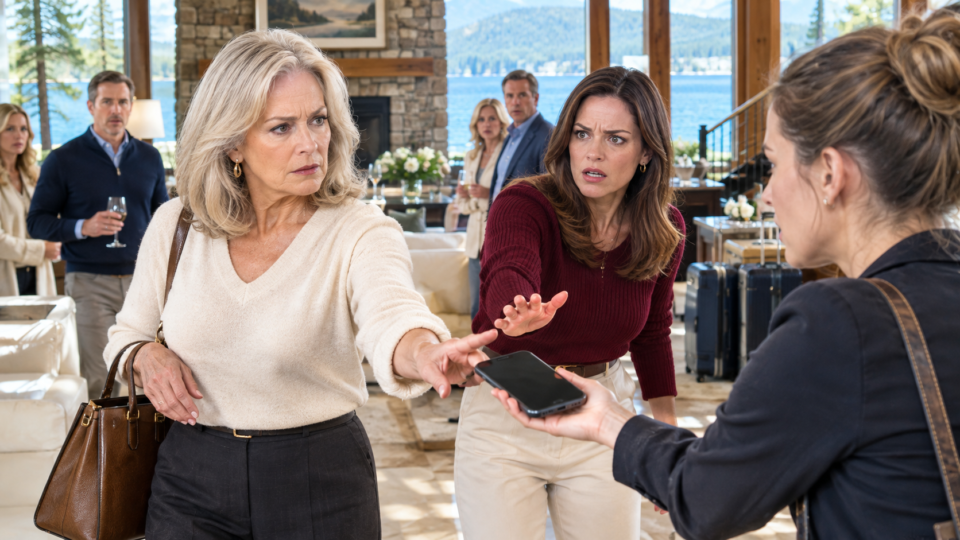
Six strangers were staring at me with glasses still raised in their hands.
A speaker near the kitchen continued playing soft country music. Someone finally reached over and switched it off.
The silence afterward was worse.
Richard remained beside the stone fireplace in khaki slacks and a quilted navy vest, wearing the expression of a man inconvenienced by an unnecessary question.
Behind him, two suitcases stood beside my staircase.
A young couple occupied my leather sofa.
A woman I had never seen before was taking photographs through the glass doors facing Lake Pend Oreille.
At my kitchen island, a man was cutting oranges on my walnut cutting board.
My cutting board.
My knives.
My glasses.
My house.
I looked back at Richard.
“Answer me.”
He spread his hands.
“I just did.”
“No, you didn’t.”
His smile tightened.
“Madison said we could manage the place.”
“My daughter does not own this house.”
“She will.”
“That is not the same thing.”
The young woman on the sofa slowly lowered her wineglass.
“Excuse me,” she said. “Are you the owner?”
“Yes.”
Her face changed immediately.
She looked from me to Richard.
“We were told he manages the property.”
Richard gave a small laugh.
“There’s no need to make this dramatic.”
I almost admired the nerve it took to say that while standing in my living room with strangers sleeping in my bedrooms.
I had driven to my mountain house outside Sandpoint, Idaho, expecting silence.
Instead, I found seven rental guests, three unfamiliar vehicles, packed coolers, wet towels hanging over the railing of my deck, and my daughter’s father-in-law acting like a hotel host.
That Saturday morning had been important for an entirely different reason.
I was supposed to meet a prospective buyer.
For twenty-three years, the house had belonged to me.
My late husband, Thomas, and I had bought it before Madison finished elementary school. Back then, the road was rougher, the dock smaller, and the kitchen had ugly green tile that Thomas swore he would replace “next summer.”
It took him six summers.
We raised our daughter partly in that house.
Madison learned to swim from our dock.
She learned to drive on the gravel road above it.
We watched thunderstorms cross the lake from the covered deck. We cooked Thanksgiving dinner there twice when snow closed the highway. Thomas and I celebrated our twentieth anniversary there with steaks that he overcooked and a bottle of wine we could barely afford.
After he died, I kept the house.
At first, selling it felt impossible.
Every room held a version of him.
His laugh seemed trapped in the kitchen.
His hands were in the shelves he had built beside the fireplace.
His initials were carved underneath the dock bench because one summer Madison had carved hers there and he had pretended to be furious before adding his beside them.
For several years, keeping the house felt necessary.
Then, slowly, grief changed shape.
The house became less like a refuge and more like a responsibility.
There were taxes.
Insurance.
Tree work.
Dock maintenance.
Snow removal.
A leaking window upstairs.
A water heater that died on Christmas Eve.
The retaining wall had needed reinforcement the previous spring, and the bill had been large enough to make me sit at my kitchen table for an hour after opening it.
I still loved the place.
I simply no longer believed love required me to own it forever.
A retired physician from Spokane named Alan Mercer had contacted my real estate broker several weeks earlier. He wanted a second home near the lake. He had already toured the property once.
That morning was supposed to be his final walkthrough before deciding whether to submit an offer.
Instead, I was standing in my own living room asking strangers why they were sleeping in my bedrooms.
I turned back to Richard.
“How much did you charge them?”
His expression hardened.
“That’s between me and the guests.”
“No. It isn’t.”
The young woman stood.
“We paid for four nights.”
My stomach tightened.
“To whom?”
“Richard.”
Richard moved toward her.
“Emily, there’s obviously some family confusion.”
She pulled out her phone.
“There was nothing confusing about the payment.”
She turned the screen toward me.
There it was.
My house.
My deck.
My dock.
My kitchen.
Even the photograph of the lake at sunset that I had taken myself three summers earlier.
Underneath the photographs was a description.
PRIVATE FAMILY-OWNED LAKE RETREAT.
The contact name was Richard Hale.
The price was $725 a night.
I stared at the screen.
Then at him.
“How long have you been doing this?”
He folded his arms.
“Diane, talk to Madison before you start accusing people.”
“I’m talking to the man collecting money from my property.”
“You weren’t using it.”
The sentence hit me harder than I expected.
Not because it was clever.
Because he said it as if my absence had somehow transferred ownership.
Before I could answer, headlights swept across the windows facing the driveway.
Richard glanced outside.
For the first time since I walked through the door, he looked nervous.
A silver SUV stopped beside the porch.
The driver stepped out.
I recognized Alan Mercer immediately.
Richard stared at me.
“Who is that?”
I picked up my keys from the entry table.
“The man who came here this morning to decide whether he wants to buy the house you’ve been renting.”
Richard’s face went still.
Then he laughed.
It was too quick.
Too forced.
“You’re selling?”
“Yes.”
“Madison knows about this?”
“She knows I’ve been considering it.”
“That’s not what she told us.”
I looked at him.
“What exactly did she tell you?”
Before he could answer, someone knocked.
I opened the door.
Alan stood on the porch wearing jeans, a gray sweater, and the mildly uncertain expression of someone who knew he had arrived at the correct address but was no longer sure he had arrived on the correct day.
“Diane.”
“Alan.”
He glanced past me at the suitcases.
“I hope I didn’t misunderstand the time.”
“You didn’t.”
A pause.
Then I stepped aside.
“You should probably come in.”
He entered slowly.
His eyes moved across the room.
The wineglasses.
The luggage.
The cooler near the deck doors.
Richard.
The strangers.
Alan had spent thirty-five years as a physician. He had the kind of face that didn’t reveal much before he had enough information.
“I see,” he said.
“You don’t,” I replied. “But you’re about to.”
Richard moved toward us.
“This is a family misunderstanding.”
I turned.
“No. A misunderstanding is when somebody arrives on the wrong weekend. You advertised my house, accepted money for it, and gave strangers access without my permission.”
One of the guests, a middle-aged man named Kevin, stepped away from the island.
“Should we leave?”
I looked at him.
His embarrassment was genuine.
So was his concern.
And suddenly I understood something important.
They had been lied to as well.
They weren’t trespassers who had broken into my house.
They were customers who had paid someone claiming to have authority.
My anger belonged somewhere else.
“You don’t need to pack this second,” I said. “I need to understand what happened first.”
Richard shook his head.
“You’re blowing this completely out of proportion.”
Alan looked at him.
“Are you the property manager?”
Richard hesitated.
That hesitation told Alan more than any answer could have.
“No,” I said. “He is not.”
Richard’s jaw tightened.
“I’m Madison’s father-in-law.”
Alan looked at me.
“Your daughter?”
“Yes.”
He nodded once.
Then he asked the question Richard clearly did not want him to ask.
“Does she have any ownership interest in the property?”
“No.”
“Power of attorney?”
“No.”
“Management agreement?”
“No.”
“Written permission to rent it?”
“No.”
Alan looked at Richard again.
Richard’s face reddened.
“This isn’t a courtroom.”
“No,” I said. “It’s my living room.”
My phone buzzed.
Madison.
I stared at her name.
Richard saw it.
“Answer her.”
I did.
“Mom?”
Her voice was breathless.
“Where are you?”
“At the lake house.”
Silence.
Not surprise.
Silence.
There is a difference.
A surprised person asks what happened.
A guilty person calculates what you know.
Finally she said, “Why?”
“Because I own it.”
“Mom—”
“Did you give Richard permission to rent my house?”
Another silence.
I looked at Richard.
He was staring at the floor.
“Madison.”
“I told him you weren’t really using it.”
“That isn’t what I asked.”
“I thought—”
“Did you give him permission?”
Her voice dropped.
“Yes.”
Something inside me went cold.
Not broken.
Cold.
“And why,” I asked, “did you believe you had the right to do that?”
“Because you said the house would come to me eventually.”
Richard looked up.
So that was it.
Not confusion.
Not a mistake.
Inheritance.
An expectation had quietly become ownership in their minds.
I gripped the phone harder.
“I said that years ago.”
“You always said this place was for family.”
“It is.”
“So what’s the difference?”
I looked around at seven strangers.
“The difference is seven people I have never met.”
“Richard knows them.”
“No. Richard charged them seven hundred twenty-five dollars a night.”
Madison went quiet again.
I asked, “Did you know that?”
Her answer came too slowly.
“Mom, can we talk about this privately?”
That was my answer.
I closed my eyes.
“How long?”
“Please don’t do this in front of everybody.”
“How long, Madison?”
Richard stepped toward me.
“Give me the phone.”
I moved away.
“Don’t touch me.”
Everyone went still.
Richard stopped.
Madison said, “Mom, please.”
“How long?”
Finally:
“Since spring.”
The retaining wall had been repaired in April.
I remembered paying the contractor.
I remembered telling Madison how expensive it had been.
I remembered her saying, You should let the house start paying for itself.
At the time, I had thought it was just a comment.
Now I looked at the rental listing on Emily’s phone.
The truth had been sitting inside that sentence all along.
“Since spring,” I repeated.
Alan said nothing.
Neither did the guests.
My daughter whispered, “We were going to tell you.”
“No, you weren’t.”
“You don’t know that.”
“Yes,” I said. “I do.”
I ended the call.
Richard stared at me.
“You had no right to hang up on her.”
I almost laughed.
“My daughter helps you rent my house without permission, and your concern is my telephone manners?”
“This money was helping the family.”
“Which family?”
He opened his mouth.
I pointed toward the stairs.
“Get your things.”
“Diane—”
“Now.”
His face changed.
The false friendliness disappeared.
“You can’t just throw everybody out.”
“I’m not throwing the guests out. I’m throwing you out.”
“This is ridiculous.”
“Then it should be very easy for you to explain to an attorney.”
That landed.
He stared at me.
I had no attorney involved yet.
But he didn’t know that.
Richard walked upstairs.
I turned toward the guests.
“I’m sorry.”
Emily shook her head immediately.
“You don’t owe us an apology.”
“Yes, I do. This happened in my house, and right now I’m the only person here with the authority to make it right.”
Kevin asked, “What do you want us to do?”
I looked at Alan.
My prospective buyer.
The man who had driven from Spokane to inspect a peaceful lake house and instead walked into a family fraud dispute.
I could already feel the sale disappearing.
But there are moments when you choose what kind of person you are going to be after someone else has made a mess.
I looked back at the guests.
“You paid for four nights?”
Emily nodded.
“This is your second?”
“Yes.”
“You can stay tonight. Give me until this afternoon to sort out the rest.”
Relief moved across several faces.
Alan spoke quietly.
“We can reschedule.”
I looked at him.
“I understand if you no longer want to.”
“I said reschedule, Diane. I didn’t say cancel.”
That surprised me.
Before I could answer, Richard came down carrying a duffel bag.
He stopped at the bottom of the stairs.
“This is going to destroy your relationship with Madison.”
I stared at him.
“No.”
His mouth tightened.
“What you did might.”
He walked out.
I watched him cross the porch and climb into his truck.
He slammed the door hard enough that one of the guests flinched.
Then he drove away.
For a few seconds, nobody spoke.
Finally Alan looked toward the lake.
“Beautiful view.”
I laughed once.
It came out closer to a sob.
“Yes.”
He nodded toward the deck.
“Maybe you and I should talk out there.”
We stepped outside.
The October air was cold enough to sting my face.
Below us, the lake looked almost metallic beneath the gray sky.
Alan rested his hands on the railing.
“I assume this wasn’t disclosed as a rental property.”
“It isn’t a rental property.”
“I believe you.”
I looked at him.
“I wouldn’t blame you for walking away.”
“I haven’t decided anything yet.”
“That sounds diplomatic.”
“It’s accurate.”
He glanced back through the windows.
“What matters to me is whether those people had access through copied keys, changed locks, electronic codes, anything that affects control of the property.”
I felt my stomach drop.
I hadn’t even thought that far.
Richard had gotten inside.
The guests had gotten inside.
How?
I looked toward the front door.
There was a keypad deadbolt Thomas had never seen. I had installed it three years earlier so Madison could use the house without carrying a key.
Madison knew the code.
Suddenly I understood how little control I actually had.
Alan must have seen my face change.
“Diane?”
I turned toward him.
“I need to change the locks.”
But as I said it, another thought arrived.
If Richard had been renting the house since spring, then this weekend might not have been the first reservation.
And if this wasn’t the first reservation, I needed to know exactly how many strangers had been sleeping under my roof.
I went back inside.
“Emily?”
She looked up.
“Can you send me the listing?”
“Of course.”
“And everything Richard sent you. Messages. Payment instructions. Check-in information.”
Her eyes widened slightly.
“Everything?”
“Everything.”
She nodded.
A minute later my phone began vibrating.
Screenshot after screenshot.
Directions.
House rules.
Wi-Fi password.
Dock instructions.
Garbage instructions.
A photograph showing where extra towels were stored.
And then I saw something that made me sit down.
Richard had sent Emily a message two days before arrival.
Owner is elderly and rarely visits. Please contact me directly with any issues.
I read it twice.
Elderly.
Rarely visits.
As though I were already a ghost.
As though my house had become available simply because they had decided I was finished with it.
Then another screenshot arrived.
The check-in instructions ended with one sentence:
Please do not contact Diane directly. She no longer handles the property.
I stared at those words until the letters blurred.
That was the moment I stopped thinking of what Richard and Madison had done as a family misunderstanding.
They had not merely used my house.
They had deliberately removed me from it.
And I intended to find out how far they had gone.
CHAPTER 2 : WHAT THEY HAD BEEN DOING WHILE I WAS GONE
By noon, I had learned enough to know that changing the locks would not be enough.
Emily sat beside me at the dining table while I photographed every page of her reservation information.
Her husband, Nate, had begun quietly gathering their belongings.
“You really don’t have to leave today,” I told them.
Emily looked uncomfortable.
“I know. But I don’t think any of us are going to relax here now.”
I couldn’t blame her.
Kevin and his wife felt the same way.
They had booked the house for a birthday weekend with friends. What had begun as a peaceful lake trip had turned into evidence in somebody else’s family betrayal.
“I’m sorry,” I said again.
Kevin shook his head.
“You didn’t take our money.”
That sentence mattered.
Because somebody had.
I asked Emily how she had found the listing.
“A friend stayed here in July.”
My eyes lifted.
“Here?”
She nodded.
“She sent me Richard’s contact information.”
“What was her name?”
“Caroline.”
“Did she rent directly from him?”
“Yes. She said he gives repeat guests a discount.”
Repeat guests.
I wrote that down.
Alan had left after giving me his number and telling me we could talk the following week. Before leaving, he had said something else.
“Document everything before anyone has time to delete it.”
So I did.
I photographed the listing.
I photographed the vehicles.
I photographed the luggage, not because I blamed the guests, but because I wanted a record of the condition in which I had found the house.
Then I walked room by room.
The changes were small.
That made them worse.
A basket of miniature shampoos in the upstairs bathroom.
A laminated Wi-Fi card on the dresser.
Extra folding luggage racks in two bedrooms.
A printed sheet inside the kitchen cabinet labeled CHECKOUT.
Strip beds.
Load dishwasher.
Take trash to outside bins.
Set thermostat to 62.
Lock deck doors.
Text Richard when departing.
I stood in my kitchen holding that page.
Someone had built procedures for my house.
Someone had created a business.
And apparently everyone involved had assumed I would never notice.
My phone rang.
Madison.
I let it ring.
Then again.
I let it ring again.
On the third call, I answered.
“Mom, please don’t hang up.”
“I’m listening.”
“Richard called me.”
“I’m sure he did.”
“He says you threatened him with an attorney.”
“I told him he could explain himself to one.”
“Why are you doing this?”
I looked at the checkout sheet in my hand.
“Why am I doing this?”
“You know what I mean.”
“No, Madison. I don’t.”
“This could have been handled privately.”
“It was private. You were secretly renting my private property.”
“We weren’t secretly—”
“Then when were you planning to tell me?”
She stopped.
I waited.
“Exactly.”
“Mom, you don’t understand the situation.”
“Then explain it.”
She exhaled.
“Richard has contacts. He knows people who come up here for fishing trips and family vacations. He said the place was sitting empty most of the year.”
“That is not his decision.”
“I know.”
“Do you?”
“Yes.”
“You gave him the door code.”
Another pause.
“Yes.”
“You gave him permission to advertise it.”
“Yes.”
“You knew he was taking money.”
“Yes.”
The last answer came quietly.
There it was.
No misunderstanding left.
“How much money?”
“I don’t know exactly.”
“How much did you receive?”
“Mom—”
“How much?”
“I didn’t receive it like that.”
“Like what?”
“He covered some things.”
“What things?”
Silence.
I felt something inside me tighten.
“Madison.”
“He paid for part of our kitchen renovation.”
I sat down.
Madison and her husband, Eric, had remodeled their kitchen that summer.
White cabinets.
Quartz countertops.
New appliances.
She had sent me photographs.
I had told her it looked beautiful.
“How much?”
“I don’t know.”
“You know.”
“About twelve thousand.”
For a moment, all I could hear was the refrigerator.
“Twelve thousand dollars.”
“It wasn’t all from the house.”
“How much was?”
“I don’t know.”
“You keep saying that.”
“Because Richard handled the money.”
“And you accepted twelve thousand dollars from him while knowing he was making money from my property.”
“It wasn’t like I was stealing from you.”
I closed my eyes.
“What would you call it?”
“You weren’t losing anything.”
That sentence.
Again.
You weren’t using it.
You weren’t losing anything.
They had built an entire moral argument around my absence.
“Madison, strangers have been sleeping in my beds, using my dock, cooking in my kitchen, and paying your father-in-law for the privilege.”
“We thought the house was eventually going to be ours.”
“Eventually.”
“You said it would be.”
“I also said I might sell.”
“You never said you were serious.”
“I did.”
“No, you said you were thinking about it.”
“That is serious when the property belongs to me.”
Her voice sharpened.
“So you’re really selling it?”
I looked out toward the lake.
“That is what concerns you?”
“It concerns me because Dad loved that house.”
That hurt.
And she knew it would.
“Do not use your father to justify this.”
“I’m not.”
“You are.”
“He wanted it to stay in the family.”
“You don’t know that.”
“Yes, I do.”
“No, Madison. You remember him loving this place. That is not the same as him making a legal declaration about what I must do with it until I die.”
“You make everything sound so cold.”
I almost laughed.
I had spent years protecting Madison from the ugliest parts of grief.
She had been twenty-nine when Thomas died.
Old enough to understand death.
Still young enough to believe losing her father was somehow uniquely hers.
I had let her believe that.
I had never told her about the months when I woke at three in the morning and reached toward his side of the bed.
I had never told her how long I kept his voicemail.
I had never told her that the first time I returned to the lake house alone, I sat in the driveway for forty minutes because I couldn’t make myself unlock the door.
And now my daughter was accusing me of being cold because I had finally become capable of selling a building.
“I’m going to ask you one question,” I said.
“All right.”
“If I had rented your house to strangers while you were away, collected thousands of dollars, and used some of that money without telling you, what would you call it?”
She didn’t answer.
“Madison?”
“That’s different.”
“Why?”
“Because this house was always supposed to be mine.”
There it was.
I had been waiting for honesty.
I finally got it.
Not ours.
Not family property.
Mine.
I stood.
“You need to listen carefully. Until this morning, I was still deciding what I wanted to do about the lake house. Now I’m not.”
“What does that mean?”
“It means you and Richard have made one decision very easy.”
“Mom.”
“I am selling it.”
Her voice broke.
“You’re doing this to punish me.”
“No.”
“You are.”
“I’m selling it because I was already considering selling it. What you did showed me that keeping it for some future idea of family has become unhealthy.”
“That’s unbelievable.”
“What’s unbelievable is that you treated an inheritance you might receive someday as though I had already died.”
She went silent.
The words shocked both of us.
But I didn’t take them back.
Because they were true.
Richard’s listing had said I rarely visited.
His instructions told guests not to contact me.
Madison had spoken about the house as hers.
They had begun living in a future where I was no longer part of the equation.
“Mom,” she whispered.
“I need the names of everyone who has rented this property.”
“I don’t have them.”
“Then Richard does.”
“He’s furious.”
“I’m not asking about his feelings.”
“What are you going to do?”
“I’m going to find out what happened.”
“You’re going to ruin everything.”
“No, Madison. I am going to find out what you already did.”
I ended the call.
Then I changed the keypad code.
I called a locksmith and asked him to come Monday to rekey every exterior door.
I changed the Wi-Fi password.
I checked the security settings on the thermostat.
I called my insurance agent.
That conversation frightened me more than anything else.
“You’ve had short-term renters?” he asked.
“Without my permission.”
He paused.
“That distinction matters, but we need to document it immediately.”
“What could happen?”
“There may be coverage issues depending on the circumstances. Were there any claims? Injuries? Property damage?”
“Not that I know of.”
“Then let’s establish that first.”
Not that I knew of.
Those four words followed me through the afternoon.
I inspected the dock.
The kayaks.
The firepit.
The upstairs balcony.
The propane grill.
Everywhere I looked, I saw liability.
People drinking on the deck.
Children near the water.
Guests using the kayaks.
Cars navigating the steep driveway after dark.
Richard had risked my property and my financial security without asking me.
At four o’clock, the guests left.
Emily stopped at the door.
“Richard still owes us for the remaining nights.”
“I’ll make sure you have documentation that I terminated the unauthorized rental.”
“Thank you.”
She hesitated.
“I’m sorry this happened to you.”
I surprised myself by saying, “I’m sorry it happened to you too.”
After they drove away, the house became silent.
That was what I had expected when I arrived that morning.
But now the silence felt different.
Contaminated somehow.
I walked upstairs.
In the main bedroom, the bed had been made with sheets I didn’t recognize.
I opened the closet.
My clothes were still there, pushed to one side.
A handwritten sign had been taped inside the door.
OWNER STORAGE — PLEASE DO NOT USE.
I stared at it.
Then I pulled it down.
Underneath, in the corner, were two plastic storage bins.
Inside them were extra towels, travel soaps, replacement sheets, paper products, and sealed toothbrushes.
Richard had stocked inventory.
I carried both bins downstairs.
Then I noticed the small desk drawer near the kitchen.
It had always been where Thomas and I kept spare batteries, pencils, instruction manuals, and random receipts.
Now there was a notebook inside.
A cheap black spiral notebook.
I opened it.
Dates.
Initials.
Amounts.
May 9–12 — $1,950.
May 24–27 — $2,400.
June 14–18 — $2,900.
June 28–July 3 — $4,350.
July 19–22 — $2,175.
August.
September.
October.
My pulse accelerated as I turned the pages.
Richard had kept a handwritten booking ledger.
Maybe he trusted paper more than computers.
Maybe he simply forgot it was there.
Beside several entries were notes.
Paid cash.
Repeat.
Madison referral.
Then I reached a page with my daughter’s name.
July 8.
M — 4,000.
August 3.
M/E — 3,500.
September 11.
Kitchen — 4,500.
Twelve thousand dollars.
Exactly what Madison had admitted receiving.
I sat down.
The truth was no longer a conversation.
It was handwriting.
I photographed every page.
Then I called my broker.
“Janet?”
“Diane, how did the walkthrough go?”
“It didn’t.”
“What happened?”
I looked at the notebook.
“It’s complicated.”
“Is Alan still interested?”
“I don’t know.”
“Do you want me to call him?”
“No.”
I took a breath.
“But I want the house officially listed.”
There was a pause.
“You’re sure?”
I looked around the kitchen Thomas had spent six summers improving.
For years, every decision about the house had been tangled in memory.
Now, for the first time, the answer felt clean.
“Yes.”
“When?”
“As soon as possible.”
“All right.”
“And Janet?”
“Yes?”
“I need one more thing.”
“What?”
“Until closing, nobody gets access without my written permission.”
She laughed softly.
“Normally I would say that goes without saying.”
“So would I.”
I looked down at Richard’s ledger.
“Not anymore.”
CHAPTER 3 : MY DAUGHTER CAME FOR WHAT SHE THOUGHT WAS HERS
Madison arrived Monday morning.
She didn’t call first.
I was standing in the driveway with the locksmith when her SUV came around the bend too quickly and stopped behind his van.
She got out before the engine had fully gone quiet.
“What are you doing?”
The locksmith looked at me.
“My daughter,” I said.
He nodded in the careful way people do when they realize they have entered a family argument and want no part of it.
Madison stared at the new lock in his hand.
“You’re changing them?”
“Yes.”
“You changed the code already.”
“Yes.”
“You locked me out.”
“No. I secured my house.”
“From me.”
“From anyone who does not have my permission.”
Her face flushed.
At forty-two, Madison still had the same expression she had at sixteen when she believed a rule existed specifically to insult her.
“You’re treating me like a criminal.”
“I haven’t called you one.”
“You don’t have to.”
The locksmith cleared his throat.
“I can finish the back door.”
“Please do.”
He disappeared around the side of the house.
Madison lowered her voice.
“Can we talk?”
“Yes.”
We went inside.
She stopped immediately when she saw the black notebook on the dining table.
Her face changed.
It was subtle.
But I saw it.
“You found that.”
“I did.”
She set her purse down.
“Richard said he left something here.”
“I’m sure he did.”
“Mom—”
“Sit.”
Her eyes flashed.
“Don’t talk to me like I’m a child.”
“Then don’t expect me to protect you from adult consequences.”
She sat.
I remained standing.
“How many rentals?”
“I told you Richard handled it.”
“Fourteen reservations are listed here.”
She looked away.
“Maybe.”
“More than thirty thousand dollars.”
“I don’t know the total.”
“I do.”
I had spent Sunday night adding the numbers.
$34,775.
That was what the notebook showed.
There might have been more.
Cash rentals.
Cancelled reservations.
Bookings recorded elsewhere.
But thirty-four thousand seven hundred seventy-five dollars was enough.
Madison rubbed her forehead.
“You make it sound like we were running some huge operation.”
“You were running an operation.”
“It paid for upkeep.”
“No, I paid for upkeep.”
“Richard bought supplies.”
“With money he made from the house.”
“He had expenses.”
“Did he pay the property taxes?”
“No.”
“Insurance?”
“No.”
“Dock repairs?”
“No.”
“Retaining wall?”
“No.”
“Utilities?”
She said nothing.
“I did.”
Madison crossed her arms.
“Then maybe you should have rented it yourself.”
That sentence ended something in me.
Not love.
A mother can love a child while seeing her clearly.
What ended was my instinct to soften reality for her.
“You still don’t understand.”
“I understand perfectly.”
“No. You understand money. You don’t understand permission.”
She looked toward the windows.
“Dad would hate this.”
Again.
Thomas.
Used like a weapon.
“Your father would have changed the locks himself.”
“You don’t know that.”
“I was married to him for thirty-four years.”
“And I was his daughter.”
“Yes. Which means you should know that he once made your uncle replace a borrowed chainsaw because he returned it with the chain damaged.”
Despite herself, Madison almost smiled.
I remembered the argument.
So did she.
Thomas had not been a cruel man.
But he believed ownership carried obligations, and borrowing carried respect.
The smile vanished.
“This isn’t a chainsaw.”
“No. It’s considerably more expensive.”
Her eyes filled with tears.
“Why are you doing this?”
There it was again.
As though my reaction were the injury.
I sat across from her.
“I want you to tell me the truth about something.”
“I have.”
“No. You’ve admitted things after I discovered them.”
She looked down.
“That’s not the same as telling the truth.”
She didn’t argue.
“When did you first discuss renting the house with Richard?”
“Last winter.”
Before the retaining wall.
Before her comment about making the house pay for itself.
“What happened?”
She hesitated.
Then, slowly, she began.
Richard had stayed at the house with Eric and Madison during a ski weekend.
He had mentioned that a property like mine could earn substantial short-term rental income.
Madison told him I had considered selling.
Richard said that was foolish.
He told her lake property would only become more valuable.
Then he asked what would happen to the house eventually.
“I said it would probably come to me.”
“Probably.”
“Yes.”
“And then?”
“He said if it was going to be ours eventually, there was no reason to let it sit empty.”
I felt a tired sadness settle over me.
“And that made sense to you.”
“At the time.”
“No. It made sense to you until I found out.”
She flinched.
I hated that I had hurt her.
I also knew I needed to.
Not cruelly.
Clearly.
“There is a difference.”
She wiped beneath one eye.
“He said we could test it.”
“Using my house.”
“Yes.”
“How did you get the photographs?”
“I had them.”
Of course she did.
Family photographs.
Vacation photographs.
Pictures I had sent her over the years.
Even the sunset image.
“And the listing?”
“Richard created it.”
“Whose idea was it to tell guests not to contact me?”
“I don’t know.”
“Madison.”
“I don’t.”
I believed her.
Not because she had earned trust, but because the confusion on her face was genuine.
That had been Richard.
A small distinction.
Still important.
“Did you ever think about what would happen if someone got hurt?”
“He said he had everything handled.”
“How?”
“I don’t know.”
“Insurance?”
“He said it was covered.”
“By whom?”
She stared at me.
I watched the realization happen.
She had never asked.
Richard had sounded confident.
That had been enough.
“What if a child drowned?” I asked.
Her face drained.
“Don’t.”
“No. Think about it.”
“Mom.”
“What if someone fell from the dock? What if there was a fire? What if a guest drove drunk down the mountain and somebody asked who authorized a commercial rental?”
“I get it.”
“Do you?”
“Yes!”
Her voice cracked.
The house echoed.
I stopped.
She was crying now.
For a moment I saw the little girl who used to come downstairs after nightmares.
Then she said, “I just didn’t want you to sell Dad’s house.”
And there it was.
Not greed alone.
Not entitlement alone.
Grief.
Twisted by entitlement.
Used to justify dishonesty.
But grief nonetheless.
I leaned back.
“It wasn’t your father’s house.”
She stared at me.
“It was ours.”
I touched my chest.
“His and mine.”
Her lips parted.
“When he died, it became mine. Not because I loved him more than you did. Not because your memories matter less. Because we built our life together, and he left his share to me.”
“I know.”
“I don’t think you do.”
She wiped her face.
“You thought keeping the house meant keeping him.”
Madison looked away.
“And when I started talking about selling it, you felt like I was selling him too.”
Her shoulders shook once.
“I didn’t want it to disappear.”
My anger softened.
Not vanished.
Softened.
“I understand that.”
“Do you?”
“Yes.”
I looked toward the fireplace.
“I spent years feeling exactly the same way.”
She looked at me.
“Then how can you sell it?”
“Because he is not in the deed.”
She frowned.
“He’s not in the dock. He’s not in the roof. He’s not in the retaining wall. Those are things.”
My throat tightened.
“He is in what happened here.”
I pointed toward the stairs.
“You falling asleep halfway down those steps on New Year’s Eve when you were ten.”
Toward the kitchen.
“Him burning Thanksgiving rolls because he was watching football.”
Toward the lake.
“The time he dropped his glasses off the dock and made us search for them for two hours.”
Madison laughed through her tears.
“He blamed me.”
“He blamed the wind.”
“He blamed everybody.”
We both laughed then.
Only for a second.
But it was real.
Then I looked at the notebook.
“And none of those memories gave you permission to do this.”
Her face fell.
“I know.”
It was the first time she said it without arguing.
I waited.
“I know,” she repeated.
“Then help me fix it.”
She looked up.
“How?”
“I want every message between you and Richard about the house.”
Her expression tightened.
“Mom.”
“Every one.”
“He’s Eric’s father.”
“And you’re my daughter.”
“That’s not fair.”
“Neither was renting my house.”
She stood and walked toward the windows.
“What are you going to do to him?”
“I don’t know yet.”
“If you sue him—”
“I said I don’t know.”
“He’ll say I was involved.”
“You were.”
She turned around.
“You would let him drag me into it?”
I stared at her.
“Madison, you are already in it.”
That frightened her more than anything I had said.
Good.
It needed to.
She sat again.
For the next hour, we went through her phone.
The first messages were almost casual.
Richard: Place is empty next weekend?
Madison: Think so.
Richard: Got a couple looking for lake access.
Then:
Your mom never comes up midweek, right?
Not usually.
Then later:
Don’t mention bookings unless she asks. No reason to stress her out.
Madison had replied:
Agreed.
I read that one twice.
She watched me.
“I’m sorry.”
I kept scrolling.
By June, the language had changed.
Richard: Another 4-night group confirmed.
Madison: Great.
Richard: We’ll put some toward your remodel.
Madison had sent a heart.
I set the phone down.
“I can’t read any more right now.”
She was crying again.
“I’m sorry.”
“I believe you’re sorry now.”
“That’s horrible.”
“It’s accurate.”
“What do you want from me?”
“I want you to become sorry for doing it, not just sorry that it has consequences.”
She looked at me for a long time.
Then she nodded.
Before leaving, she stopped at the front door.
“Are you really selling?”
“Yes.”
“Even after this?”
“Especially after this.”
She swallowed.
“Can I say goodbye to it?”
I looked around.
“Not today.”
Pain crossed her face.
I hated myself a little for causing it.
But boundaries that arrive only after betrayal often feel cruel to the person who benefited from having none.
“When?”
“When I’m ready.”
She nodded.
Then she left.
That afternoon, my broker called.
“Diane, Alan wants another walkthrough.”
I looked through the window as Madison’s SUV disappeared between the pines.
“When?”
“Wednesday.”
I hesitated.
“Is he still considering an offer?”
Janet laughed softly.
“He wouldn’t be driving back from Spokane for the scenery.”
For the first time in three days, something loosened in my chest.
Then my phone buzzed.
A text from Richard.
You need to think carefully before turning a family matter into something bigger.
I stared at it.
A second message arrived.
Madison has more to lose than I do.
I read that sentence twice.
Then I took a screenshot.
Because Richard had just reminded me why documenting everything mattered.
CHAPTER 4 : THE HOUSE WAS MINE BEFORE IT WAS ANYONE’S INHERITANCE
I did not answer Richard.
That was difficult.
Every part of me wanted to call him.
I wanted to ask what he meant.
I wanted to tell him that threatening my daughter was a poor strategy.
I wanted to hear him explain how a man who had taken money from my property believed he was the one with leverage.
Instead, I forwarded the message to the attorney I had contacted Monday afternoon.
Her name was Susan Bell.
She practiced in Sandpoint and had spent twenty years dealing with property disputes, contracts, estates, and the strange things families did when money and real estate occupied the same room.
When I showed her Richard’s ledger and Madison’s messages, she removed her glasses.
“Well,” she said.
I waited.
“That eliminates quite a bit of ambiguity.”
“What happens now?”
“That depends on what you want.”
“I want him to stop.”
“That part is straightforward. Written notice. No authority to advertise, access, manage, rent, or represent the property. We preserve the evidence. We identify active reservations and notify anyone affected.”
“And the money?”
“That is less straightforward.”
“Because Madison was involved?”
“Among other reasons.”
I looked down.
Susan’s voice softened.
“You don’t have to decide every consequence today.”
That was the first useful thing anyone had said to me in days.
I had been behaving as though discovering the betrayal required me to know instantly what justice looked like.
It didn’t.
I could secure the house first.
Stop the rentals.
Protect myself.
Then decide.
Susan drafted a formal notice.
Richard was instructed to remove every advertisement, cease accepting reservations, return or account for payments, and surrender any keys or access information.
She also advised me not to meet him alone.
I almost objected.
Then I remembered his message.
Madison has more to lose than I do.
I said nothing.
Wednesday morning, Alan returned.
This time the house was empty.
No luggage.
No wineglasses.
No rental guests.
No Richard.
Just me, Janet, Alan, and the October light moving across the lake.
Alan inspected everything carefully.
The deck.
Roofline.
Mechanical room.
Dock.
Retaining wall.
He asked sensible questions.
When we reached the kitchen, he noticed the faint rectangular mark where the rental checkout sheet had been taped inside the cabinet.
“You changed all the locks?”
“Yes.”
“Access codes?”
“Yes.”
“Any future reservations?”
“Two that we know about. They’ve been notified that the listing was unauthorized.”
He nodded.
“And your insurance company?”
“Informed.”
“Good.”
I smiled slightly.
“You sound like my attorney.”
“I spent my career asking patients questions they didn’t always want to answer.”
“That must have made you popular.”
“Only after they recovered.”
I laughed.
The sound surprised me.
Alan walked toward the glass doors.
“I like this house.”
I joined him.
“So did my husband.”
“You don’t anymore?”
I considered the question.
“I love it.”
“That wasn’t what I asked.”
I looked at him.
He had noticed.
“I love what happened here,” I said. “I’m tired of being responsible for the structure that contains the memories.”
He nodded.
“That makes sense.”
Most people had told me I would regret selling.
Madison had told me I was abandoning Thomas.
Friends had told me lake property was impossible to replace.
Richard had apparently decided an empty house was wasted money.
Alan was the first person who simply allowed my reason to be enough.
He submitted an offer that evening.
It was slightly below asking price.
Cash.
Thirty-day close.
Inspection contingency.
No demand for furniture.
I sat at my dining table with Janet and read it twice.
“What do you think?” she asked.
I looked around the room.
My eyes stopped on the fireplace.
Twenty-three years.
A marriage.
A childhood.
A death.
A betrayal.
And still, somehow, a house was only a house.
“Counter at asking.”
Janet smiled.
“I thought you might.”
Alan accepted the next morning.
When Madison learned, she called me.
I almost didn’t answer.
But I did.
“Is it true?”
“Yes.”
“You accepted an offer?”
“Yes.”
Her breathing changed.
“How could you not tell me?”
“I’m telling you now.”
“After you accepted it.”
“I wasn’t asking permission.”
“I’m your daughter.”
“Yes.”
“Does that mean anything to you?”
The question hurt.
Maybe because it was unfair.
Maybe because part of it wasn’t.
“It means enough that I haven’t cut you out of my life.”
Silence.
“Is that what you want?”
“No.”
“Then why does everything sound like punishment?”
“Because for the first time, I’m making decisions without protecting you from how they feel.”
She began crying.
“I’m losing Dad all over again.”
“No.”
“Yes, I am.”
“No, Madison.”
“You don’t get to tell me how I feel.”
“You’re right.”
I waited.
“But I can tell you what you’re losing. You’re losing access to a property. Your father died nine years ago. Selling the house does not kill him again.”
“That’s easy for you to say.”
“It is not easy for me to say.”
My voice broke.
That stopped her.
I had been composed for days.
Too composed.
Suddenly I wasn’t.
“You think I don’t know what this costs me?”
“Mom—”
“I slept beside that man for thirty-four years. I held his hand when he died. I packed his clothes. I signed the papers. I came to this house alone afterward and found his coffee mug in the cabinet exactly where he left it.”
I covered my mouth.
For several seconds I couldn’t speak.
Madison was silent.
Then I continued.
“I have spent nine years learning that keeping every object he touched will not bring him back.”
“I didn’t know.”
“No. You didn’t.”
“I’m sorry.”
I sat down.
This apology sounded different.
Smaller.
Less defensive.
“Come up Saturday,” I said.
“What?”
“Come say goodbye.”
She cried harder.
“Really?”
“Yes.”
Saturday was cold and bright.
Madison came alone.
I had expected Eric.
She told me he thought we needed time without him.
That was probably wise.
We walked through the house.
She touched things.
The stair rail.
The fireplace stones.
The kitchen counter.
Upstairs, she stood in the doorway of the bedroom that had been hers as a child.
“You painted it.”
“Three years ago.”
“It used to be yellow.”
“It was terrible.”
“I picked that yellow.”
“You were eleven.”
“I had excellent taste.”
“You had a purple beanbag chair.”
“That was fashionable.”
We both laughed.
Then she sat on the edge of the bed.
“I really am sorry.”
I leaned against the doorframe.
“I know.”
“I thought because you said it would come to me…”
She stopped.
“I turned a possibility into a promise.”
“Yes.”
“And then Richard made it sound practical.”
“Yes.”
“And I wanted the money.”
That was new.
I waited.
“I keep making it about Dad because that sounds better.”
Her eyes filled.
“But I wanted the money too.”
I sat beside her.
“Thank you for saying that.”
“I knew the kitchen remodel was more than Eric and I should spend. Richard said the rentals would cover it. I told myself it wasn’t hurting you.”
She stared at her hands.
“I think I knew that if I asked you, you’d say no.”
“I would have.”
“That’s why I didn’t ask.”
There it was.
The cleanest truth yet.
Not confusion.
Not grief.
Not Richard manipulating her.
A choice.
She had known my answer.
So she had avoided asking.
“I don’t know how to fix that,” she whispered.
“You don’t fix trust with one conversation.”
She nodded.
“How do I fix it?”
“You tell the truth when it costs you something.”
She looked at me.
“And you respect an answer even when you don’t like it.”
She nodded again.
We went down to the dock.
The water was almost perfectly still.
Madison sat on the bench.
Her fingers moved beneath it.
Then she smiled.
“They’re still here.”
I knew what she had found.
The initials.
M.H.
T.W.
Mine beside Thomas’s.
Madison ran her thumb across her father’s initials.
“I thought whoever bought it would erase everything.”
“Maybe they will.”
Her face tightened.
“Or maybe they won’t.”
“That doesn’t bother you?”
“Yes.”
I sat beside her.
“But memories don’t become more real because strangers preserve our scratches in a piece of wood.”
She leaned against me.
For a while, neither of us spoke.
Then she said, “Richard is furious with me.”
“Why?”
“Because I gave you the messages.”
I looked at her.
“He says I betrayed him.”
“Interesting definition.”
She almost smiled.
“He wants me to say the rentals were my idea.”
“Were they?”
“No.”
“Then don’t.”
“He says if you demand the money back, he’ll tell everyone I took twelve thousand.”
“You did.”
She winced.
“I know.”
“What are you going to do?”
Her answer came slowly.
“Tell the truth.”
I looked at her.
For the first time since I had walked into the house and found Richard beside my fireplace, I felt something that resembled hope.
Not because everything was repaired.
It wasn’t.
But because my daughter finally understood that getting out of trouble and making something right were not the same thing.
The following Tuesday, she transferred twelve thousand dollars into a separate account and told me she would repay whatever portion was determined to have come from the rentals.
I did not tell her she didn’t have to.
Consequences mattered.
So did effort.
Richard responded differently.
He hired an attorney.
His attorney’s first letter claimed Richard had reasonably believed Madison possessed authority to manage the property on behalf of the family.
Susan read that sentence aloud.
Then she looked at me.
“Fortunately, his own messages appear to contradict that.”
She placed one of Madison’s screenshots on the table.
Don’t mention bookings unless she asks. No reason to stress her out.
I stared at it.
The truth had been there from the beginning.
If Richard believed Madison had authority, there would have been no reason to hide the rentals from me.
Susan smiled without humor.
“People often explain their intentions more clearly before they know anyone is collecting evidence.”
Richard’s attorney stopped using the phrase “reasonable belief” in the next letter.
By then, the online listing had disappeared.
The reservations had stopped.
The locks were changed.
The guests had been notified.
And the house was under contract.
Richard had lost the one thing he had counted on.
Access.
But he still wanted control over the story.
At Thanksgiving, I discovered how badly.
CHAPTER 5 : THE LAST THANKSGIVING
I almost cancelled Thanksgiving.
For nine years after Thomas died, I hosted it.
Sometimes at the lake house.
Usually at my home in Spokane.
That year, with the sale scheduled to close in early December, Madison asked whether we could have one final Thanksgiving at the lake.
My first instinct was no.
Then I remembered what I had told her.
Trust was rebuilt by telling the truth when it cost something.
It was also rebuilt by allowing people the opportunity to behave differently.
So I agreed.
Under one condition.
Richard was not invited.
Madison accepted immediately.
Eric did too.
On Wednesday evening, however, Eric called.
“My dad knows.”
“About Thanksgiving?”
“Yes.”
“How?”
A pause.
“My mother told him.”
Richard and his wife had been separated for several months. I had known they were having problems, but not how serious things were.
“What does he want?”
“To come.”
“No.”
“I told him.”
“Good.”
“He says he needs to talk to you.”
“He has an attorney.”
“I know.”
“He can communicate through her.”
Another pause.
“Diane, he’s making this difficult for Madison.”
That irritated me.
“Richard has been making things difficult for Madison since he involved her in this.”
“I know.”
“Do you?”
“Yes.”
Eric sounded exhausted.
“I’m not defending him.”
“Then don’t ask me to let him into my house.”
“I’m not.”
He took a breath.
“I’m warning you that he might come anyway.”
I looked toward the windows.
The lake was dark.
“Then he will be asked to leave.”
Thanksgiving morning arrived with light snow.
Madison came early.
She carried pies and sweet potatoes.
Eric arrived an hour later with their two teenagers.
For several hours, it felt almost normal.
My granddaughter complained about peeling potatoes.
My grandson stole pieces of turkey skin.
Madison found Thomas’s old carving knife and cried for thirty seconds before laughing at herself.
I burned the first tray of rolls.
“You’re becoming Dad,” Madison said.
“Take that back.”
“No.”
We were laughing when headlights appeared outside.
Madison stopped.
Eric closed his eyes.
I knew before I saw the truck.
Richard.
He walked onto the porch carrying nothing.
No food.
No coat appropriate for the weather.
Just anger.
Eric met him outside.
Their voices were low at first.
Then louder.
I could not hear every word through the glass, but I heard enough.
“Family.”
“Humiliated.”
“Lawyers.”
“Money.”
Madison stood beside me.
“I’ll make him leave.”
“No.”
She looked at me.
“I will.”
I opened the door.
Cold air rushed inside.
Richard looked past Eric at me.
“We need to talk.”
“No.”
“Diane.”
“You were told not to come.”
“This affects my son.”
“Then talk to your son.”
“It affects Madison.”
“Then stop threatening her.”
His face changed.
“I never threatened her.”
“You texted me that she had more to lose than you.”
“That wasn’t a threat.”
“What was it?”
“A fact.”
I stepped onto the porch.
Eric stood between us.
Behind me, Madison said, “Dad, go inside.”
Eric turned.
“I’m staying.”
Richard looked at his son.
“You’re taking her side?”
Eric’s face hardened.
“This is not about sides.”
“It sure looks like it.”
“You rented a house you didn’t own.”
“With Madison’s permission.”
Madison stepped onto the porch.
“My permission didn’t matter.”
Richard stared at her.
She swallowed.
“You knew that.”
“Be careful.”
There it was.
That tone.
The same one he had used with me.
Not loud.
Not openly threatening.
Just enough pressure to remind the other person that resistance would have consequences.
Madison straightened.
“No. You be careful.”
Richard blinked.
She continued.
“I gave you the code. I knew about the rentals. I took money. I was wrong.”
“Madison—”
“But you told me Mom didn’t need to know.”
“You agreed.”
“Yes.”
“You benefited.”
“Yes.”
Richard seemed almost disappointed that she wasn’t denying it.
“I’m not going to lie about what I did so you can pretend you thought we had permission.”
His face darkened.
“You have no idea what your mother is doing to this family.”
Madison’s voice trembled.
“She didn’t do this.”
Silence.
Snow moved through the porch light.
Richard looked at me.
“You got what you wanted.”
I stared at him.
“What exactly do you think I wanted?”
“You’re selling the house. You turned Madison against me. You’ve got attorneys demanding financial records.”
“I wanted to arrive at my property and find it exactly as I left it.”
That stopped him.
“I wanted to meet a buyer without discovering strangers in my bedrooms.”
He looked away.
“I wanted my daughter to understand that I am still alive and my property is still mine.”
Richard shoved his hands into his vest pockets.
“Nobody said you were dead.”
“You didn’t have to.”
I thought about the listing.
Owner is elderly and rarely visits.
Do not contact Diane directly.
She no longer handles the property.
“You treated my absence like a vacancy.”
His jaw moved.
“You weren’t doing anything with the place.”
“There it is again.”
“What?”
“The idea that something belongs to whoever can make the most money from it.”
“I improved its value.”
“You stocked shampoo.”
“I brought in revenue.”
“For yourself.”
“I paid Madison.”
“With money generated by property you did not own.”
“She was going to inherit it.”
I almost smiled.
“You keep using the future tense as permission for the present.”
He looked toward Madison.
“This is what she does. She makes everything sound legal and technical.”
“No,” I said. “The law is technical. Ownership is actually very simple.”
He took a step closer.
Eric moved immediately.
“Dad.”
Richard stopped.
I looked at him.
“You knew.”
He said nothing.
“You knew I had not approved the rentals. Your own messages prove it.”
Still nothing.
“You knew Madison did not own the house. You knew I might say no. So you made sure nobody asked me.”
His face had gone pale with anger.
“You think you’re better than everybody because you can afford to let a million-dollar property sit empty.”
There it was.
Not family.
Not Thomas.
Not grief.
Resentment.
I had heard versions of it before.
From people who believed an unused bedroom should be theirs.
An unspent dollar should be shared.
An inheritance expected someday should be available today.
“You don’t know what I can afford,” I said.
“You weren’t hurting.”
“That is not the standard for whether stealing from someone is acceptable.”
“I didn’t steal.”
“Then return the money.”
He stared at me.
Madison looked at him.
Eric did too.
Richard’s mouth opened.
Closed.
I nodded.
“That’s what I thought.”
He turned toward his truck.
Then stopped.
“You’re going to regret selling this place.”
Maybe he expected that to wound me.
Instead, I looked through the windows.
At the table.
At my daughter.
At my grandchildren.
At the kitchen where Thomas once burned an entire pan of gravy because he got distracted telling a story.
Maybe I would regret it.
People regret things.
That doesn’t mean the decision was wrong.
“I might,” I said.
Richard looked surprised.
“But if I do, the regret will belong to me.”
He said nothing.
“So will the decision.”
He walked away.
His truck disappeared into the snow.
When I went back inside, nobody spoke for several seconds.
Then my grandson looked at the turkey.
“Are we still eating?”
I laughed.
“Yes.”
Madison laughed too.
Then everybody did.
We ate at the long dining table.
Halfway through dinner, Madison raised her glass.
“I want to say something.”
Eric looked nervous.
I probably did too.
She looked at me.
“I’m sorry I treated something that might someday be mine as though it already belonged to me.”
The table went quiet.
She continued.
“And I’m sorry I used Dad as an excuse.”
Her eyes filled.
“He taught me better than that.”
I reached across the table.
She took my hand.
“That’s enough,” I said.
“No.”
She shook her head.
“I need to finish.”
So I let her.
“I thought Mom selling this house meant we were losing part of him. But I think I was really afraid that if the house belonged to somebody else, then our memories would somehow belong to them too.”
She looked around.
“They don’t.”
My granddaughter was crying now.
So was I.
Madison smiled.
“They can paint everything. Tear down the dock. Replace the kitchen. Whatever they want.”
“Don’t give Alan ideas,” I said.
Everyone laughed.
Madison squeezed my hand.
“Dad was here because we were here.”
That was the closest thing to peace I had felt in years.
Not victory.
Peace.
There is a difference.
CHAPTER 6 : THE LAST KEY
The sale closed twelve days later.
Alan Mercer became the owner of the lake house on a clear December morning.
The final paperwork was signed in an office in Sandpoint.
I expected some dramatic feeling when I wrote my name.
Grief.
Relief.
Regret.
Instead, I felt strangely calm.
Twenty-three years reduced to signatures, initials, disclosures, wire instructions, and a final settlement statement.
When it was finished, Janet hugged me.
“You all right?”
“Yes.”
“You sure?”
“No.”
She laughed.
“That sounds more believable.”
There were still matters involving Richard.
Those did not resolve in a cinematic courtroom confrontation.
Real life rarely does.
Through attorneys, he eventually provided records showing that the unauthorized rentals had generated more money than his handwritten ledger reflected.
Some had gone toward cleaning and supplies.
Some had gone to Madison.
Some had gone to him.
The guests whose reservations had been cancelled received refunds.
Madison repaid the twelve thousand dollars she had accepted, using savings and postponing several things she and Eric had planned to buy.
I did not enjoy watching her do it.
That mattered.
Consequences should not require cruelty.
Richard eventually agreed to a financial settlement rather than continue fighting over records, representations, and unauthorized use.
Susan handled most of it.
I did not demand everything I could possibly demand.
I demanded enough to make one point permanent:
My property had never been his business.
My daughter and I took longer.
There was no settlement document for that.
No signature that restored trust.
For months, our conversations were cautious.
She stopped assuming.
I stopped rescuing.
When she wanted something, she asked.
When I said no, sometimes she was disappointed.
But she learned to let no remain no.
And I learned something too.
I had helped create part of the problem.
Not the dishonesty.
That belonged to Madison and Richard.
But I had spent years talking about inheritance too casually.
This will all be yours someday.
You’ll have the lake place eventually.
Don’t worry, everything goes to you.
I had meant those sentences as reassurance.
Madison had slowly begun hearing them as ownership.
So I changed the way I spoke.
Someday was not today.
Expectation was not entitlement.
Love was not permission.
And inheritance was not a rehearsal for someone else’s death.
Three weeks after the closing, Alan called.
For one terrible second, I thought something had gone wrong with the house.
A pipe.
The roof.
The dock.
Old habits.
Instead he said, “I found something you might want.”
“What?”
“Under the dock bench.”
I smiled before he explained.
“The initials?”
“Yes.”
“I know about them.”
“There are four sets.”
“Four?”
I had forgotten.
He sent me a photograph.
Thomas’s initials.
Mine.
Madison’s.
And beneath them, almost invisible beneath years of weathering, three smaller letters.
A date.
The first summer we owned the house.
I stared at the photograph for a long time.
“Do you want the board?” Alan asked.
“What?”
“I’m replacing a damaged section nearby. I can remove that one carefully if you want it.”
For a moment, temptation hit me.
Take it.
Keep it.
Preserve it.
Put it in my house.
Turn it into something.
A shelf.
A sign.
Proof.
Then I imagined Thomas laughing.
He would have thought cutting a perfectly good board out of a dock because our initials were scratched underneath it was ridiculous.
“No,” I said.
“You sure?”
“Yes.”
“Okay.”
“Alan?”
“Yes?”
“Leave it there.”
“I will.”
After we hung up, I sent the photograph to Madison.
She called almost immediately.
“Did you know about the date?”
“I’d forgotten.”
“I want that board.”
I laughed.
“Alan offered.”
“And?”
“I told him to leave it.”
“Mom!”
“What are you going to do with an old dock board?”
“Keep it.”
“Where?”
“I don’t know.”
“Exactly.”
She was quiet.
Then she laughed.
“Dad would tell us we were both insane.”
“He absolutely would.”
A few months later, Alan sent me another photograph.
Spring had reached the lake.
The snow was gone.
The water was blue.
Two Adirondack chairs sat on the deck.
His grandchildren were on the dock wearing life jackets.
I studied the picture.
Once, seeing another family there would have destroyed me.
Instead, I felt something unexpected.
Gratitude.
The house had not died because I sold it.
It had simply stopped being mine.
There was freedom in understanding the difference.
That summer, Madison invited me to dinner.
When I arrived, I noticed something missing from her kitchen.
The expensive pendant lights she had planned to buy had never been installed.
She caught me looking.
“We decided the old ones are fine.”
“They are.”
“We’re trying something new.”
“What?”
“Not spending money we don’t have.”
I smiled.
“Radical.”
She rolled her eyes.
Later, while Eric grilled outside, Madison handed me an envelope.
Inside was a check.
I looked at the amount.
“What is this?”
“The last part.”
“You already repaid the twelve thousand.”
“This isn’t that.”
“Then what?”
She sat across from me.
“Interest.”
I almost laughed.
“I’m not charging you interest.”
“I know.”
“Then take it back.”
“No.”
“Madison.”
“Mom, please.”
Her expression was serious.
“I need to do this.”
I looked at the check again.
It wasn’t a huge amount.
That wasn’t the point.
“What changed?” I asked.
She thought for a moment.
“I used to think apologizing meant feeling bad enough that the other person would forgive me.”
I waited.
“Now I think it means accepting that I don’t get to decide when the damage is repaired.”
I folded the check.
“You’ve been talking to somebody smarter than me.”
“A therapist.”
“That explains it.”
She laughed.
Then her eyes filled.
“Are we okay?”
I could have said yes.
It would have been easy.
It would also have been dishonest.
“We’re getting there.”
She nodded.
“Okay.”
And because she had finally learned not to demand the answer she wanted, that answer was enough.
Richard and I never repaired our relationship.
There wasn’t much relationship to repair.
He had been my daughter’s father-in-law.
Someone I saw at holidays.
Someone I tolerated because our families were connected.
After the settlement, we had no reason to speak.
Eric maintained a relationship with his father on his own terms.
Madison did too, though more cautiously.
I never asked either of them to choose.
That would have repeated the same mistake Richard made.
Control disguised as family loyalty is still control.
I did, however, keep one thing from the lake house.
Not the dock board.
Not Thomas’s mug.
Not a photograph.
The old brass key.
It no longer opened anything because I had changed the locks before the sale.
Technically, it was useless.
I found it months later in the pocket of a winter coat.
I stood in my hallway holding it in my palm.
For twenty-three years, that key meant I could enter the house whenever I wanted.
Then for a few terrible months, people had behaved as though my right to enter my own property mattered less than their plans for it.
Richard thought an empty house was an opportunity.
Madison thought a future inheritance was a present right.
And for a while, I wondered whether I had somehow caused everything by holding on too long, talking too freely, trusting too much.
Eventually I understood something simpler.
People can misunderstand your generosity.
They can mistake access for ownership.
They can mistake silence for consent.
They can even convince themselves that because you have more than you currently use, taking some of it harms no one.
But permission is not a technicality.
It is the line between being welcomed and taking.
Between borrowing and stealing.
Between family and entitlement.
I put the old key in the small wooden box where I keep photographs of Thomas.
Not because I wanted the house back.
I didn’t.
I kept it because of what it reminded me.
The last time I visited the lake house before closing, I walked through every room alone.
I started upstairs.
Madison’s old bedroom.
The guest room.
The main bedroom.
Then downstairs.
Kitchen.
Dining room.
Great room.
Fireplace.
I stood in the exact spot where Richard had been standing the morning I discovered the rental guests.
I could almost see him again.
Khaki slacks.
Navy vest.
That patient little smile.
Relax, Diane.
As though anger required his permission too.
I walked onto the deck.
The lake was cold and gray.
A wind moved through the pines.
For a few minutes, I thought about the woman I had been when Thomas and I first bought the place.
I was younger than Madison was now.
Terrified by the mortgage.
Excited by everything.
Thomas had stood on the unfinished deck and said, “Can you believe this is ours?”
Ours.
For most of my life, that had been my favorite word.
Our marriage.
Our daughter.
Our house.
Our future.
After Thomas died, I had to learn a word I never expected to need.
Mine.
Not selfishly.
Not angrily.
Simply truthfully.
My life.
My decisions.
My grief.
My future.
My house, until I chose to sell it.
That distinction saved me.
I touched the deck railing one final time.
“Goodbye, Tom,” I whispered.
Not goodbye to him.
I knew that now.
Goodbye to the place where one part of our life had happened.
Then I went inside.
I turned off the lights.
Checked the windows.
Locked the deck door.
At the front entrance, I stopped.
For twenty-three years, closing that door had always meant I would return.
That afternoon, I knew I wouldn’t.
I stepped outside.
Pulled the door shut.
Locked it.
And for the first time, the sound did not feel like something ending.
It sounded like a decision.
I drove down the mountain without looking back.
Three days later, the house belonged to Alan.
Months later, another family laughed on the dock.
My daughter and I were rebuilding something more important than property.
And Richard could no longer make a dollar from a place he had never owned.
Sometimes people ask whether I regret selling.
The answer changes depending on the day.
I miss the view.
I miss summer mornings on the deck.
I miss Thomas making coffee before sunrise.
I miss Madison at twelve years old running barefoot toward the lake.
I miss a hundred things.
But missing something is not the same as regretting the decision to let it go.
That was the lesson nobody had understood when I walked into my house and found strangers drinking wine beneath my roof.
Richard believed an unused house was wasted.
Madison believed a promised inheritance was already hers.
For a while, even I believed love meant keeping every place where happiness had once lived.
We were all wrong.
A house can hold memories.
It cannot own them.
And neither can anyone else.
The memories came with me.